Clear Sky Science · en
Many-body electronic structure, self-doped double-exchange, and Hund metallicity in 1T-CrTe2 bulk and monolayer
Why this strange magnet matters
Imagine a magnet so thin it is only a single atom thick, yet it can still work near room temperature and could be switched or stretched inside future electronics. That is the promise of a material called 1T-CrTe2, a layered crystal made of chromium and tellurium. This paper digs into what makes its magnetism so robust, uncovering a subtle dance between electrons that behave partly like a flowing metal and partly like tiny locked-in compass needles. Understanding this hidden choreography is key to building next-generation spintronic devices that use electron spin, not just charge, to process information.
The promise of ultra-thin magnets
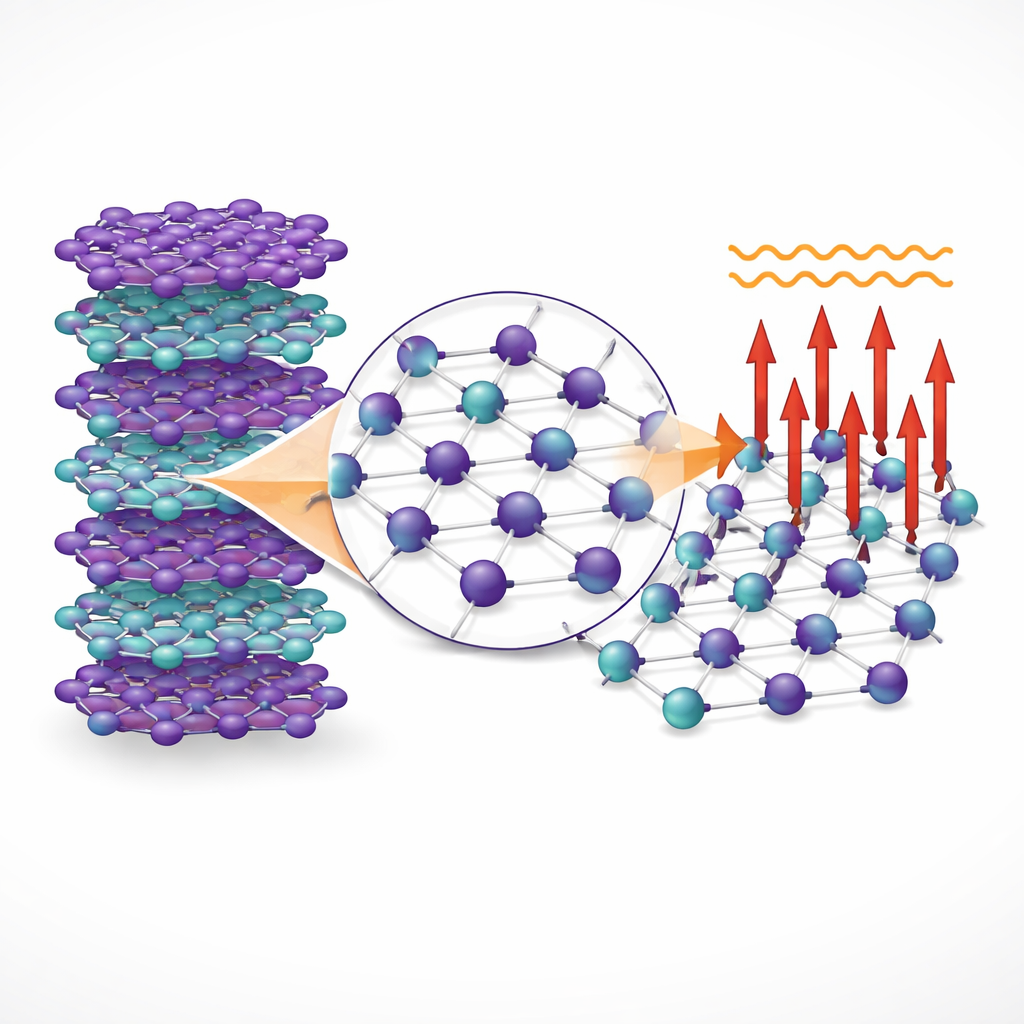
Two-dimensional magnets have become a major focus of research because they can be peeled down to a few atomic layers while still keeping their magnetic order. 1T-CrTe2 is particularly exciting: in bulk form it is ferromagnetic above room temperature and remains magnetic even when made very thin. Experiments have already shown unusual behavior in films only a few layers thick, including strong spin polarization and complex changes of the Curie temperature, the point where magnetism disappears. Yet, despite many proposals, there has been no consensus on what microscopic mechanism actually stabilizes its magnetism.
A dual personality inside the electrons
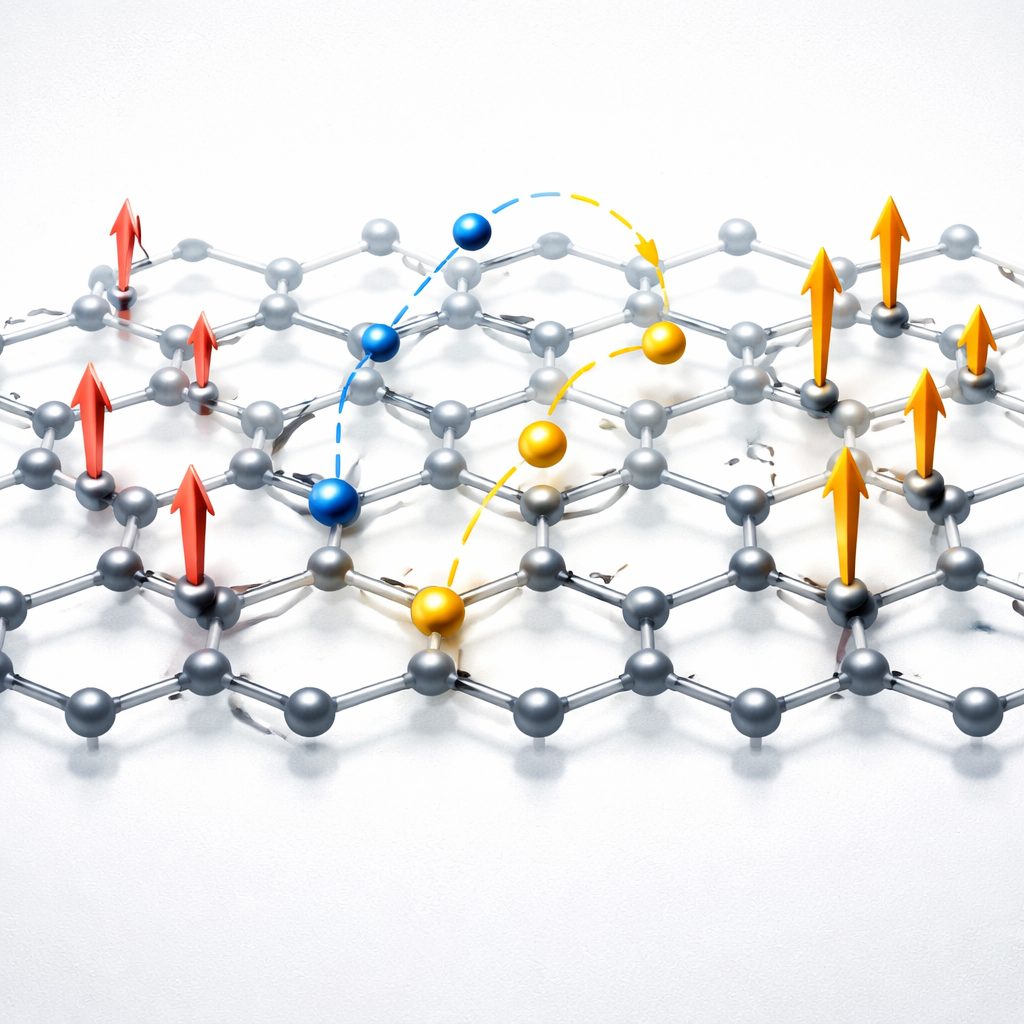
The authors use a powerful computational approach that combines density functional theory with dynamical mean-field theory to capture how electrons interact in 1T-CrTe2. Their analysis reveals that the chromium d electrons do not all behave the same way. One subset acts like itinerant carriers that can move across the crystal, while another subset remains relatively localized and carries more rigid magnetic moments. This "dual nature" shows up in calculated magnetic response functions and in how strongly different orbitals deviate from simple metallic behavior. The result is a material where mobile electrons and local moments coexist in the same atomic shell.
A self-doped engine for ferromagnetism
Building on this dual personality, the study argues that 1T-CrTe2 is best described as a "self-doped" double-exchange ferromagnet. In classic double exchange, extra carriers supplied by chemical doping hop between atoms and, in doing so, favor parallel alignment of local spins. Here, no external dopant is needed. Because tellurium pulls on electrons less strongly than oxygen in related compounds, chromium and tellurium states hybridize strongly, effectively providing their own hopping carriers. The authors show that the strength of Hund’s coupling—the interaction that prefers electrons on the same atom to align their spins—is crucial: only above a certain threshold does ferromagnetism appear and the calculated Curie temperature rises, matching experimental trends.
Hund metallicity and hidden correlations
The same calculations reveal that 1T-CrTe2 is not an ordinary metal but a "Hund metal". In such systems, Hund’s coupling generates large local moments and strong quantum fluctuations even though the material remains metallic. The team sees signatures typical of this regime: enhanced scattering of electrons at low temperature, large spin moments coexisting with strong charge fluctuations, and a separation between the temperature scales at which spin and orbital degrees of freedom become screened. Interestingly, the way these effects unfold in 1T-CrTe2 resembles, but is not identical to, well-known Hund metals such as iron-based superconductors, and shows hints of behavior related to orbital-selective Mott phases where some orbitals become nearly localized while others stay metallic.
What happens when you make it one layer thick
The authors then ask what occurs when 1T-CrTe2 is thinned down to a single layer. One might expect that simply reducing dimensionality would weaken magnetic order. Instead, their calculations show that structural relaxation—small shifts in the positions of tellurium atoms and changes in bond angles—is the main reason the Curie temperature drops in the monolayer. These geometric changes reduce the efficiency of electron hopping that underpins double exchange, lowering the ordering temperature. At the same time, however, the local magnetic moments actually grow stronger because correlations linked to Hund’s coupling are enhanced in the monolayer. This provides a natural explanation for experiments that find increased spin polarization even as the Curie temperature falls in thinner films.
Big-picture takeaway for future devices
In accessible terms, the work shows that 1T-CrTe2 is powered by a built-in engine for magnetism: some electrons roam to keep the material metallic, while others stay put and act as small bar magnets, and Hund’s rule forces them to cooperate. This self-doped double-exchange mechanism, combined with robust Hund metallic behavior, sustains strong ferromagnetism in both bulk and monolayer forms. When the material is thinned, subtle structural distortions, rather than the mere loss of neighboring layers, weaken long-range order but simultaneously boost local spin strength. These insights point to strain and structural engineering as powerful knobs for tuning two-dimensional magnets, guiding the design of ultrathin, room-temperature spintronic components based on correlated layered materials like 1T-CrTe2.
Citation: Lee, D.H.D., Lee, H.J., Kim, T.J. et al. Many-body electronic structure, self-doped double-exchange, and Hund metallicity in 1T-CrTe2 bulk and monolayer. npj 2D Mater Appl 10, 33 (2026). https://doi.org/10.1038/s41699-026-00670-9
Keywords: two-dimensional magnetism, van der Waals materials, Hund metal, double-exchange ferromagnetism, spintronics