Clear Sky Science · en
Transition-selective photocurrents in Floquet-driven monolayer MoSe2
Shaping Electric Currents with Light
Imagine being able to steer tiny electric currents in a sheet of material using nothing more than the direction of a flashlight beam. This study shows how carefully tuned laser light can reshape the electronic landscape of an ultra-thin crystal, creating short bursts of current that carry a hidden topological "signature". The work points toward future light-controlled electronics that operate at trillion-times-per-second speeds, far beyond today’s devices.
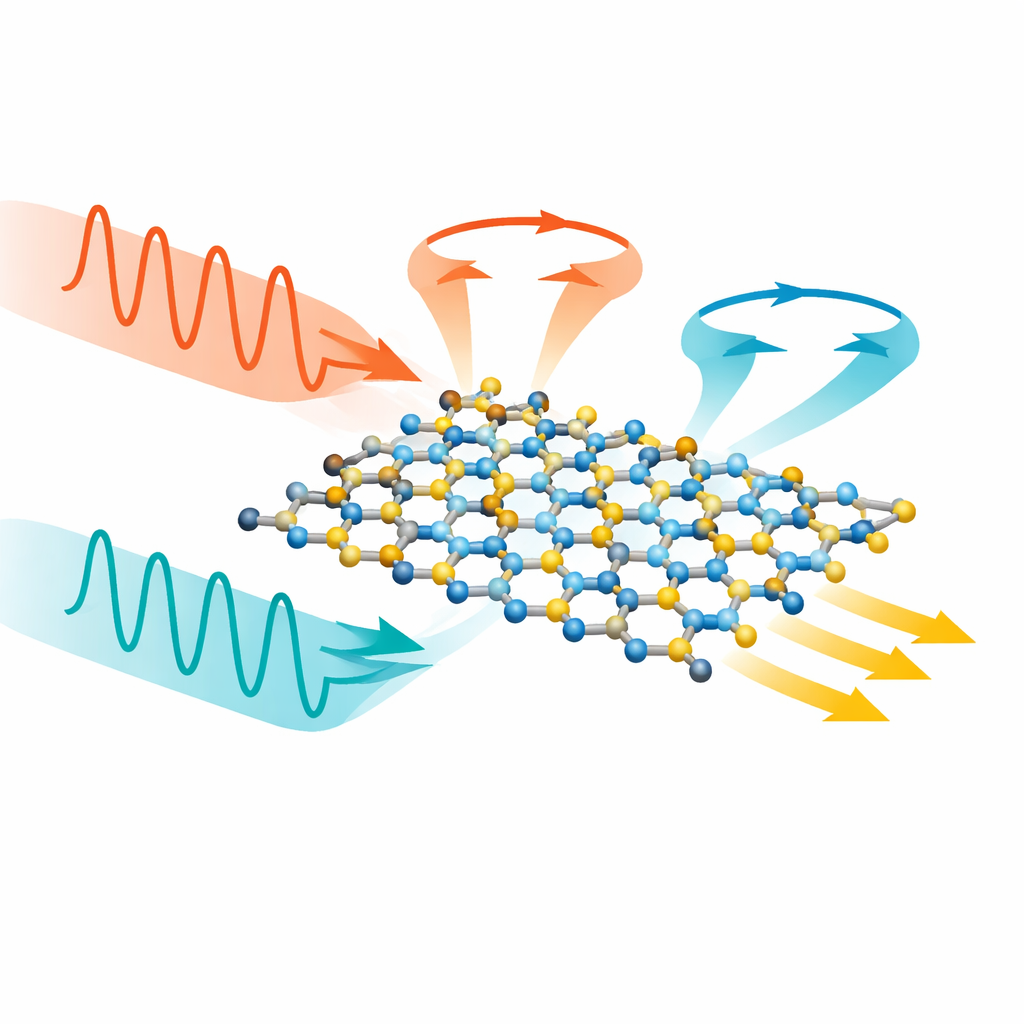
A Flat Crystal Under a Rhythmic Drive
The researchers focus on monolayer MoSe₂, a two-dimensional semiconductor just one atom thick. Such materials already fascinate scientists because electrons in them behave in unusual ways tied to their "valley" and spin degrees of freedom. Here, the team studies what happens when this flat crystal is driven by a strong, rapidly oscillating laser field—a regime known as Floquet driving, where the material’s electrons become dressed by photons and form new, light-induced energy bands that exist only while the laser is on.
Breaking Symmetry Without Breaking Time
In many earlier studies, circularly polarized light was used to break time-reversal symmetry and produce topological effects. By contrast, this work uses linearly polarized light, which keeps time-reversal symmetry intact but selectively breaks certain spatial symmetries of the crystal. Using a combination of Floquet theory and first-principles electronic structure calculations, the authors show that light polarized along the x-direction destroys both the threefold rotational symmetry of the lattice and a particular mirror-like symmetry, while light polarized along the y-direction breaks only the rotation but preserves the mirror. This subtle difference means the material’s electronic structure can be reshaped in different, highly controlled ways simply by rotating the polarization of the pump beam.
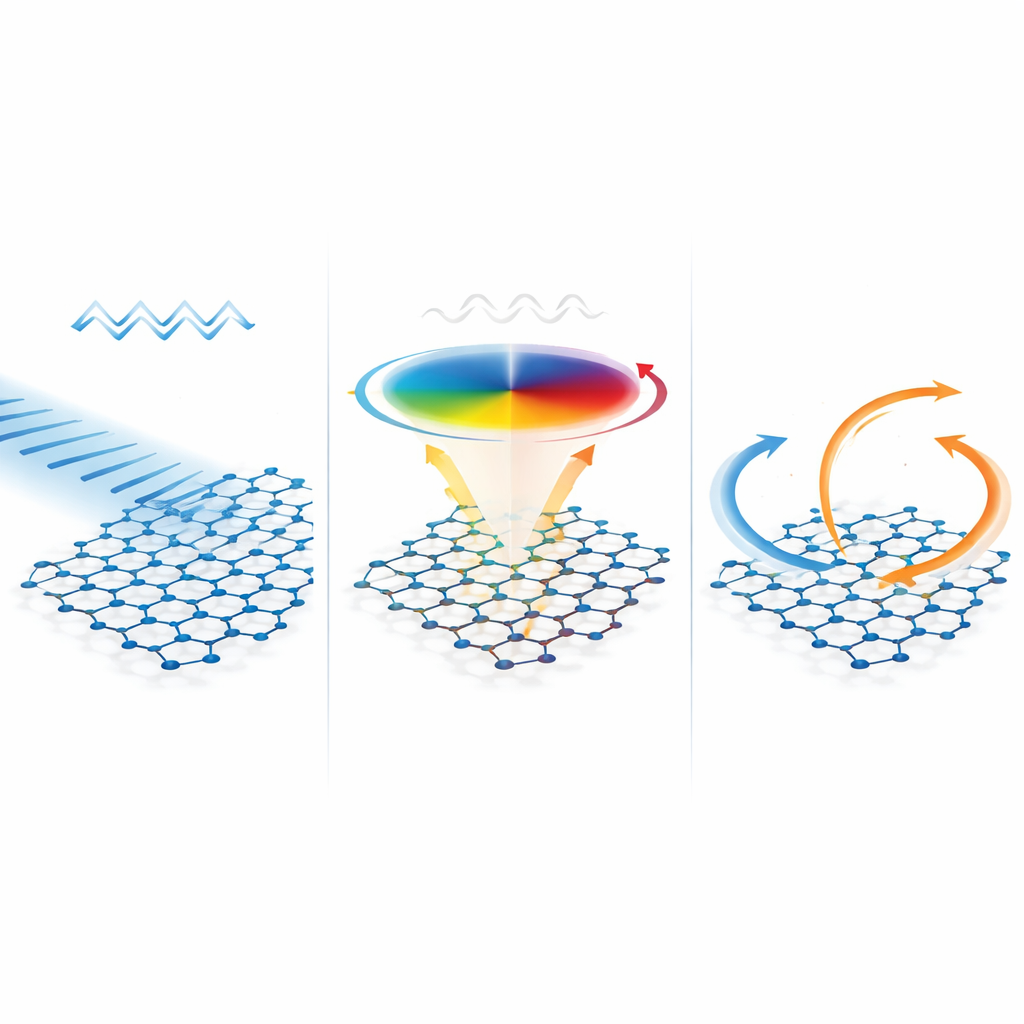
From Distorted Bands to Directional Photocurrents
When the driving light energy is tuned close to the material’s band gap, electronic states in the valence and conduction bands strongly hybridize with their photon-dressed replicas. This near-resonant mixing distorts the band structure around special points in momentum space and produces an uneven distribution of a geometric quantity called Berry curvature. In practical terms, this asymmetry creates a Berry curvature dipole—a built-in imbalance that lets light generate a net current even without applying a voltage. The team calculates how this distorted geometry leads to a circular photogalvanic effect: a current triggered by a circularly polarized probe beam, whose direction (x versus y) and strength depend sharply on whether the pump light is x- or y-polarized.
A Light-Driven Topological Switch
As the pump photon energy is swept through and beyond the band gap, the Floquet bands undergo a series of inversions, in which conduction and valence characters swap roles. The authors track this process through valley and spin Chern numbers, quantities that classify the topological nature of the photon-dressed bands. They find that the system toggles between a quantum valley Hall–like phase and a quantum spin Hall–like phase as the frequency increases. Strikingly, the calculated photocurrent reverses its sign at exactly the same frequencies where these topological indices switch, revealing that the measured current is not just a by-product of symmetry breaking but a direct, macroscopic probe of the underlying Floquet topology.
Watching Topological Currents in Real Time
To test these predictions, the authors propose pump–probe experiments that detect the emitted terahertz radiation from the ultrafast photocurrents. The expected current strengths are comparable to those already observed in related two-dimensional materials, making experimental verification realistic with current technology. More broadly, the work shows that linear polarization can act as a precise control knob for turning on and steering topological currents in flat crystals, on timescales of tens of femtoseconds. For a lay reader, the key message is that by rhythmically driving a material with light, researchers can temporarily rewrite its rules of symmetry and topology, switching exotic current patterns on and off in ways that static materials simply cannot achieve.
Citation: Min, HG., Roh, C.J., Kim, C. et al. Transition-selective photocurrents in Floquet-driven monolayer MoSe2. npj 2D Mater Appl 10, 32 (2026). https://doi.org/10.1038/s41699-026-00669-2
Keywords: Floquet engineering, monolayer MoSe2, nonlinear photocurrent, Berry curvature, topological phases