Clear Sky Science · en
Enhancing plasmonic superconductivity in layered materials via dynamical Coulomb engineering
Why tiny sandwiches of materials matter
Scientists are racing to design materials that conduct electricity without any loss, a state known as superconductivity. This could transform power grids, computers, and medical devices—but most known superconductors only work at very low temperatures. This paper explores a new way to boost superconductivity in ultra-thin "van der Waals" materials by carefully choosing what sits next to them, showing that the right neighboring metal layer can raise their operating temperature by up to a factor of twenty.
Shaping electricity with invisible forces
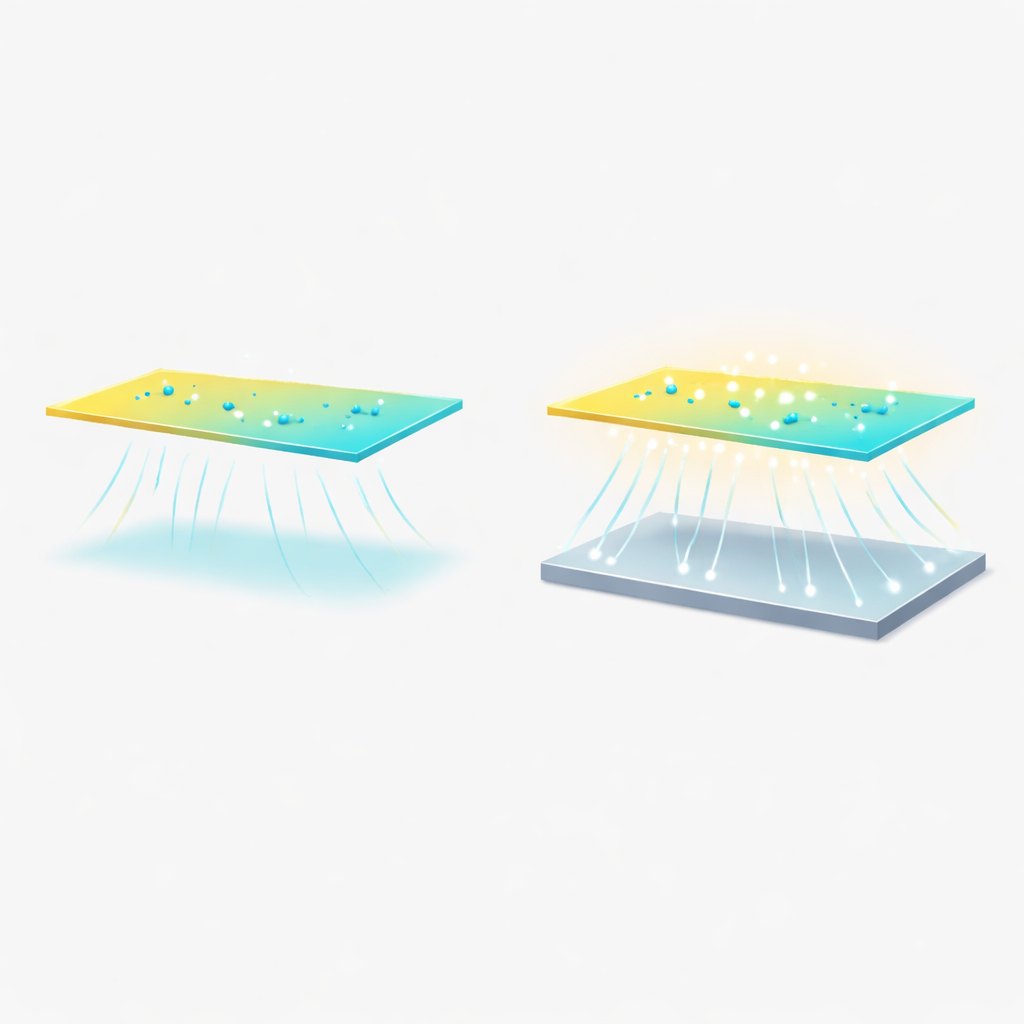
In atomically thin materials, electrons feel electric forces more strongly than in bulk solids. These forces are not fixed: they can be altered by placing the material on different substrates or stacking it with other layers. Traditionally, researchers have used this "Coulomb engineering" to statically screen, or soften, the repulsion between electrons. In this work, the authors go further and focus on the time-dependent, or dynamical, part of these forces. They show that by adjusting how a nearby metallic layer responds to moving charges, one can sculpt the collective vibrations of electrons—bosonic modes such as plasmons and phonons—that mediate attraction between electrons and can drive superconductivity.
Building a two-layer playground for electrons
The study analyzes a simple but powerful model: a superconducting two-dimensional layer separated by an insulating spacer from a metallic "screening" layer beneath it. The layers are electrically isolated in the sense that electrons do not hop between them, but they still interact through long-range electric fields. In the superconducting layer, electrons already interact with lattice vibrations (phonons), while the metal layer supports its own charge oscillations (plasmons). When the layers are brought closer together, these different vibrations mix and hybridize into new composite modes whose energy and strength can be tuned by the layer spacing, the background dielectric constant, and the electronic properties of the metal layer.
New hybrid waves and their fingerprints
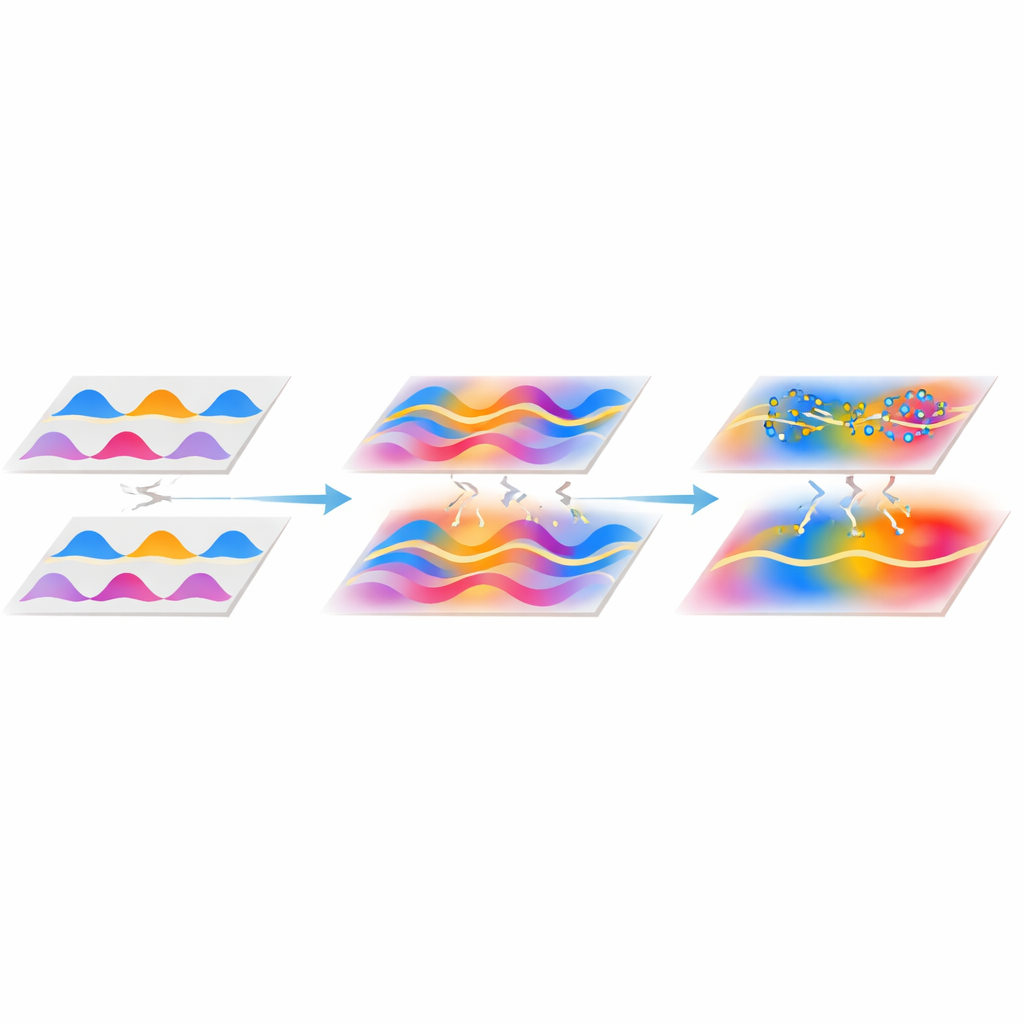
By computing how electrons respond in this setup, the authors find that decreasing the distance between layers produces two distinct kinds of interlayer plasmon waves. One mode involves in-phase motion of charge in both layers and shifts to higher energy; the other is an out-of-phase, dipole-like oscillation that can lie at relatively low energy and couple strongly to electrons in the superconducting layer. As the layers approach, parts of this lower mode can be swallowed by the sea of ordinary electron excitations and become damped, while the remaining portion still contributes to pairing. These changes leave clear traces in the calculated electronic spectrum: additional "replica" features appear near the main electronic band, whose positions shift as the plasmon energies and damping evolve with distance and environment.
Turning knobs to boost superconductivity
To understand how these hybrid waves affect superconductivity, the authors solve advanced equations that track how electrons pair up as temperature is lowered. They separate the problem into intuitive pieces: an effective attraction between electrons, an effective boson energy scale, an adjusted measure of the bare repulsion, and a mass-renormalization factor. They find that bringing the metallic screening layer closer and choosing materials with stronger electronic interactions both enhance the net attraction more than they increase the residual repulsion, especially in a regime where plasmon effects dominate over phonons. Under favorable conditions, this "bosonic engineering" can boost the calculated superconducting critical temperature by up to an order of magnitude compared with an isolated monolayer.
Design rules for better layered superconductors
The work yields concrete design guidelines. A screening layer whose electrons are heavy—that is, have a large effective mass—shifts plasmon modes to lower energies and reduces harmful damping, strengthening the attractive channel while easing the effective repulsion. Adjusting the carrier density in the screening layer, by contrast, mainly shifts plasmon energies upward and has a smaller and sometimes negative impact on the transition temperature. The authors argue that electron-doped transition metal dichalcogenides paired with heavy-electron metallic layers separated by a thin insulator, such as hexagonal boron nitride, are promising platforms to test these ideas and to probe whether plasmons truly help drive superconductivity.
What this means for future technologies
From a lay perspective, this study shows that superconductivity in ultra-thin materials is not just a property of the sheet itself, but of the whole sandwich. By carefully selecting and tuning neighboring layers, researchers can deliberately shape the invisible waves that run through the system and use them to coax electrons into a lossless, superconducting state at higher temperatures. This approach of "bosonic engineering" offers a roadmap for designing next-generation superconducting devices and may help settle a long-standing question: can collective electron waves, rather than lattice vibrations alone, play a decisive role in creating superconductivity?
Citation: in ’t Veld, Y., Katsnelson, M.I., Millis, A.J. et al. Enhancing plasmonic superconductivity in layered materials via dynamical Coulomb engineering. npj 2D Mater Appl 10, 30 (2026). https://doi.org/10.1038/s41699-026-00668-3
Keywords: plasmonic superconductivity, 2D materials, van der Waals heterostructures, Coulomb engineering, bosonic modes