Clear Sky Science · en
Oxygen passivation driven defect states healing in monolayer MoSe2 for ultra-high photoresponsivity
Sharper Eyes for Faint Light
Being able to see in very dim light is vital for technologies like security cameras, night‑vision systems, and environmental sensors. This research shows how a single sheet of atoms made from molybdenum and selenium can be gently “repaired” with oxygen so that it becomes an extraordinarily sensitive light detector, able to pick up signals far weaker than those conventional devices can see.

Fixing Tiny Flaws in Flat Crystals
The study focuses on a class of ultra‑thin materials called two‑dimensional transition metal dichalcogenides, which are only one atom thick yet can interact strongly with light. A popular member of this family, MoSe2, has a bandgap well suited for visible light and is relatively stable in air. However, when grown in large areas using chemical vapor deposition, its lattice tends to form missing selenium atoms—tiny vacancies that act like potholes for moving charges. These defects trap electrons and holes, wasting incoming light as heat instead of useful signal and dimming the material’s glow.
Healing with a Breath of Oxygen
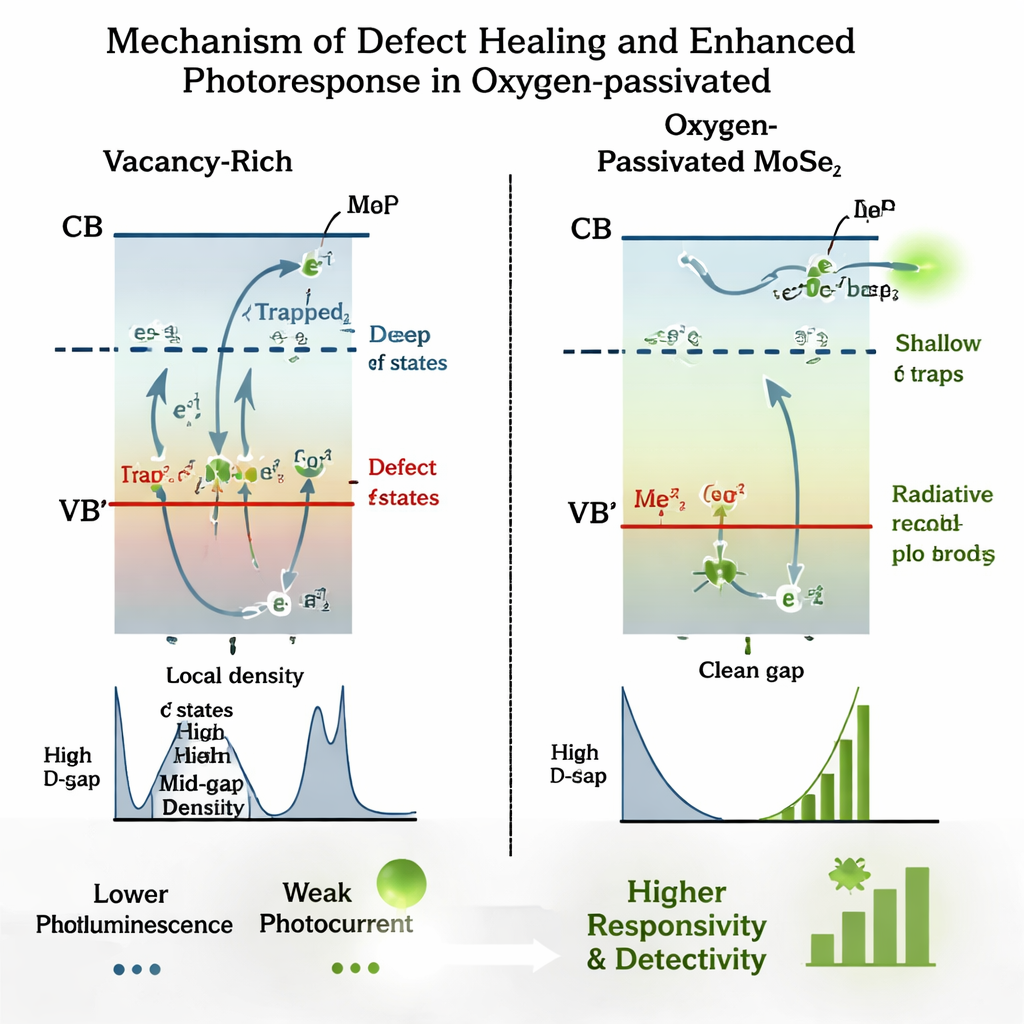
Instead of stacking different 2D materials into complex layered devices, the authors engineer the MoSe2 itself during growth by introducing a carefully tuned amount of oxygen gas. They compare vacancy‑rich MoSe2 (VSe‑MoSe2) with oxygen‑passivated MoSe2 (OP‑MoSe2). Microscopy shows that the oxygen‑treated crystals grow as smooth, equilateral triangles, while vacancy‑rich flakes look more irregular. Raman and photoluminescence measurements reveal that oxygen‑treated samples have sharper vibrational signatures and much brighter light emission, clear signs of improved crystal quality and fewer harmful defects. Low‑temperature optical tests even uncover spectral features linked to multi‑exciton complexes, which typically appear only in very clean, well‑ordered materials.
How Oxygen Changes the Electronic Landscape
To understand what is happening at the atomic scale, the team turns to quantum‑mechanical simulations and surface‑sensitive spectroscopy. Calculations show that selenium vacancies introduce deep electronic states in the middle of the energy gap, acting as traps where charge carriers can fall and disappear. When an oxygen atom occupies a vacancy, it forms strong bonds with molybdenum and largely removes these deep states, replacing them with much shallower ones close to the conduction band edge. Ultraviolet photoelectron measurements confirm that oxygen shifts the material’s work function and makes it more p‑type, bringing its energy levels into better alignment with the gold contacts used for the device. Together, these changes reduce wasteful non‑radiative recombination and ease the flow of charges through the detector.
Building an Ultra‑Sensitive Light Detector
The researchers then fabricate simple photodetectors by placing metal electrodes on single‑layer MoSe2 grown on a silicon dioxide wafer. Under green light with a wavelength of 530 nanometers, the oxygen‑passivated devices exhibit striking performance. They achieve an enormous responsivity of about 0.74 × 10⁵ amperes per watt at an exceptionally weak light level of 89 nanowatts per square centimeter, far surpassing vacancy‑rich devices and most reported MoSe2 detectors. The specific detectivity reaches the 1014 Jones range, meaning the device can distinguish extremely faint signals from noise, and the noise‑equivalent power falls to roughly 0.087 femtowatts per square‑root hertz. Despite this extreme sensitivity, the detectors respond in just a few tens of milliseconds and remain stable over weeks in air, with little loss in performance after hundreds of on‑off cycles.
From Lab Device to Night‑Time Watcher
To highlight practical relevance, the team demonstrates weak‑light tracking that mimics a security surveillance scenario. A low‑power green LED, positioned about 1.5 meters from the device, shines a narrow beam onto the detector while a moving object periodically blocks the light. The oxygen‑passivated MoSe2 photodetector cleanly records the resulting current dips for both slow and fast motions, showing that it can follow moving targets under illumination levels far below normal room lighting. This capability, combined with straightforward fabrication and scalable growth, suggests that oxygen‑healed monolayer MoSe2 could underpin future generations of compact, highly sensitive cameras and sensors that operate reliably even when light is scarce.
Citation: Yadav, S., Salazar, M.F., Hardeep et al. Oxygen passivation driven defect states healing in monolayer MoSe2 for ultra-high photoresponsivity. npj 2D Mater Appl 10, 29 (2026). https://doi.org/10.1038/s41699-026-00666-5
Keywords: 2D photodetectors, MoSe2, defect passivation, weak light detection, oxygen doping