Clear Sky Science · en
ROS-driven antibacterial mechanisms of multi-metallic (TiVNbMo)₄C₃Tx MXene
New Weapons Against Tough Infections
Bacteria that shrug off antibiotics are one of today’s biggest medical worries. This study explores a cutting-edge material called a multi-metallic MXene, a sheet only a few atoms thick, to see whether it can kill harmful bacteria in water. By understanding exactly how this material attacks microbes, researchers hope to design safer, more effective coatings and filters for hospitals, water systems, and medical devices.
Ultra-Thin Sheets with a Metallic Twist
The material at the heart of this work is a two-dimensional sheet made from four different metals arranged in ultra-thin layers. To make it, scientists start from a solid block and chemically remove certain layers, leaving behind stacks of flexible metallic sheets that look like an accordion under the microscope. These sheets have a huge surface area, sharp edges, and a mix of metals that can easily give and take electrons. All of these traits are important, because they control how strongly the sheets can grab onto bacteria and how aggressively they can drive chemical reactions at their surface. 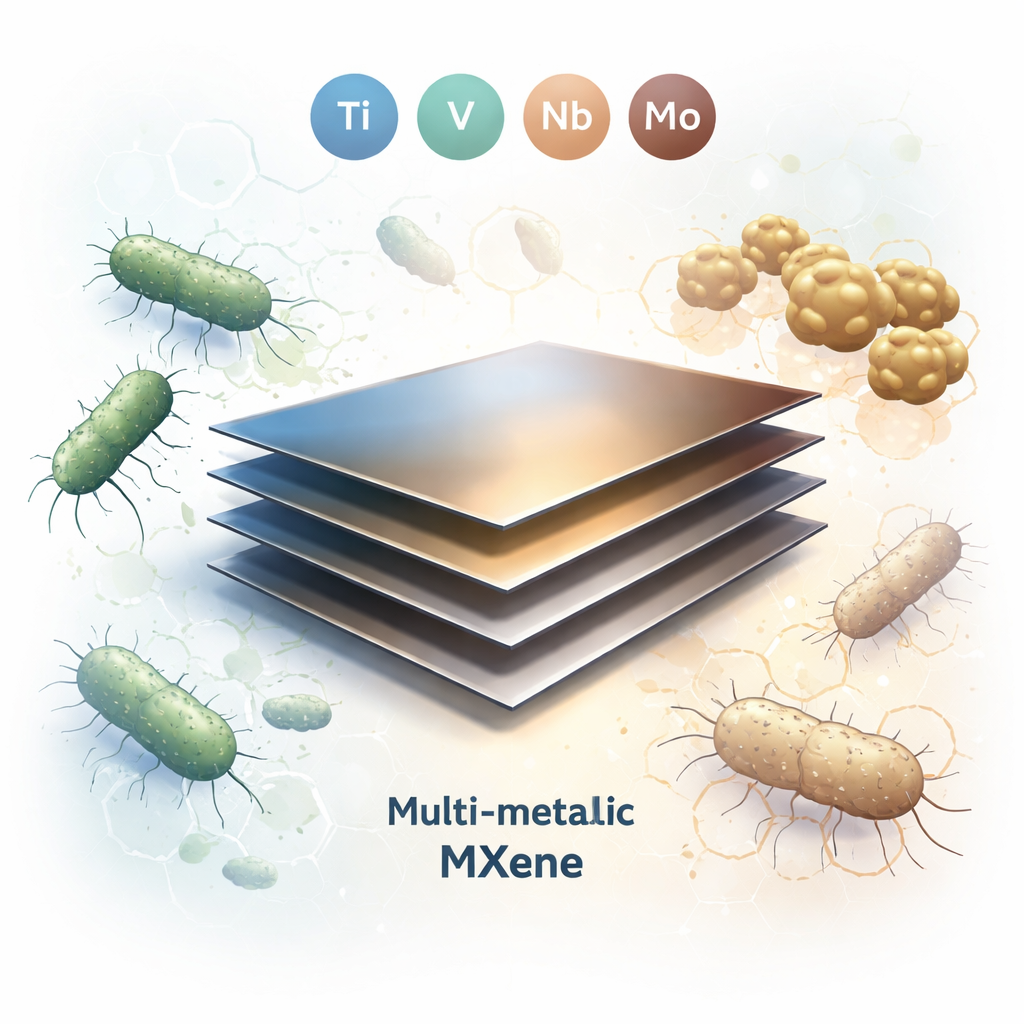
Putting the Material to the Test
The team compared the new four-metal MXene to two better-known MXenes that contain just a single main metal. They mixed each material with two common test bacteria: rod-shaped Escherichia coli representing Gram-negative germs, and round clusters of Staphylococcus aureus representing Gram-positive germs. Over four hours, they counted how many bacteria survived at different material doses. All three MXenes reduced bacterial numbers, but the multi-metal version was the clear winner. At moderate concentrations it wiped out more than 98% of both bacterial types, and it started to show strong killing power even at doses where the other MXenes were still relatively weak.
Attack by Chemical Stress and Tiny Blades
To learn how the material kills, the researchers looked at both chemistry and structure. First, they used tests that mimic a cell’s natural defenses to measure “oxidative stress” – chemical damage caused by reactive oxygen species, or ROS. These are short-lived, aggressive forms of oxygen that can chew through fats, proteins, and DNA. The multi-metal MXene depleted protective molecules much more strongly than the other MXenes, and was the only one that clearly produced superoxide and hydroxyl radicals under dark conditions, without any added light. At the same time, electron microscope images of bacteria exposed to the multi-metal sheets showed torn membranes, leaking contents, and deformed shapes, consistent with a “nanoknife” effect where sharp sheet edges slice or puncture the cell wall. 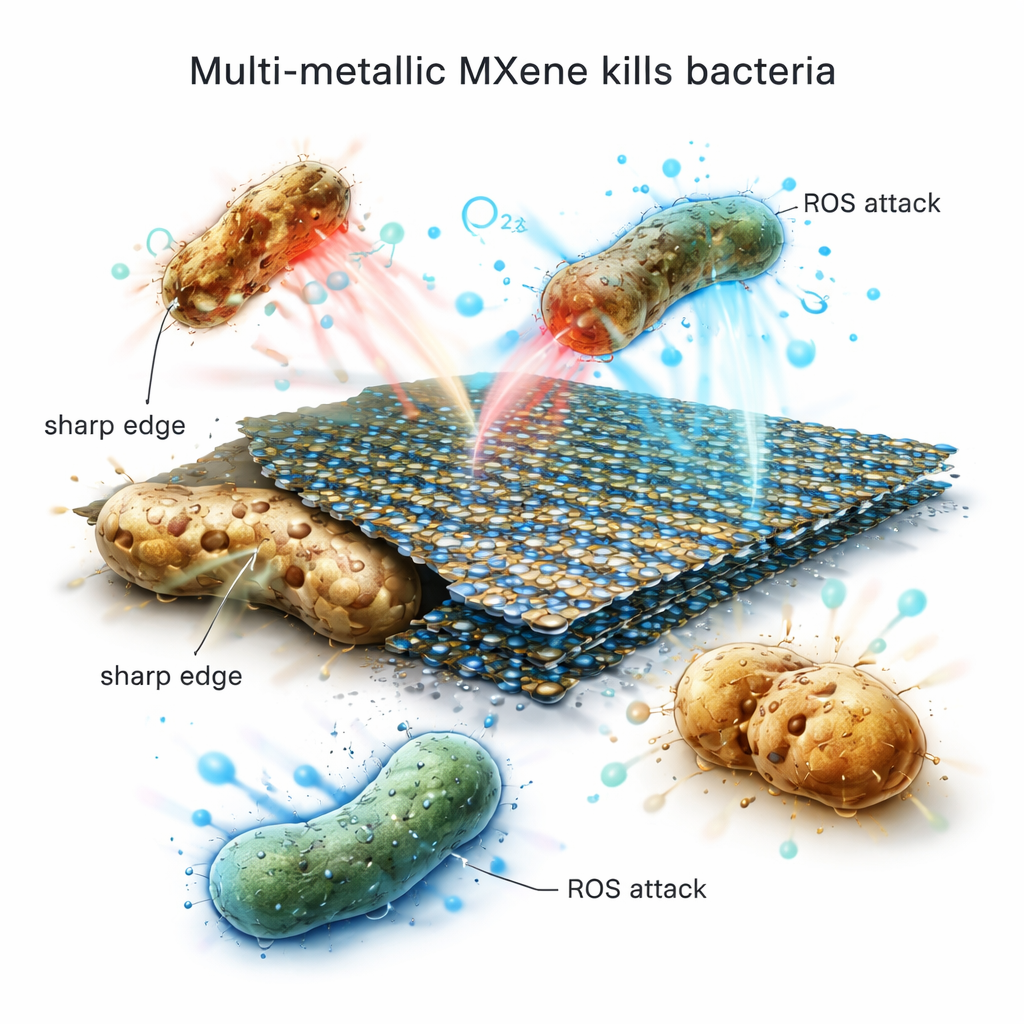
Why Four Metals Matter
The authors trace this powerful one-two punch back to the material’s mixed-metal makeup and large sheet size. Having four different metals packed together gives the sheet many sites that can shuffle electrons back and forth, which encourages continuous ROS generation. The slightly thicker, larger flakes provide broad contact with the bacterial surface, allowing them to both press against and wrap around the cells. This boosts physical damage and keeps bacteria close to the regions where ROS are being formed. The surface of the sheets is also water-loving and negatively charged, helping them stick to bacterial outer layers and disturb the way cells take in nutrients.
From Lab Discovery to Practical Uses
Overall, the study shows that this multi-metallic MXene behaves as a highly efficient antibacterial material in water, working mainly through strong ROS production backed up by mechanical cutting from sharp edges. For non-specialists, the takeaway is that careful tuning of composition and structure at the atomic scale can create new materials that hit bacteria on several fronts at once, potentially reducing the chance of resistance. While more work is needed to test safety and performance in real-world settings, these findings point toward future filters, coatings, and medical tools that use ultra-thin metallic sheets as powerful, antibiotic-free barriers against infection.
Citation: Wahib, S., Ibrahim, Y., S. El-Malah, S. et al. ROS-driven antibacterial mechanisms of multi-metallic (TiVNbMo)₄C₃Tx MXene. npj 2D Mater Appl 10, 27 (2026). https://doi.org/10.1038/s41699-026-00665-6
Keywords: antibacterial nanomaterials, MXenes, reactive oxygen species, multidrug-resistant bacteria, 2D materials