Clear Sky Science · en
Tumor genomics in patients younger than 40 years of age with metastatic breast cancer
Why Age Matters in Advanced Breast Cancer
For many women, breast cancer is now a treatable disease with improving survival. Yet when the cancer has already spread through the body—called metastatic breast cancer—outcomes are still often poor, especially for women diagnosed at very young ages. This study asks a pressing question for patients, families, and doctors: are the tumors of younger women with metastatic breast cancer fundamentally different at the DNA level, and could that help explain why their disease can behave more aggressively and respond differently to treatment?

Who Was Studied and What Was Measured
Researchers drew on data from more than 2,300 women with metastatic breast cancer treated at a major cancer center between 2009 and 2020. They focused on three age groups at the time metastatic disease was diagnosed: 40 or younger, 41 to 55, and over 55. Tumor samples—either from the original breast tumor or from a metastatic site—underwent detailed DNA testing using a panel of cancer-related genes. The team compared how often particular genetic changes occurred in each age group, and then linked those patterns to how long patients lived after their metastatic diagnosis.
Distinct DNA Patterns in Younger Women
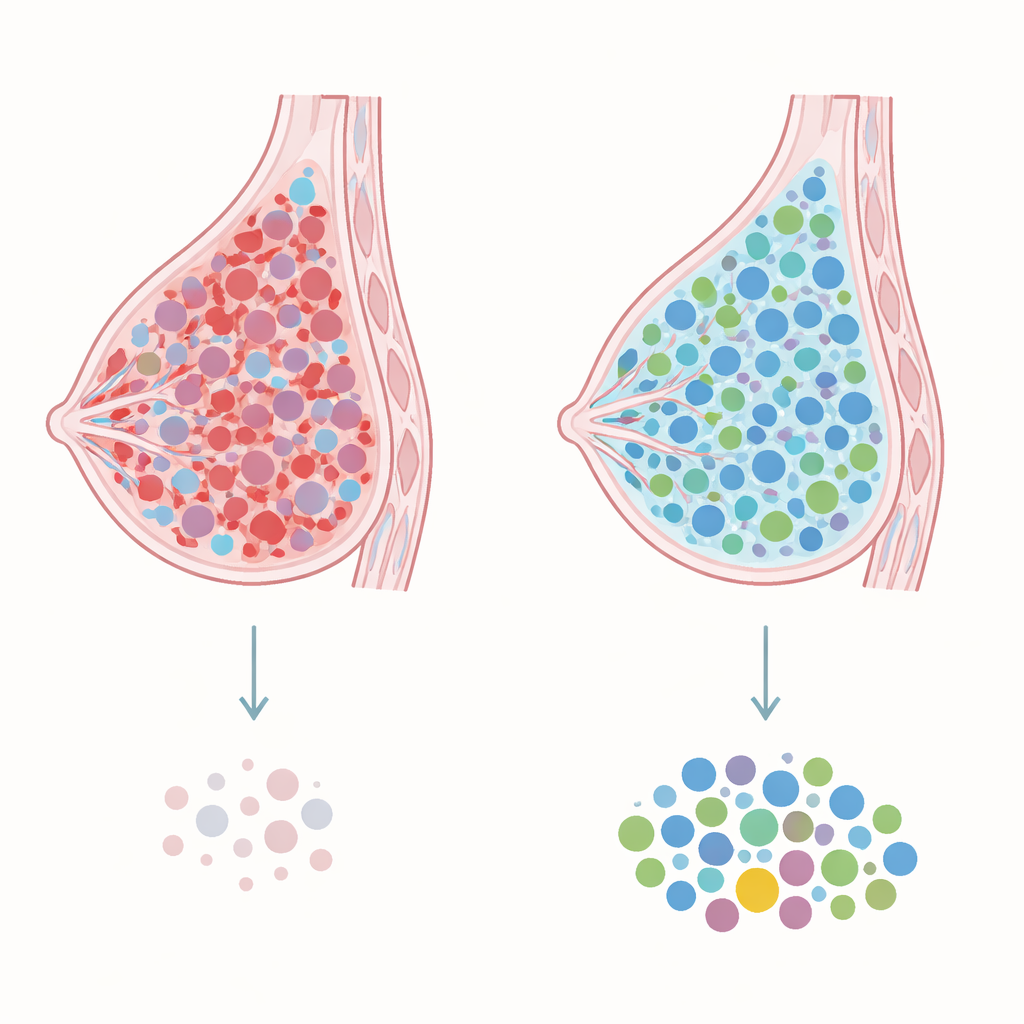
The tumors of women aged 40 and under looked strikingly different from those of older women. Younger patients’ cancers were more likely to have extra copies (amplifications) of the ERBB2 gene—which drives HER2-positive disease—and of the growth-related gene MYC. They also more often carried damaging mutations in TP53, a key “guardian” of the genome, and less often had mutations in PIK3CA and CDH1, genes more common in older patients. When the researchers grouped genes into broader signaling pathways, tumors in younger women more often showed disruption of the TP53 pathway, while older patients more frequently had alterations in the PI3K pathway and MYC pathway. These differences held up even after accounting for tumor subtype, stage at first diagnosis, and whether the sample came from the primary or metastatic site.
Mutation Burden and Immune-Related Clues
Another important feature was tumor mutational burden—how many mutations are scattered across the cancer’s DNA. Among women whose disease came back after earlier treatment, older patients generally had a higher mutational burden than younger patients, especially in a common subtype known as hormone receptor–positive, HER2-negative. This pattern did not appear as clearly in women whose cancer was metastatic from the start. Because tumors with many mutations may respond better to certain immunotherapies, the lower mutational burden seen in younger women suggests they may be less likely to benefit from those drugs, underscoring the need for other targeted approaches tailored to this age group.
How Genetic Changes Related to Survival
When the team examined survival, they found that age and tumor genetics intertwined in complex ways. Among women whose cancer had returned after earlier treatment, those diagnosed with metastatic disease at 40 or younger lived for a shorter time than those over 55, even after similar treatments. Certain genetic changes were linked to outcomes across ages: mutations in TP53 and PTEN and amplifications of MYC or FGFR1 were tied to shorter survival, while mutations in genes such as GATA3 and MAP3K1 and amplifications of ERBB2 were associated with longer survival, likely reflecting sensitivity to effective HER2-targeted therapies. Notably, harmful TP53 mutations were both more frequent in younger women and strongly associated with worse outcomes, hinting that this single pathway may be a key driver of their poorer prognosis.
What This Means for Patients and Care
To a lay reader, the main message is that metastatic breast cancers in younger women are not simply earlier versions of the same disease seen in older women—they are wired differently. Younger patients’ tumors tend to rely more on damaged DNA-guarding systems like TP53 and on growth-promoting genes such as ERBB2 and MYC, while older patients’ tumors more often use the PI3K pathway and other routes. These differences may influence which drugs work best and how long patients live. The authors argue that carefully reading the DNA of metastatic tumors, especially in very young women, should guide the search for more precise treatments and clinical trials, from drugs that exploit BRCA-related weaknesses to new strategies for hard-to-target genes like TP53. Understanding these age-specific genetic fingerprints is a critical step toward giving every woman with metastatic breast cancer—no matter how young—the most effective, personalized care possible.
Citation: Brantley, K.D., Kodali, A., Kirkner, G.J. et al. Tumor genomics in patients younger than 40 years of age with metastatic breast cancer. npj Precis. Onc. 10, 144 (2026). https://doi.org/10.1038/s41698-026-01333-0
Keywords: metastatic breast cancer, young-onset cancer, tumor genomics, TP53 mutation, precision oncology