Clear Sky Science · en
5-hydroxymethylcytosine profiles in circulating cell-free DNA associate with disease status in patients with osteosarcoma
Why a blood-based clue to bone cancer matters
Osteosarcoma is the most common bone cancer in children and teens, and even with aggressive surgery and chemotherapy, many patients still relapse. Doctors currently rely on scans and tissue biopsies to see whether cancer is present or returning, but these tools can miss small deposits of disease and cannot easily be repeated. This study explores a promising alternative: a blood test that reads tiny chemical marks on DNA fragments shed by tumors, potentially offering a gentler, earlier window into how a patient’s osteosarcoma is behaving.
Reading signals from tumor DNA in the bloodstream
All of us have small fragments of DNA circulating in our blood, released when cells naturally die. Cancer cells also shed DNA, and researchers are developing blood tests, or “liquid biopsies,” to detect it. The team in this study focused not on mutations in the DNA code, but on a chemical tag called 5-hydroxymethylcytosine (5-hmC). This mark tends to appear on genes that are switched on. Using a technique called nano-hmC-Seal, they captured and sequenced 5-hmC-marked DNA fragments from small amounts of plasma taken from children and young adults with osteosarcoma, children with another cancer (neuroblastoma), and healthy children. The goal was to see whether the pattern of 5-hmC marks in blood could distinguish active bone cancer from no disease.
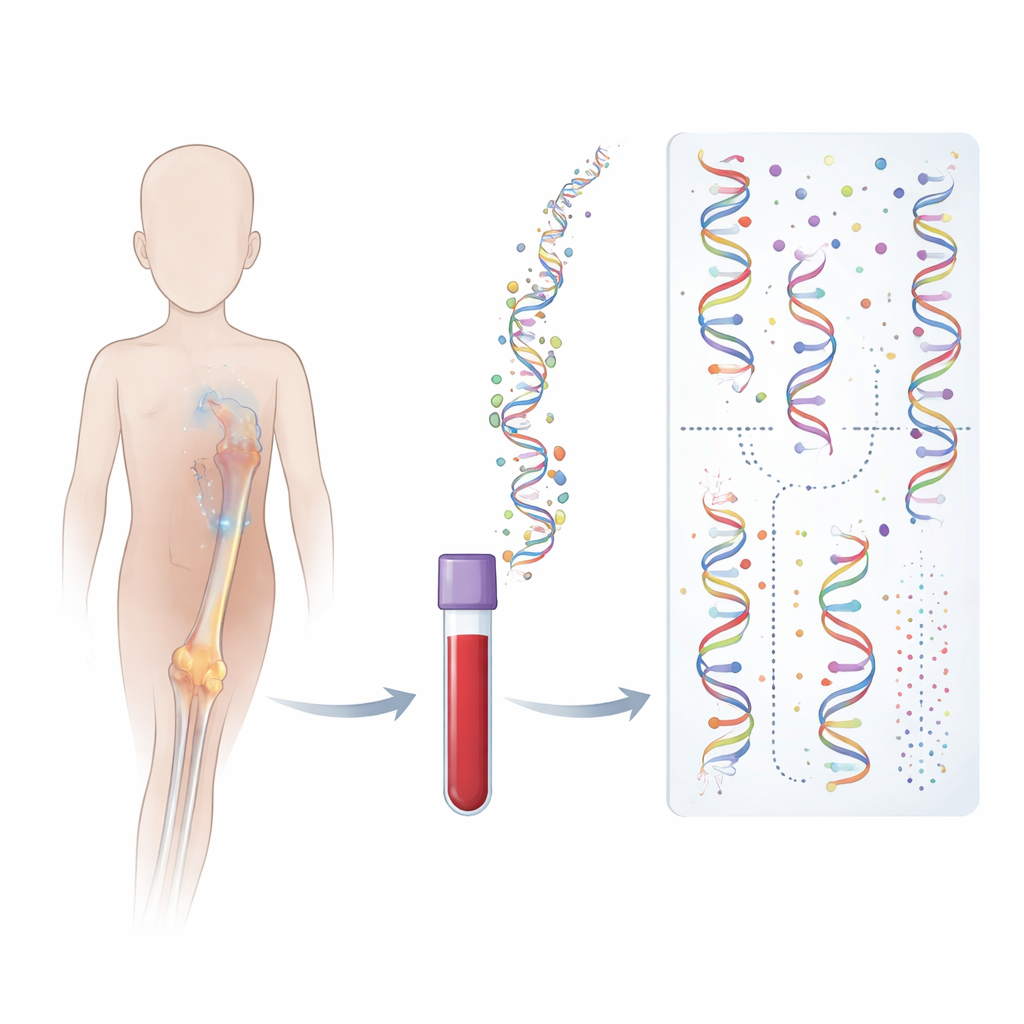
Finding a fingerprint of active osteosarcoma
The researchers first studied a small “Discovery” group of five osteosarcoma patients whose tumors were still in place and compared their blood DNA patterns to those of healthy children. They identified 136 genes that carried more 5-hmC in osteosarcoma patients, and 126 genes with higher marks in healthy children. Together, these 262 genes formed a signature fingerprint of the disease. When this fingerprint was applied to a larger, independent “Validation” group of 17 osteosarcoma patients (55 blood samples), an unsupervised clustering analysis—essentially letting the data group itself—separated samples into two main clusters. One cluster was enriched for samples from patients with primary tumors or bone metastases, while the other mostly contained samples from patients with no detectable disease on imaging, alongside many healthy children.
How well the blood test tracked disease status
To turn this fingerprint into something more clinically usable, the team built a semi-quantitative score for each blood sample, based on how strongly the 136 osteosarcoma-associated genes were marked with 5-hmC. In the validation group, scores were significantly higher in patients with active disease than in those with no evidence of disease, especially among patients whose primary bone tumors had not yet been surgically removed. Using a simple cutoff (score above zero versus below zero), the blood test classified active versus inactive disease with about 65% sensitivity and 64% specificity—comparable to some existing DNA-based tests in osteosarcoma. Importantly, scores tended to fall after surgery and rose again when bone metastases appeared, suggesting that the signal follows real changes in tumor burden, even if it is not perfect for every situation.
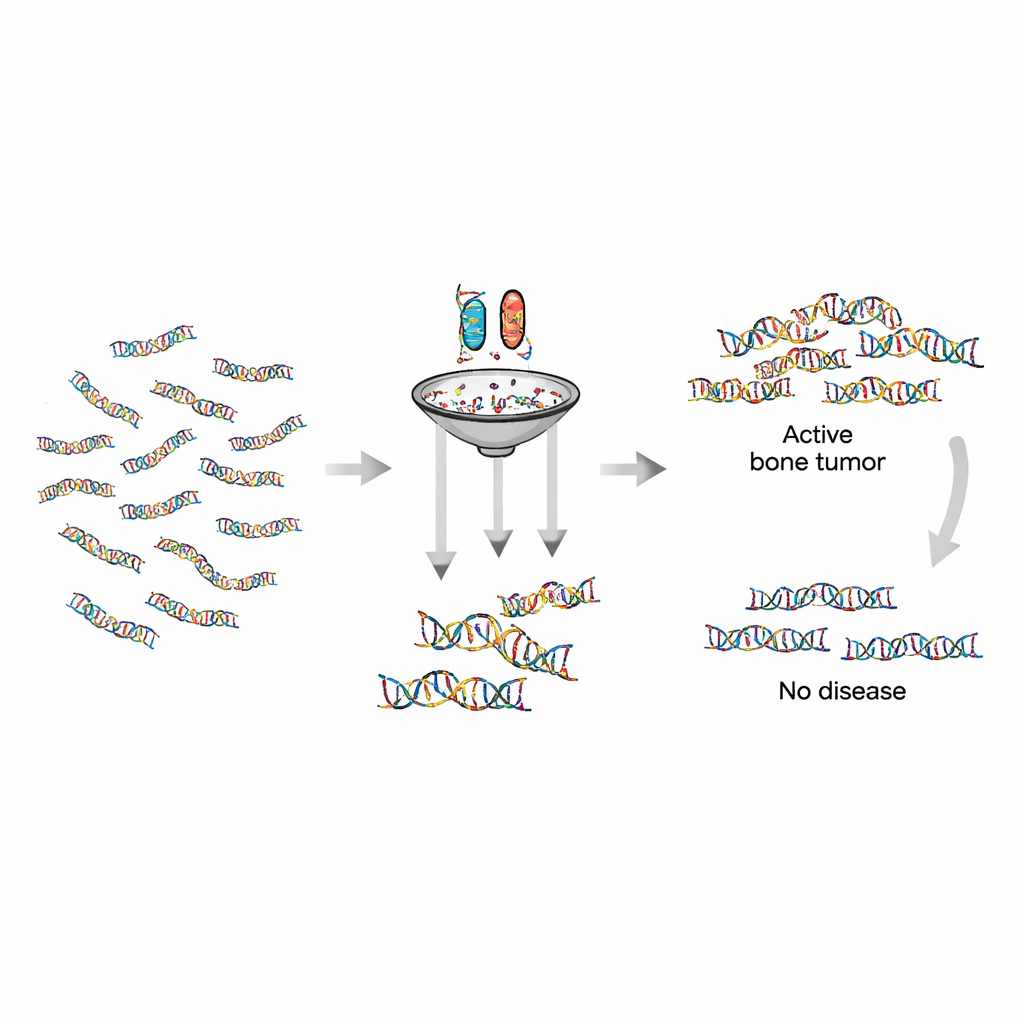
What the DNA marks reveal about bone biology
To understand what biology this blood signal might reflect, the researchers compared their 5-hmC-marked genes to large RNA sequencing datasets from osteosarcoma tumors, normal bone, and healthy blood. The osteosarcoma blood signature genes were much more active in tumor and normal bone tissue than in blood, and overlapped significantly with genes known to be expressed in osteosarcoma. Many were linked to nerve signaling and gamma-aminobutyric acid (GABA) activity, which has been implicated in bone formation. This pattern suggests that the signature is capturing the intense bone turnover and abnormal bone biology within osteosarcoma, rather than random noise. A second gene set built from samples with clearly detectable circulating tumor DNA produced very similar results, strengthening confidence in the approach.
Limits, challenges, and future promise
Not every form of osteosarcoma shed a strong enough signal to be picked up. Samples from patients with only small lung or lymph node metastases often looked similar to those from patients without disease, probably because these tiny lesions release very little tumor DNA into the blood. The overall number of patients, especially at first diagnosis, was modest, and the assay currently focuses only on genes, not other regulatory regions of the genome. Still, the study showed that in at least one patient, high 5-hmC marks on the MYC gene mirrored a known amplification of that cancer-driving gene and fell as treatment shrank the tumor, hinting at future use for tracking specific genetic changes.
What this could mean for patients
In plain terms, this work shows that a specialized blood test can detect chemical patterns on DNA fragments that are associated with active osteosarcoma in the body, particularly when the main bone tumor or bone metastases are present. While the test is not yet accurate enough to stand alone, its moderate sensitivity and specificity and its ability to mirror changes in disease burden suggest it could become a valuable companion to imaging and other liquid biopsy methods. With larger studies and refined gene signatures, 5-hmC profiling of circulating DNA may eventually help doctors monitor bone cancer more gently and more frequently, catching dangerous changes earlier while sparing young patients some invasive procedures.
Citation: Neczypor, E.W., Reisert, H., Moore, K. et al. 5-hydroxymethylcytosine profiles in circulating cell-free DNA associate with disease status in patients with osteosarcoma. npj Precis. Onc. 10, 125 (2026). https://doi.org/10.1038/s41698-026-01326-z
Keywords: osteosarcoma, liquid biopsy, cell-free DNA, epigenetic biomarkers, pediatric cancer