Clear Sky Science · en
Three-stage response of the equatorial Pacific to CO₂ forcing controlled by shifting trade winds
Why this matters for our future climate
The tropical Pacific Ocean is a major engine of Earth’s climate, shaping weather patterns from monsoons to hurricanes. Scientists know that adding carbon dioxide (CO₂) to the atmosphere will eventually make the eastern tropical Pacific warmer in an El Niño–like way, but what happens in the first decades has been puzzling. Observations over recent decades show a surprising cooling in parts of the eastern Pacific, more like a La Niña pattern. This study uses a very large set of climate model simulations to untangle how the equatorial Pacific actually responds to a sudden jump in CO₂, and what that means for the climate we experience over the next several decades.
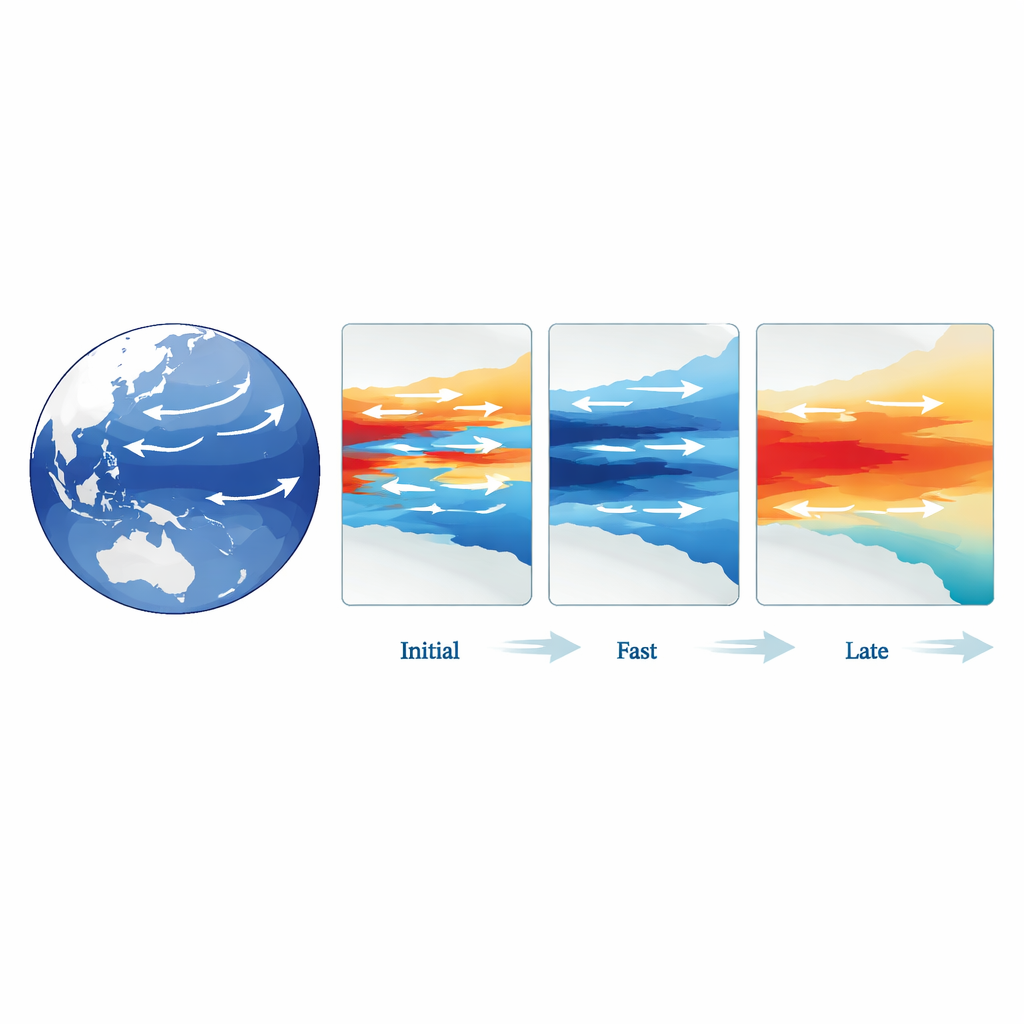
Three phases of ocean change
The authors find that the equatorial Pacific does not adjust smoothly to higher CO₂. Instead, it passes through three distinct stages. In the first couple of years, the "Initial" stage, the pattern of warming or cooling in the central Pacific varies wildly from one model run to another. Some runs show early cooling along the equator, others show warming. This spread is driven mostly by internal climate randomness, much like how natural El Niño and La Niña events come and go even without human influence. Because of this noise, the team concludes that looking at just one simulation, or one model, is not enough to decide whether a model’s early response is realistic.
A decades-long La Niña–like period
Once this noisy beginning is averaged out, the model settles into a "Fast" response that dominates the first one to several decades. In this stage, the temperature difference between the warm western Pacific and the cooler eastern Pacific becomes stronger, and the trade winds blowing from east to west along the equator intensify. The central and western equatorial Pacific cool relative to surrounding tropical waters, giving the basin an overall La Niña–like flavor even as the planet as a whole warms. When the authors repeat the analysis under a more gradual, 1%-per-year CO₂ increase—closer to the real world—this La Niña–like pattern persists for roughly 60 years before giving way to something different.
Eventual shift toward El Niño–like warming
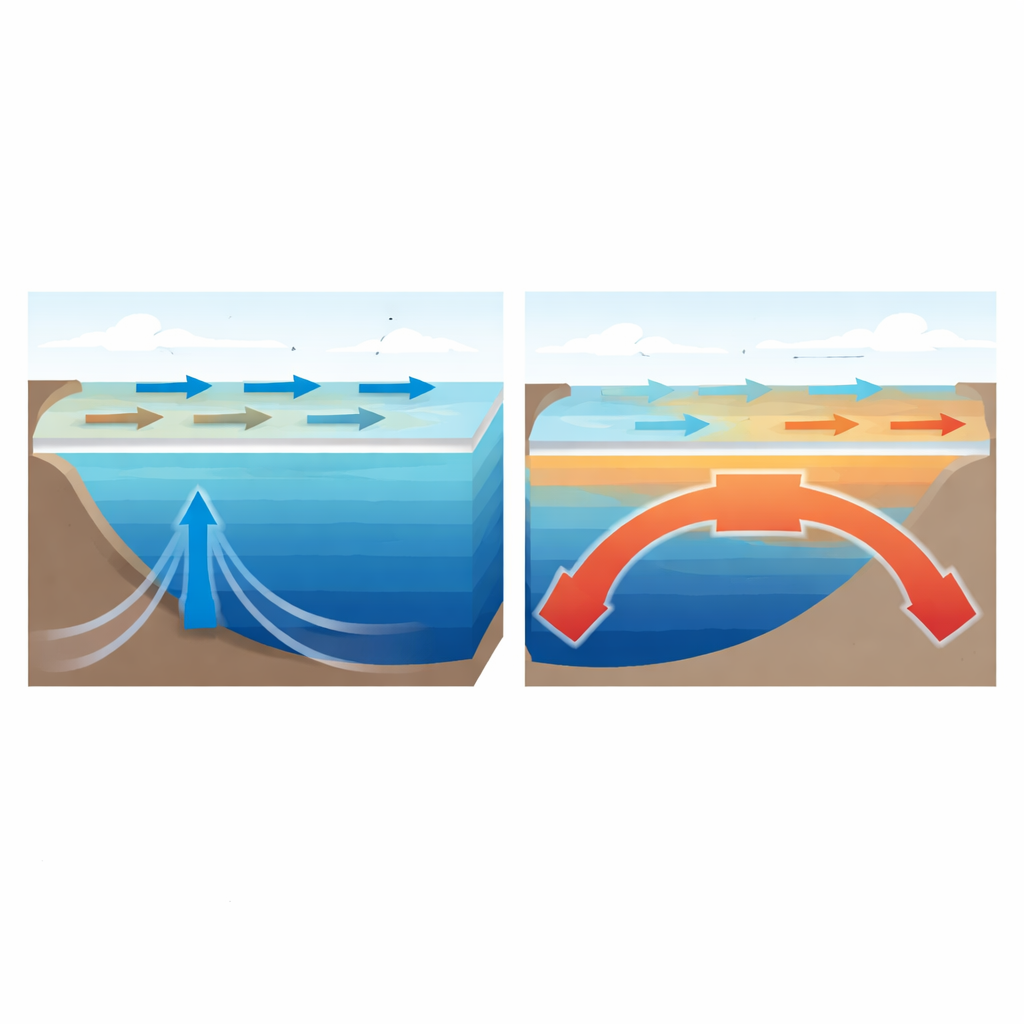
On longer timescales, beyond about 50 years after an abrupt CO₂ jump, the system enters a "Late" response. Here the eastern equatorial Pacific finally warms more than the west, the trade winds weaken, and the familiar El Niño–like pattern emerges. This shift is not because the basic cooling influence of cold deep water rising in the east disappears; in the model, that upwelling-related cooling remains surprisingly persistent for at least a century. Instead, other processes gradually outmuscle it. As the oceans slowly absorb heat and redistribute it, and as circulation patterns adjust, the export of heat away from the equator weakens, allowing the eastern Pacific surface to catch up and eventually surpass the warming in the west.
How winds and land warming steer the ocean
To understand what controls these stages, the authors trace energy flows in the upper ocean. They confirm that the classic "ocean thermostat"—where stronger layering in the ocean helps upwelling keep the eastern Pacific cool—does cool the region, but it does so continuously, not just at the beginning. What actually flips the system from La Niña–like to El Niño–like is the way winds move heat north–south. In the Fast stage, stronger trade winds drive surface waters away from the equator, pulling warm water toward higher latitudes and reinforcing equatorial cooling. Later on, as those winds weaken, less heat is exported and the equatorial Pacific warms. A key trigger for the early wind strengthening is that land areas, especially in the Northern Hemisphere, heat up faster than the oceans when CO₂ jumps. This land–ocean contrast shifts tropical rain belts and strengthens certain high-pressure systems, which in turn intensify the trade winds over the Pacific. As the oceans slowly warm and the contrast between land and sea growth rates diminishes, this wind pattern relaxes, allowing the Late-stage warming pattern to emerge.
What this means for the coming decades
Translated into everyday terms, the study suggests that the climate system may spend many decades in a La Niña–leaning state after CO₂ levels rise, with stronger trade winds and a cooler-than-expected eastern Pacific, before eventually tilting toward an El Niño–like world. Because present-day CO₂ has increased by roughly half relative to preindustrial times, the authors infer that we are still largely in this Fast, La Niña–like phase. This may help explain why observations show a strengthened Pacific trade-wind system in recent decades, even as long-term projections point toward future weakening. The timing of the eventual shift toward an El Niño–like pattern remains uncertain and will depend on internal climate variability, pollution changes, and other factors, but the message is clear: near-term and long-term tropical Pacific changes are governed by different mechanisms, and understanding the wind- and land-driven Fast response is crucial for anticipating regional climate impacts over the next several decades.
Citation: Moreno-Chamarro, E., Günther, M., Putrasahan, D. et al. Three-stage response of the equatorial Pacific to CO₂ forcing controlled by shifting trade winds. npj Clim Atmos Sci 9, 79 (2026). https://doi.org/10.1038/s41612-026-01391-y
Keywords: equatorial Pacific, trade winds, CO2 forcing, El Niño and La Niña, tropical climate change