Clear Sky Science · en
Significance of Atlantic sea surface temperature anomalies to Arctic sea ice variability revealed by deep learning
Why distant oceans matter for Arctic ice
When people think about melting Arctic sea ice, they usually imagine smokestacks and carbon dioxide, not warm waters thousands of kilometers away in the Atlantic Ocean. Yet this study shows that subtle changes in sea surface temperatures in specific Atlantic regions leave a clear fingerprint on how much ice covers the Arctic. Using advanced deep learning tools applied directly to observations, the authors uncover a surprisingly strong and fast link between distant warm seas and the fate of polar ice, shedding light on why Arctic conditions can change from year to year in ways that standard climate models struggle to capture.

Tracking the ups and downs of Arctic ice
Over the past four decades, Arctic sea ice has thinned and shrunk, contributing to rising temperatures, shifting storm tracks, and more extreme weather in mid-latitudes. While long‑term human‑driven warming explains the overall downward trend, natural year‑to‑year and decade‑to‑decade variability still plays a large role. One of the key suspects behind this variability is the pattern of ocean surface temperatures outside the polar regions, but past studies have disagreed on whether the Pacific, Atlantic, or Indian Ocean matters most, and traditional linear statistical tools have had trouble teasing apart their individual roles.
Letting deep learning read the oceans
To tackle this problem, the researchers trained three separate deep neural network models, each fed only daily sea surface temperature anomalies from one basin—the Pacific, Atlantic, or Indian Ocean—over 1982–2022. The task was demanding but simple in concept: from a single snapshot of the ocean’s surface temperatures, the model had to reconstruct the Arctic’s total sea ice extent for that day. The authors carefully optimized where in each basin to look, how far in advance to use the temperatures, and at what spatial and temporal resolution. They found that using high‑resolution daily data was crucial: the models performed noticeably worse when fed only monthly averages or coarser maps, suggesting that relatively fast, fine‑scale ocean signals matter for Arctic ice.
Atlantic waters stand out from the crowd
The Atlantic‑based network clearly outperformed those trained on the Pacific or Indian Oceans. It reproduced not only the long‑term decline of Arctic sea ice but also much of the year‑to‑year wobbling, and did so consistently across different time periods. Its skill remained significant even after mathematically removing the long‑term warming trend, meaning it was capturing genuine variability rather than just tracking the steady loss of ice. The connection was especially strong in summer and winter, the seasons when Arctic sea ice is most predictable and feedbacks between ice and sunlight or atmosphere are most active. In contrast, the Pacific and Indian models showed weaker, more intermittent links: they could capture particular episodes, such as some extreme low‑ice years, but failed to maintain robust performance across the full four‑decade record.
Hotspots in the Caribbean and Gulf Stream
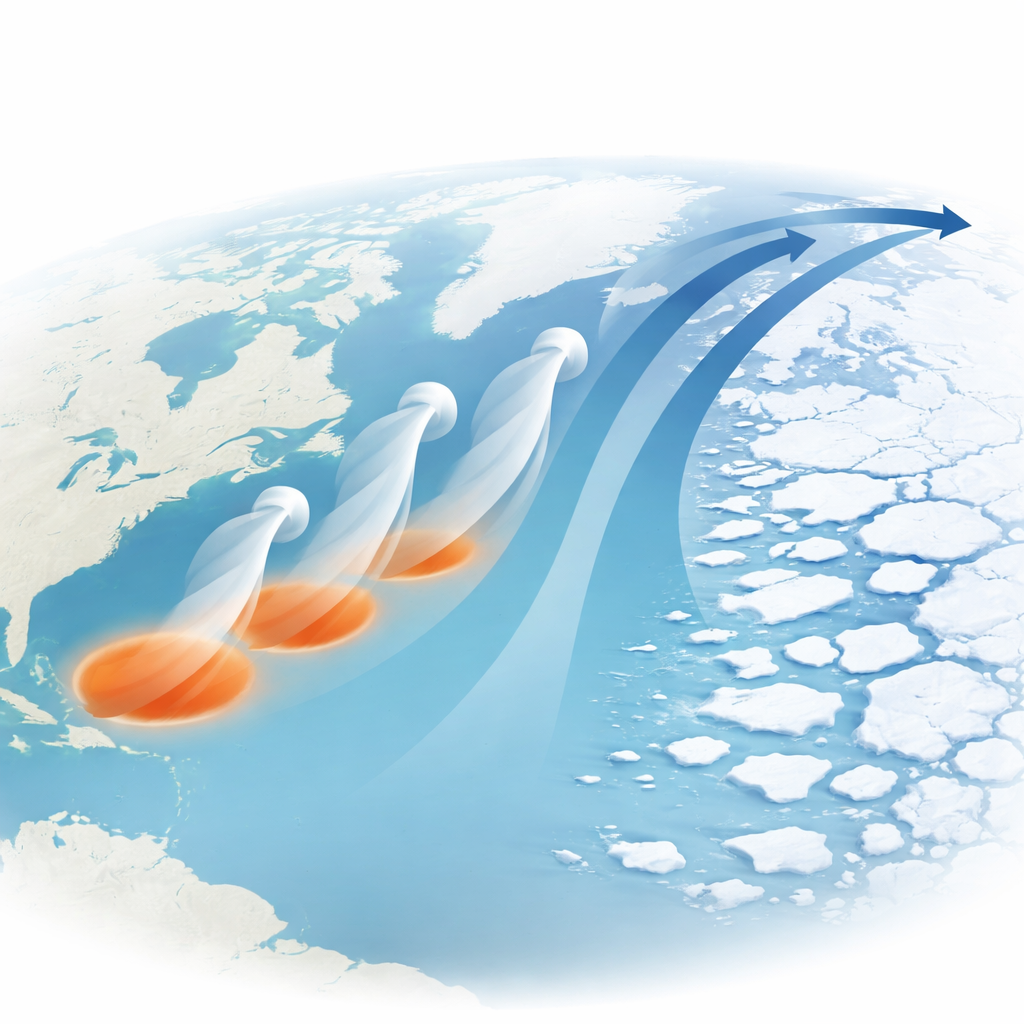
Deep neural networks are often criticized as “black boxes,” so the team applied explainable AI techniques to see where in the Atlantic the model was drawing its information. Two independent methods—integrated gradients and a systematic “occlusion” test that temporarily hides small patches of ocean from the model—converged on the same answer: the Caribbean Sea and the Gulf Stream region are the chief hotspots. Warmer‑than‑usual water in these areas tended to be associated with reduced Arctic sea ice about 20 days later. Further analysis suggested that this link is carried not by slow ocean currents, but by rapid atmospheric changes driven by extra evaporation and heat flux from the unusually warm water into the air. When the authors built new models using only the component of surface heat flux directly tied to sea surface temperature, they matched the Atlantic temperature model’s performance and found nearly identical hotspots.
Hidden rhythms and nonlinear links
Looking at the timing of these signals, the authors decomposed Atlantic temperature patterns into slower, decade‑scale swings and faster, interannual variations lasting two to seven years. A standard linear regression model mainly benefited from the slower, smoother components. The deep learning model, by contrast, extracted additional skill from the higher‑frequency, interannual signals, which appear irregular and episodic in simple statistical analyses. Wavelet techniques confirmed that in the Caribbean and Gulf Stream regions, bursts of interannual temperature variability sometimes move in step with Arctic sea ice changes, often with the ocean leading the ice. This behavior hints at complex, nonlinear atmospheric pathways, likely involving changes in moisture transport, cloud formation, and major circulation patterns such as the Arctic and North Atlantic Oscillations.
What this means for the future of Arctic ice
In plain terms, the study argues that certain warm patches of the Atlantic—especially in the Caribbean and along the Gulf Stream—play an outsized role in shaping how much sea ice covers the Arctic from year to year. By harnessing deep learning and interpretability tools, the authors show that these regions influence the Arctic quickly, within weeks, largely through enhanced evaporation and heat transfer into the atmosphere that then alters weather patterns over the polar seas. While human‑driven warming remains the main engine of long‑term ice loss, understanding these remote ocean “control knobs” can improve seasonal forecasts and help scientists untangle how natural climate rhythms and greenhouse‑gas‑driven trends combine to shape the rapidly changing Arctic.
Citation: Li, Y., Gan, B., Zhu, R. et al. Significance of Atlantic sea surface temperature anomalies to Arctic sea ice variability revealed by deep learning. npj Clim Atmos Sci 9, 70 (2026). https://doi.org/10.1038/s41612-026-01347-2
Keywords: Arctic sea ice, Atlantic Ocean, teleconnections, deep learning, climate variability