Clear Sky Science · en
Carbon-climate feedback responses to spatial aerosol model implementation variations
Why invisible air pollution matters for climate goals
Tiny particles in the air, known as aerosols, have quietly been cooling our planet by reflecting some sunlight back to space. As societies clean up air pollution, this hidden cooling will fade, exposing more of the warming caused by greenhouse gases. This study asks a deceptively simple question with big consequences: does it matter exactly where on Earth those aerosols are located, or is it enough to know their global average effect? The answer turns out to be crucial for how we estimate future warming and the amount of carbon dioxide we can still emit while meeting temperature targets.
How particles in the air shape land and sea
Aerosols are not spread evenly around the globe. They are concentrated over industrial regions and biomass-burning areas, mostly in the Northern Hemisphere and over land. These particles interact directly with sunlight, scattering or absorbing it and therefore changing how much energy reaches Earth’s surface. The authors use an Earth system climate model of intermediate complexity to compare several idealized futures. In each, the overall strength of aerosol cooling is kept the same, but the way it is spread across the planet is altered: realistically concentrated plumes, a perfectly uniform haze, aerosols only over land, only over oceans, or confined to one hemisphere.

Same global cooling, different warming outcomes
Despite identical global-average aerosol forcing, the simulations do not produce the same temperatures. When the model smooths aerosols out into a uniform global layer, surface air temperature ends up almost 0.1 degrees Celsius warmer than in the plume-like, regionally detailed case. That may sound small, but in the tight accounting of ambitious climate targets it is significant. It corresponds to an extra 200 billion tonnes of carbon dioxide that humanity would not be able to emit while still meeting a given temperature goal. The reason is that the climate system responds not just to how strong the aerosol cooling is overall, but where that cooling occurs relative to land, ocean, and existing circulation patterns.
Soils breathe more, oceans store less heat
The model reveals that land areas are especially sensitive. When aerosols are treated as uniform, there is relatively less cooling over land than in the realistic plume case, particularly in Northern mid- and high latitudes. Warmer land surfaces speed up soil respiration—the breakdown of organic matter by microbes—releasing more carbon dioxide back into the air. Although plant growth increases slightly in the warmer, CO₂-richer conditions, this extra uptake is smaller than the added soil emissions. As a result, the land stores less carbon overall, leaving more CO₂ in the atmosphere and boosting warming. At the same time, the more even aerosol layer places extra particles over the oceans, reducing sunlight reaching the sea surface and slightly weakening ocean heat uptake. This change in heat storage, especially in the vast Southern Ocean, also nudges global temperatures upward.
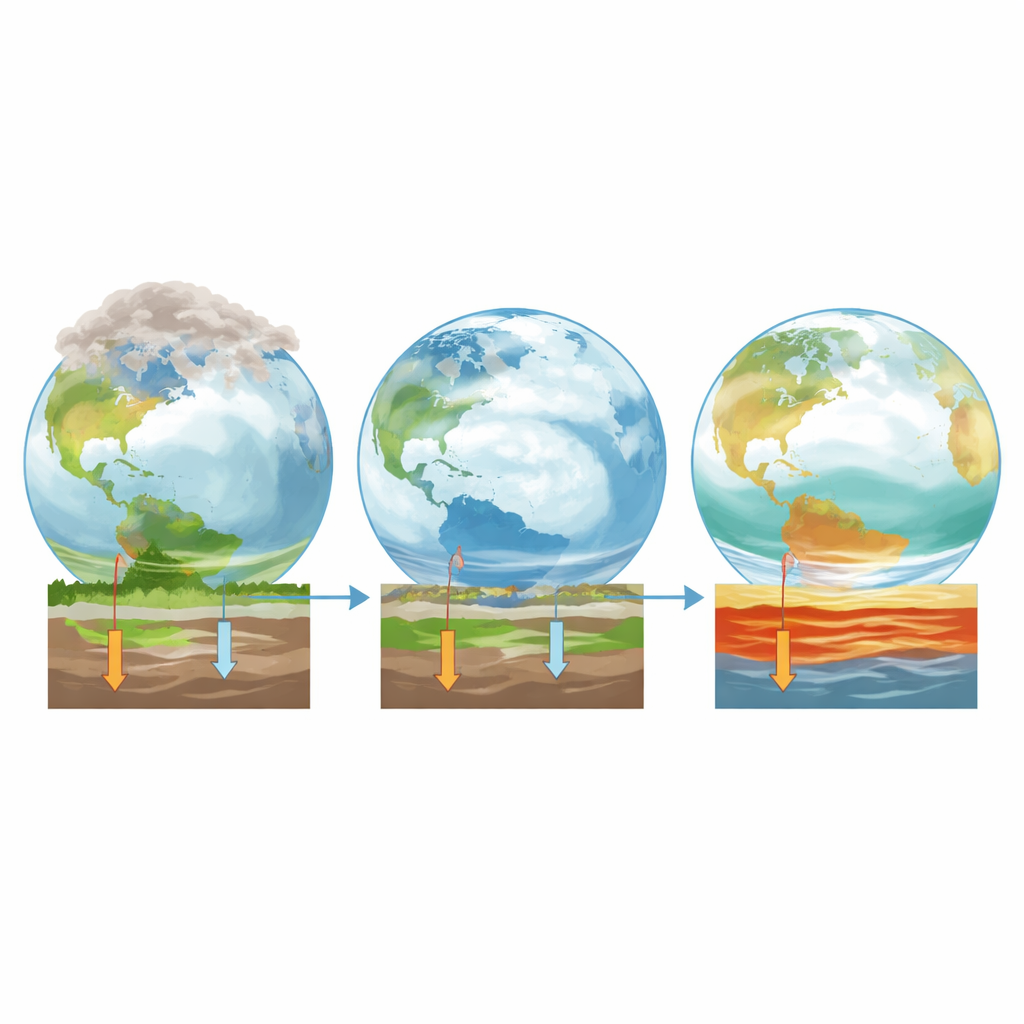
What happens when aerosols shift around the globe
By switching aerosols on only over land, only over ocean, or only in one hemisphere, the study teases apart the roles of these regions. Aerosols restricted to land amplify land cooling, slow soil respiration, and enhance carbon storage on continents, which cools the climate relative to the uniform case. Aerosols placed only over oceans or mainly in the Southern Hemisphere, by contrast, resemble the uniform experiment and lead to warmer outcomes, with reduced land carbon uptake and altered ocean heat storage. These patterns echo the historical dominance of aerosol pollution over Northern land areas and highlight how any future southward or oceanward shift in aerosols could change both heat uptake by the oceans and the strength of the land carbon sink.
Implications for climate tools and policy choices
Many simple climate models and policy metrics collapse all non‑CO₂ influences, including aerosols, into a single global number. This study shows that such simplification can miss important feedbacks between climate and the carbon cycle. Failing to represent where aerosols are emitted can bias estimates of remaining carbon budgets and the risks associated with rapid pollution cuts or deliberate aerosol-based interventions. For a layperson, the takeaway is that “where” pollution occurs matters almost as much as “how much” for our climate future. Better capturing the spatial pattern of aerosols in simplified models will lead to more reliable guidance on how quickly emissions must fall, how much warming we can still avoid, and what side effects to expect from efforts to clean the air or manipulate sunlight.
Citation: Monteiro, E.A., Tran, G., Gidden, M.J. et al. Carbon-climate feedback responses to spatial aerosol model implementation variations. npj Clim Atmos Sci 9, 69 (2026). https://doi.org/10.1038/s41612-026-01343-6
Keywords: aerosols, carbon budget, climate feedbacks, land carbon sink, ocean heat uptake