Clear Sky Science · en
An analytical framework reduces cloud feedback uncertainty by linking percentage cloud change to surface ocean warming patterns
Why clouds still hold big climate secrets
How much the planet will ultimately warm for a given amount of greenhouse gas is still surprisingly uncertain, and one of the biggest reasons is clouds. They can cool the Earth by reflecting sunlight or warm it by trapping heat, and small shifts in their behavior add up to large changes in global temperature. This study tackles that long‑standing puzzle by showing that where and how the oceans warm helps determine how clouds change, and by using new satellite observations to narrow the range of future climate outcomes.

Uneven oceans, shifting clouds
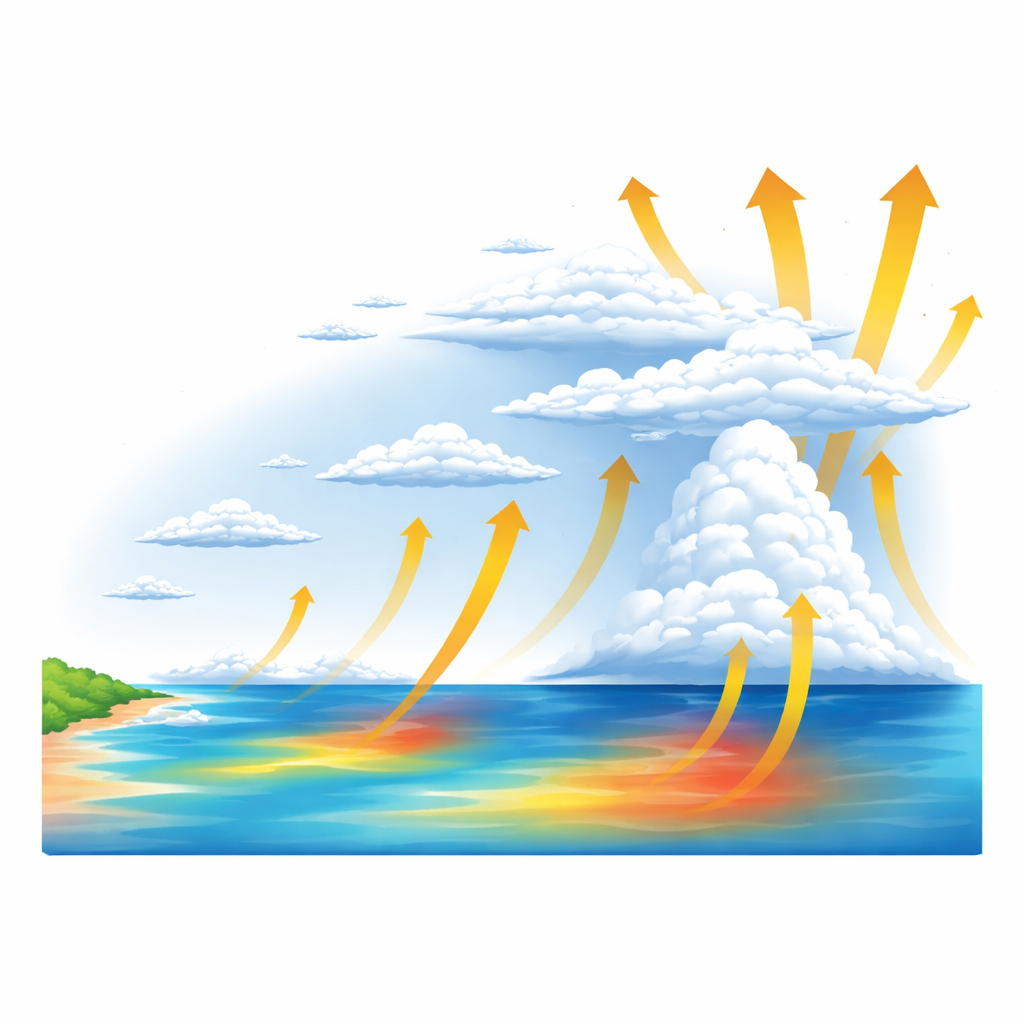
As the planet warms, the sea surface does not heat up evenly. Some tropical regions warm faster than others, creating recognizable patterns of warmer and cooler water. These patterns alter rainfall and winds, which in turn reshape where different types of clouds appear. The authors show that in the tropics, the key quantity is not just how much cloud cover changes, but the percentage change relative to how cloudy a region was to begin with. When viewed this way, satellite data and climate models reveal a simple rule: areas of ocean that warm more than the tropical average tend to lose a larger fraction of their low‑lying clouds and gain a larger fraction of high clouds.
A simple "warmer‑gets‑higher" rule
From this behavior, the team proposes a “warmer‑get‑higher” picture of cloud change. Over patches of ocean that warm more strongly, low clouds thin or retreat, while taller clouds become more common, raising the average cloud‑top height. Because low clouds are especially good at reflecting sunlight back to space, their loss lets more solar energy in, amplifying warming. High clouds, by contrast, tend to trap outgoing heat. The study finds that the percentage response of high and low clouds to local warming has opposite signs but similar strength, tightly linked to changes in cloud height across the tropical sky.
Turning cloud patterns into a usable formula
To make this insight practical, the authors build an analytical framework that connects three ingredients: how sensitive cloud fraction is to sea surface temperature patterns, how much cloud cover exists in today’s climate, and the map of future ocean warming itself. This allows cloud changes—and their effect on the planet’s energy budget—to be written down in a compact way that separates the influence of model physics from the influence of ocean patterns. Using detailed cloud measurements from NASA’s MODIS instruments together with several independent sea surface temperature records, they estimate how real‑world clouds have responded to recent warming and use that behavior to adjust the cloud responses simulated by 21 major climate models.
Cutting the spread in cloud and temperature projections
The new framework is applied in two stages. First, the observed sensitivity of clouds to warming and the observed present‑day cloud cover are used to correct model biases. This step alone cuts the spread in global cloud feedback—the extra heating or cooling caused by cloud changes—for all cloud types roughly in half and removes many unrealistic regional features. Second, the authors analyze how differences in future sea surface temperature patterns contribute to the remaining spread. They find that these patterns explain nearly four‑fifths of the leftover uncertainty. By constraining the most plausible patterns using observations, they further tighten the range of cloud feedbacks, especially in key low‑cloud regions over the eastern tropical oceans.
What this means for climate sensitivity
Cloud feedback is a central piece of the puzzle known as climate sensitivity: how many degrees the Earth will eventually warm if carbon dioxide levels double. After applying their two‑step correction, the authors find that the average strength of cloud feedback across models stays roughly the same, but the range of possible values shrinks by almost 60 percent. When this improved cloud information is fed back into estimates of climate sensitivity, the most likely warming remains a little above 4 °C, but the uncertainty band narrows by about one‑third. In everyday terms, the work does not offer comfort that warming will be mild; rather, it makes very high or very low outcomes less plausible and shows that better understanding of cloud–ocean linkages can meaningfully sharpen our picture of the planet’s future.
Citation: Ma, J., Feng, J., Su, H. et al. An analytical framework reduces cloud feedback uncertainty by linking percentage cloud change to surface ocean warming patterns. npj Clim Atmos Sci 9, 66 (2026). https://doi.org/10.1038/s41612-026-01339-2
Keywords: cloud feedback, sea surface temperature patterns, climate sensitivity, tropical clouds, climate models