Clear Sky Science · en
Precession-driven salinity feedback in the western Pacific warm pool: insights from alkenone hydrogen isotopes over the past 450 kyr
Why a distant patch of ocean matters to everyday weather
The Western Pacific Warm Pool is a vast region of bathtub‑warm seawater north of Australia and around Indonesia. Though it is far from most people’s homes, it helps power the global climate system, feeding the monsoon rains that support billions of people and shaping events like El Niño and La Niña. This study looks back 450,000 years to ask a simple but crucial question: what controls how salty this warm pool becomes over long stretches of time, and what does that mean for future droughts and floods in the tropics? 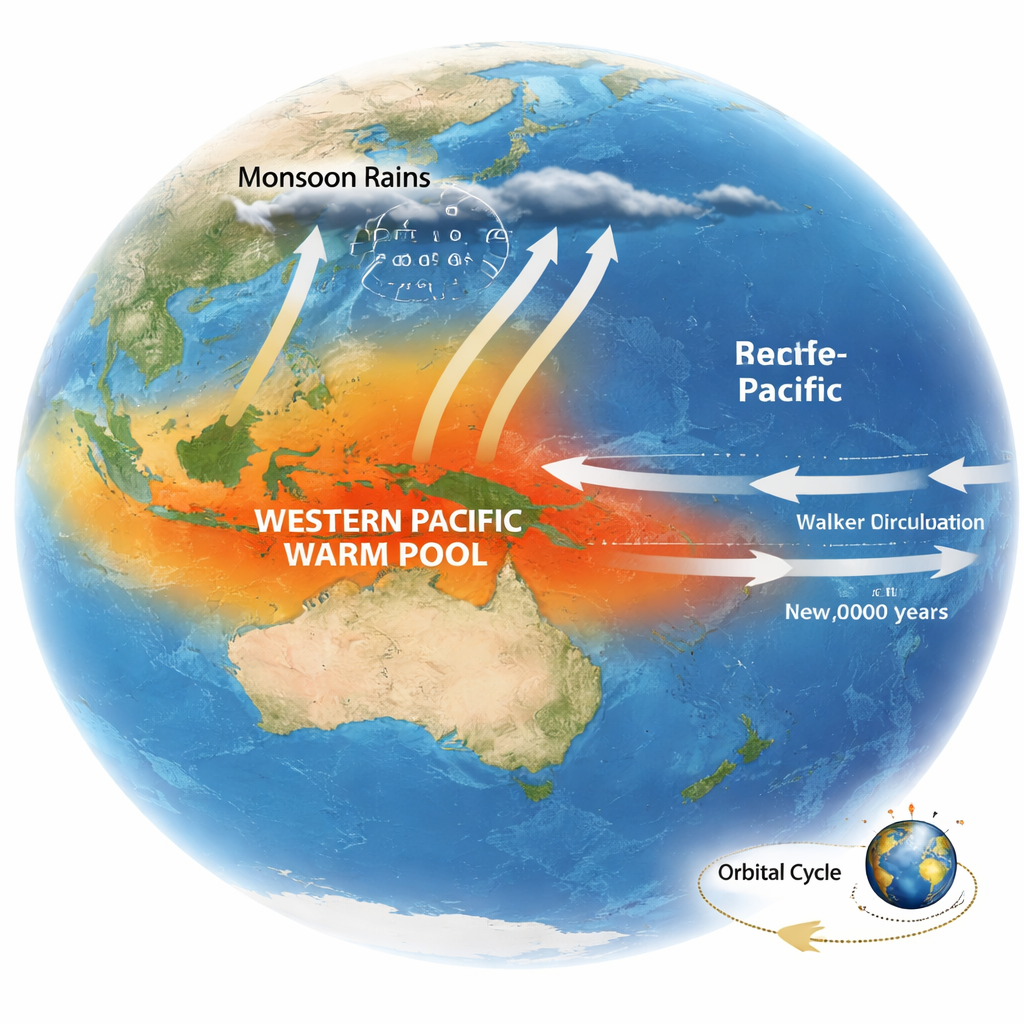
Following ancient clues locked in ocean mud
To reconstruct past changes in sea‑surface salinity—the amount of dissolved salt near the ocean surface—the researchers drilled into seafloor sediments at a site just north of New Guinea. These muddy layers, built up over hundreds of thousands of years, contain the remains of microscopic algae that once floated at the surface. The algae produced special waxy molecules called alkenones. By measuring the hydrogen atoms in these alkenones, scientists can infer how salty the surrounding seawater was when the algae grew, because evaporation and rainfall leave a distinct fingerprint in the hydrogen they incorporate. Unlike older methods that mixed together local salt changes with the growth and melting of global ice sheets, this hydrogen‑based approach more directly tracks the balance between evaporation and precipitation in the warm pool itself.
Earth’s slow wobble as a climate metronome
When the team compared their 450,000‑year salinity record with calculations of Earth’s changing orbit, a clear pattern emerged. The strongest signal matched “precession,” a slow wobble in Earth’s spin that reshapes when and where sunlight is strongest in the tropics roughly every 23,000 years. Periods when the Northern Hemisphere received more intense summer sunshine lined up with peaks in warm‑pool salinity. Climate model simulations that include water isotopes confirmed this link: stronger summer sun sharpened temperature contrasts between north and south, invigorated trade winds and the Walker circulation across the Pacific, and promoted La Niña‑like conditions. All of these together dried out the warm pool surface and made it saltier.
A three‑part recipe for a saltier warm pool
The authors describe a “salinification triad” that explains the observed swings in saltiness. First, extra sunshine boosts evaporation over the already warm waters, leaving salt behind. Second, stronger trade winds push salty surface water from other parts of the Pacific into the warm pool. Third, high‑pressure systems reduce local rainfall, so less fresh water falls back into the ocean to dilute the salt. Proxy records from Asian cave deposits and loess soils, along with the climate simulations, show that at these times more of the evaporated moisture is carried toward East Asia, intensifying monsoon rains there even as the source region in the western Pacific becomes saltier. 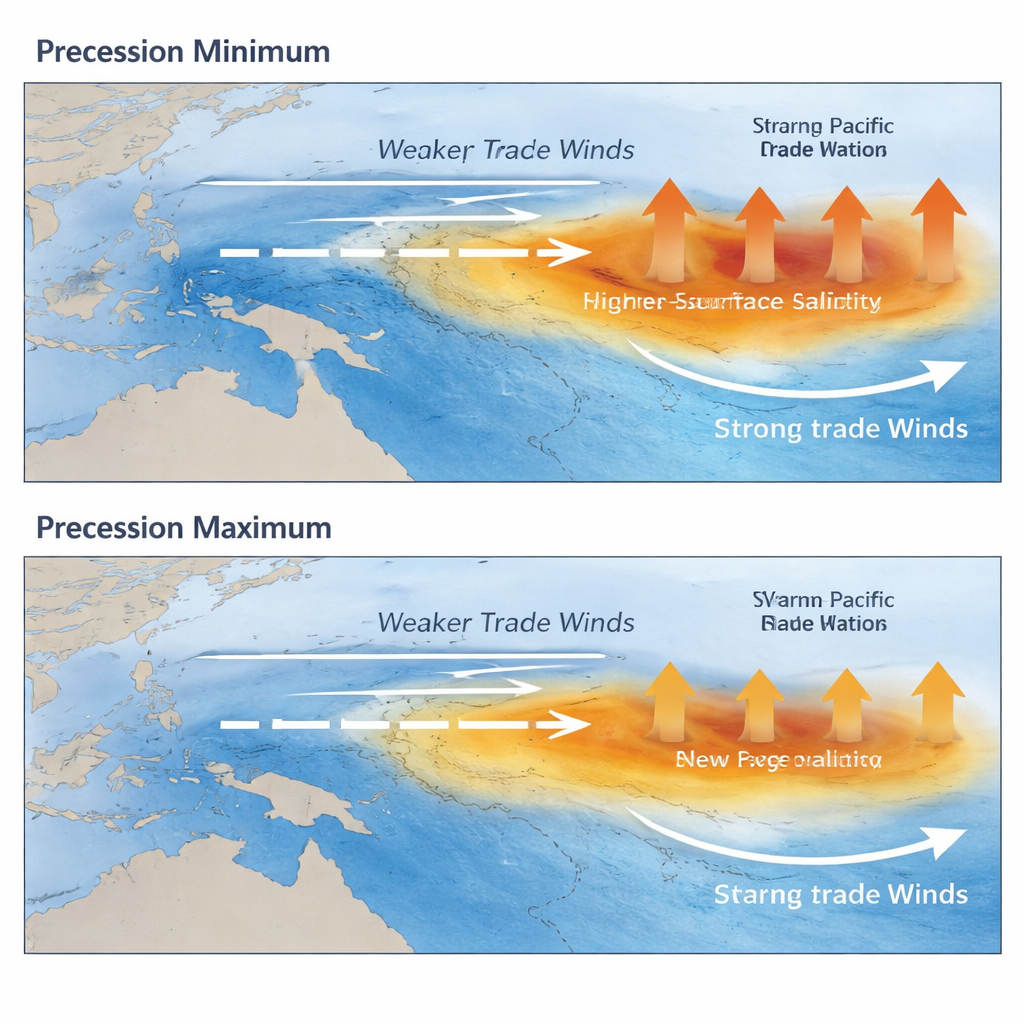
High‑latitude hints in a tropical story
Although the tropical precession cycle dominates, the study also finds a weaker imprint of “obliquity,” the 41,000‑year rhythm in how much Earth tilts. When peaks in tilt align with the precession‑driven bright summers, changes in distant high‑latitude oceans subtly alter currents and upwelling in the South Pacific. That in turn feeds extra salty water into the warm pool, adding about 10–20 percent to the total salinity swings. This combined tropical–polar influence helps reconcile earlier, seemingly conflicting records that emphasized either tropical sunlight or polar ice sheets as the main drivers of western Pacific climate over ice‑age cycles.
What this means for a warming world
For non‑specialists, the core message is that the Western Pacific Warm Pool is not just a passive tub of warm water—it is an active “engine” whose saltiness rises and falls in step with slow changes in incoming sunlight, and that engine strongly affects monsoon rains and extreme weather around the Indo‑Pacific. The new hydrogen‑based salinity record shows that most long‑term changes there come from tropical evaporation and winds, not from distant ice sheets. As human‑driven warming adds energy to the climate system, similar processes—stronger evaporation, shifting winds, and altered moisture transport—could amplify future swings between drought and deluge in some of the world’s most densely populated regions. Understanding how this engine has operated over hundreds of thousands of years gives scientists a sharper tool for testing models that project tomorrow’s monsoons.
Citation: Yuan, R., Zhang, R., Jiang, L. et al. Precession-driven salinity feedback in the western Pacific warm pool: insights from alkenone hydrogen isotopes over the past 450 kyr. npj Clim Atmos Sci 9, 60 (2026). https://doi.org/10.1038/s41612-026-01335-6
Keywords: Western Pacific Warm Pool, sea surface salinity, orbital cycles, tropical monsoon, paleoclimate