Clear Sky Science · en
Bridging idealized and operational models: an explainable AI framework for Earth system emulators
Why better climate models matter
Seasonal forecasts and long‑term climate projections shape decisions about food security, water management, and disaster preparation. Yet even today’s most sophisticated computer models can misjudge important patterns like El Niño, which can swing between droughts and floods around the globe. This paper introduces a new way to make those complex models smarter and more trustworthy by letting them “learn” from simpler, highly tuned models through an explainable form of artificial intelligence.

Two kinds of climate models, two kinds of strengths
Modern operational climate models simulate the entire Earth system in fine detail, tracking atmosphere, ocean, land, and ice on global grids. They are powerful but imperfect: they tend to be biased in how they represent extreme events and the statistics of recurring patterns such as El Niño and La Niña. On the other end of the spectrum are idealized models. These are stripped‑down equations that focus on a few key processes, often in just one region or along a single line across the ocean. Because they are simple and fast, scientists can tune them carefully so that they reproduce specific behaviors and statistics extremely well. Unfortunately, these two model worlds rarely meet: the detailed models are too complex to adjust by hand using insights from the simple ones, and the simple ones lack the rich fields needed for practical prediction.
A bridge built with explainable AI
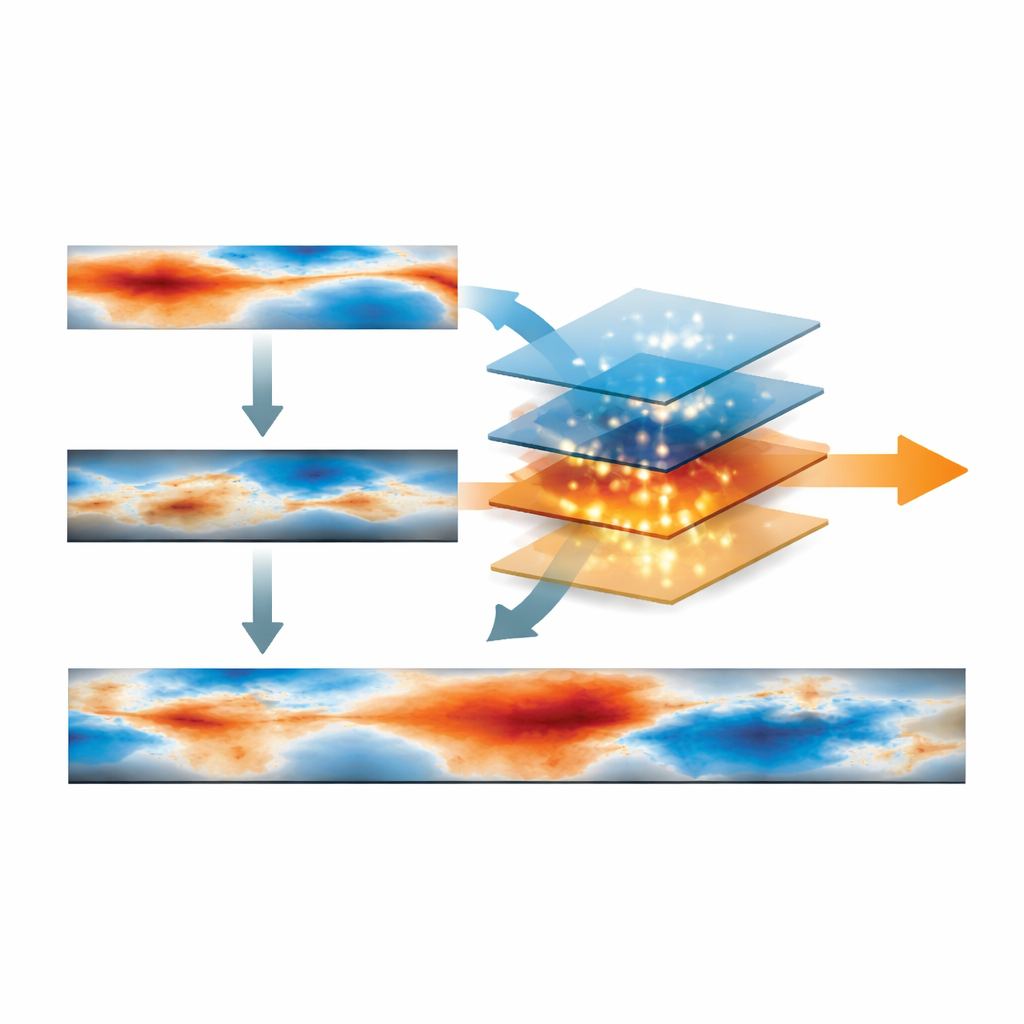
The authors propose a “bridging model” that combines the strengths of both approaches using explainable artificial intelligence rather than a black‑box fix. First, they compress the huge output of a complex climate model into a compact “latent” representation using an autoencoder, a neural network that learns how to rebuild the full fields from a much smaller set of numbers. They then enrich this compact state with a handful of key variables—such as sea‑surface temperature and thermocline depth along the equator—produced by an idealized model that is known to match observations well. A second neural network learns how the compressed state evolves over time, while a data‑assimilation step repeatedly nudges this evolving state toward the patterns coming from the idealized model. Because this correction is done through well‑understood statistical formulas, the influence of the simple model on the full system can be quantified and traced, making the process explainable.
Fixing El Niño’s shape, strength, and rhythm
To test their framework, the researchers focus on the El Niño–Southern Oscillation in the equatorial Pacific, whose warm (El Niño) and cool (La Niña) phases strongly affect global weather. Many state‑of‑the‑art models, including those used in the CMIP6 intercomparison project, struggle to reproduce the diversity of El Niño events: some peak in the eastern Pacific, others in the central Pacific, and their intensity and timing vary from cycle to cycle. Using idealized models that accurately capture the statistics of these variations, the bridging model substantially corrects the biases of a leading operational model (CESM2). It improves the spatial patterns of surface and subsurface temperatures and winds, matches the observed probability distributions and seasonal rhythms of El Niño indices, and reproduces realistic sequences of events, including extreme and multi‑year episodes.
Exploring "what‑if" worlds quickly and clearly
Because the bridge runs on a compressed version of the full model, it is far cheaper to simulate than the original climate system: a multi‑decade run takes minutes on a standard computer instead of the vast resources needed for a full global model. This efficiency allows scientists to generate large ensembles to study rare extremes and to explore “what‑if” scenarios. For example, by changing a slowly varying parameter in the idealized model that represents the strength of the Pacific trade winds, the authors examine futures with persistently weakened or strengthened atmospheric circulation. The bridging model responds by shifting where and how strongly El Niño events occur, in line with previous studies, but at a fraction of the computational cost. Because the corrections come through a transparent data‑assimilation step, researchers can see which parts of the system are being steered and how strongly.
A new kind of climate twin
In everyday terms, this framework lets a big, detailed climate model “borrow the wisdom” of a simple, well‑understood one without becoming a mysterious black box. The resulting hybrid behaves like a digital twin of the real climate system: it preserves the rich, high‑resolution fields needed for impact studies while aligning its key patterns and statistics with both observations and carefully tuned theory. The authors argue that this approach can be extended to other regions, to multiple models, and even beyond Earth science to any complex system where simple and detailed models coexist. By making the corrections interpretable, their work fosters closer collaboration between communities that build idealized models and those that maintain operational ones, paving the way for more reliable predictions of climate extremes that matter for society.
Citation: Behnoudfar, P., Moser, C., Bocquet, M. et al. Bridging idealized and operational models: an explainable AI framework for Earth system emulators. npj Clim Atmos Sci 9, 65 (2026). https://doi.org/10.1038/s41612-026-01334-7
Keywords: El Niño, climate modeling, explainable AI, data assimilation, digital twins