Clear Sky Science · en
ENSO modulated upstream convection as the primary control on interannual δ¹⁸O variability in East Asia
Why raindrops in China hold clues to distant seas
Every drop of rain carries a subtle chemical fingerprint that records where it came from and what it experienced on its journey through the sky. In East Asia, these fingerprints—tiny shifts in the oxygen atoms inside water molecules—are widely used to reconstruct past monsoon rains from cave deposits and tree rings. Yet scientists have long disagreed over what these signals really mean. This study uses an advanced climate model to show that much of the year‑to‑year oxygen signal in East Asian rain is controlled not by local storms, but by the waxing and waning of El Niño in the tropical Pacific Ocean.
Reading the hidden code in rain
The authors focus on a specific variant of oxygen, called heavy oxygen, whose abundance in rain is written as δ¹⁸O. When moist air rises and rains out, heavy oxygen tends to fall first, leaving the remaining vapor increasingly light. That means the δ¹⁸O value in rainfall reflects how much the air has rained on its way. Over central‑eastern China—home to many famous cave records—scientists have proposed a range of explanations for δ¹⁸O swings: changes in the strength of the summer monsoon winds, shifts in where the moisture comes from, or the tug of distant oceans such as the Indian Ocean. To untangle these ideas, the team used IsoGSM3, an atmosphere model that explicitly tracks water isotopes and can “tag” moisture from different source regions, then compared its output to real‑world measurements.
El Niño’s long reach into Asian rains
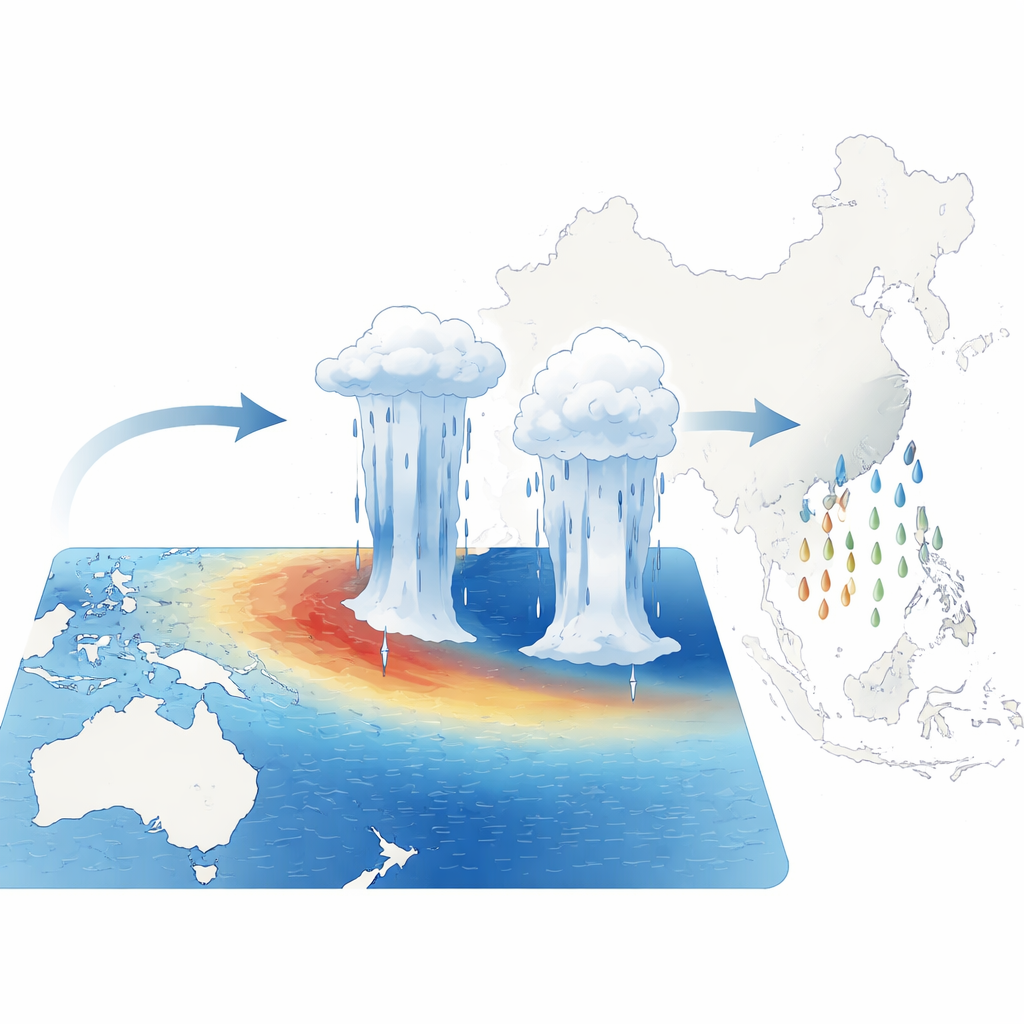
Across seven decades of simulated climate, a single pattern stands out as the dominant source of year‑to‑year δ¹⁸O swings over East Asia: the El Niño–Southern Oscillation (ENSO). When the central‑eastern tropical Pacific is warmer than usual—an El Niño event—deep thunderstorm activity shifts eastward over the Pacific. Upstream regions to the west, from India across the Bay of Bengal and the Maritime Continent toward the South China Sea, see weaker towering storms and less intense rainout. As a result, air arriving over China has experienced fewer rounds of heavy‑oxygen removal and carries moisture that is, paradoxically, richer in heavy oxygen. This leads to higher δ¹⁸O values in East Asian summer rain that line up closely with El Niño cycles.
How distant storms reshape rain’s journey
The model’s tagging experiments reveal that what matters most is not dramatic reshuffling of where the moisture originates, but how it is processed en route. During summer, much of the water feeding central‑eastern China actually comes from land areas through recycled evaporation, with smaller but important shares from the Indian and Pacific Oceans. From one year to the next, these fractions shift only by a few percent—too little to explain the sometimes large δ¹⁸O swings. Instead, the key is how strongly air masses are squeezed by convection and rainout as they cross the tropical ocean “corridor” south of China. When convection is vigorous along this path, repeated rainout strips away heavy oxygen before the air turns northward, producing low δ¹⁸O rain over China. When El Niño weakens those storms, the air retains more heavy oxygen and the downstream rain signature flips.
Jet stream twists and the late‑season twist
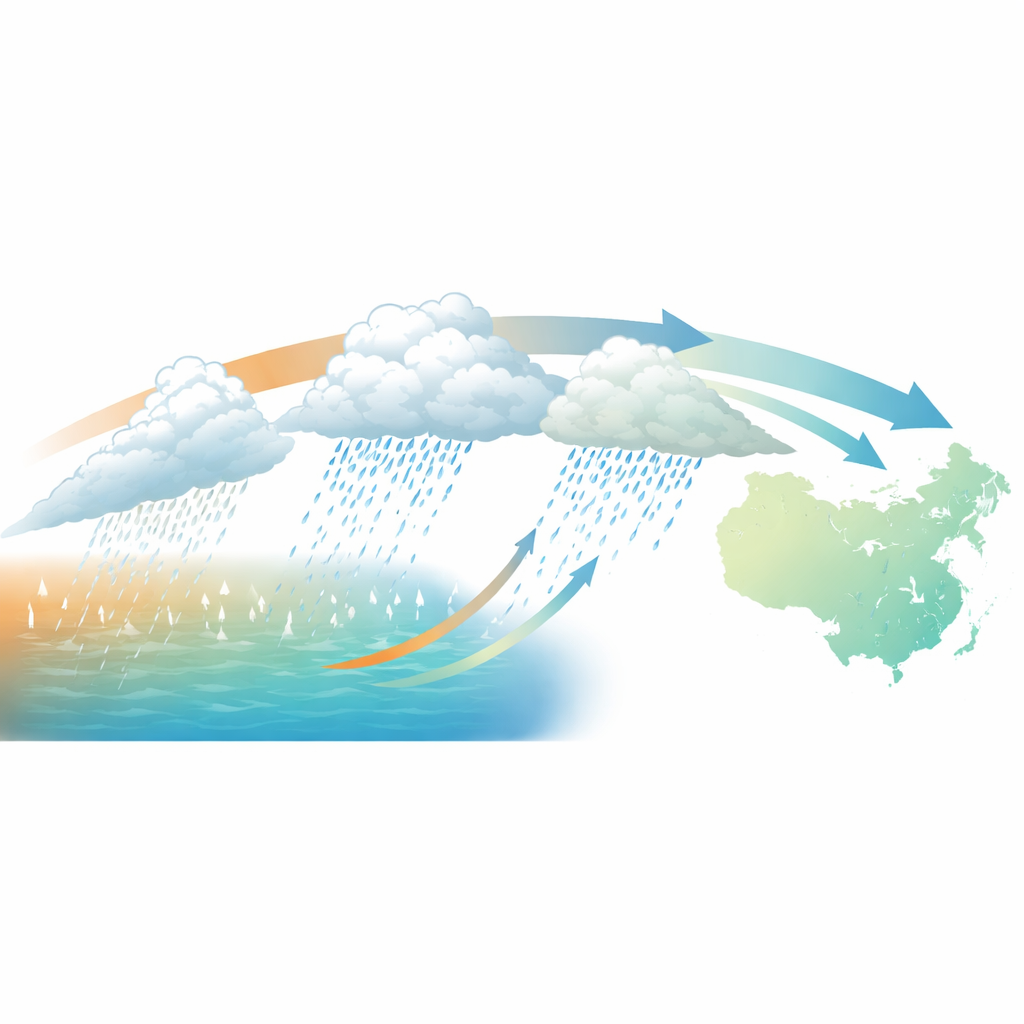
ENSO also leaves its mark higher up in the atmosphere. The study shows that during El Niño years, the upper‑level westerly jet stream over East Asia tends to shift a bit southward in September and October, as the summer monsoon winds retreat. This shift suppresses the usual late‑season flow of cool, ocean‑sourced air into East Asia and favors a larger share of local, land‑recycled moisture. Together, these changes raise δ¹⁸O in late‑season rain across the monsoon region. When the researchers statistically remove the influence of El Niño, this link between the jet stream and δ¹⁸O largely disappears—evidence that ENSO is the hidden puppeteer behind many of these atmospheric arrangements.
Why cave records can miss the signal
Even though ENSO clearly imprints itself on East Asian δ¹⁸O, the leading ENSO‑related pattern explains only about one‑fifth of the total year‑to‑year variation. Other local and regional processes add plenty of “noise.” Cave deposits and similar archives compound the problem: water can sit and mix in underground rock for years before forming calcite layers, and scientists often sample those layers at multi‑year spacing. Simple modeling in this study shows that if water spends more than a couple of years moving through the rock, much of the ENSO‑band signal is blurred away. That helps explain why nearby caves in China sometimes disagree on short timescales, even though they share a common climate.
What this means for past and future climate stories
For a non‑specialist, the key takeaway is that the story recorded in East Asian oxygen‑isotope archives is written largely by far‑off tropical storms tied to El Niño, not just by how hard local monsoon winds blow or by which ocean supplied the water. Year‑to‑year changes in the chemical fingerprint of rain mainly reflect how strongly air is wrung out over the Indo‑Pacific tropics before reaching China, and how ENSO nudges the jet stream during the monsoon’s closing act. Over centuries to millennia, the same upstream convective machinery likely operates in slower, more persistent ways, meaning that cave and tree‑ring records from East Asia may be telling us about long‑term reorganizations of tropical storm belts, as well as shifts in monsoon strength. Understanding that story will be crucial for interpreting the region’s rich archive of natural climate records in a warming world.
Citation: Sinha, A., Cheng, J., Li, H. et al. ENSO modulated upstream convection as the primary control on interannual δ¹⁸O variability in East Asia. npj Clim Atmos Sci 9, 64 (2026). https://doi.org/10.1038/s41612-026-01333-8
Keywords: El Niño Southern Oscillation, East Asian summer monsoon, oxygen isotopes, paleoclimate records, tropical convection