Clear Sky Science · en
Anthropogenic warming projected to drive a decline in global tropical cyclone frequency in CMIP6 simulations
Fewer Storms in a Warmer World?
Tropical cyclones—called hurricanes or typhoons depending on where they form—are among the most destructive weather systems on Earth. As the planet warms, many people assume we will simply see more of these storms. This study uses a new generation of global climate models to ask a more subtle question: how will the number of tropical cyclones around the world change, and why?
Counting Future Storms
The researchers analyzed simulations from 26 state-of-the-art climate models participating in the latest international comparison project (CMIP6), all run under a high-emissions “business as usual” scenario for 2015–2099. They used a standardized technique to “detect” tropical-cyclone-like storms directly in the model output and then tuned the method so that each model’s recent storm counts match observations in every major ocean basin. This allowed them to compare relative changes across models on a common footing, rather than being misled by models that simply produce too many or too few storms overall.
Fewer Cyclones Almost Everywhere
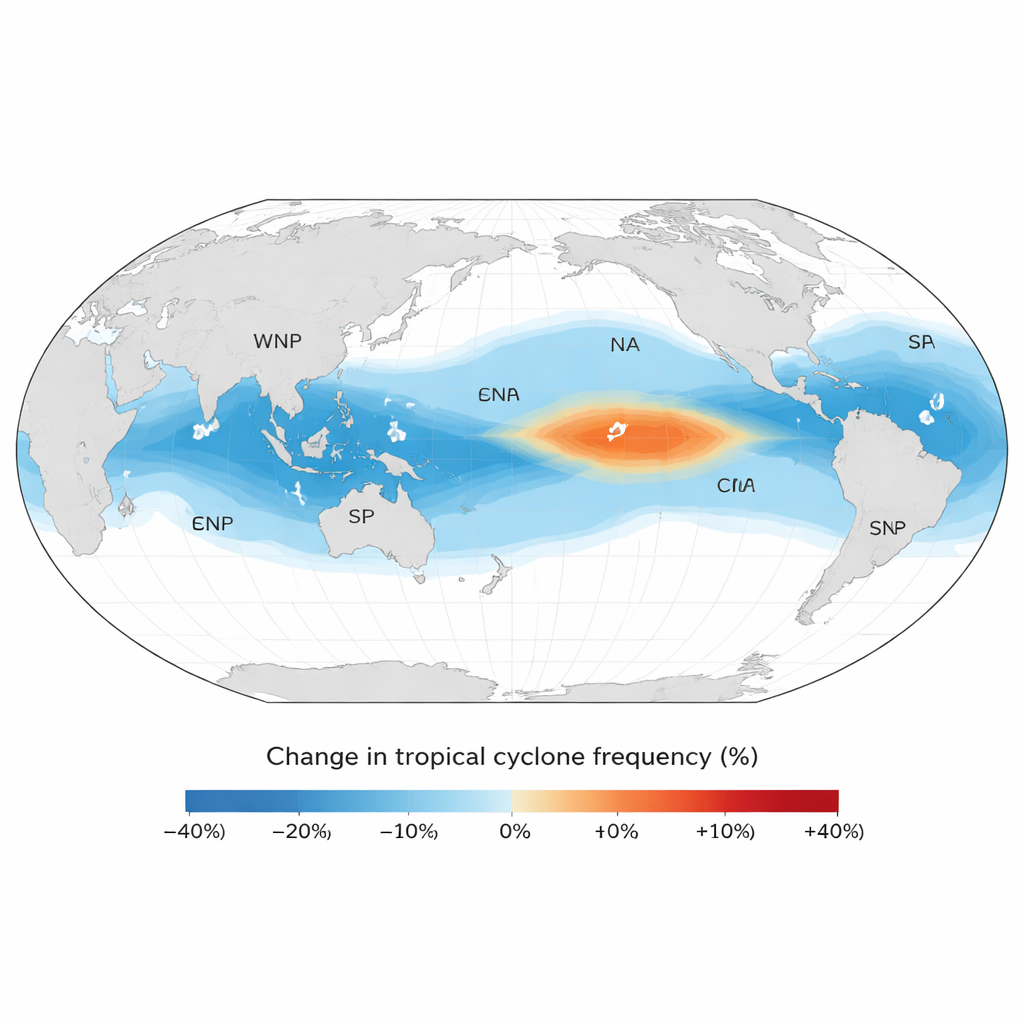
Across the model ensemble, global tropical cyclone frequency declines through the 21st century. By 2070–2099, the world sees about 2–10% fewer storms each year than in the early 2000s. The drop is not uniform: the western North Pacific, eastern North Pacific, North Atlantic, South Indian Ocean, and South Pacific all show substantial decreases, with some basins losing more than a quarter of their storms. One notable exception is the central Pacific, where many models project a marked increase in storm formation, partly offsetting declines elsewhere in the Northern Hemisphere. However, the models also tend to overproduce storms in that region today, so the size of the future increase there may be exaggerated.
Why Warmer Seas Don’t Always Mean More Storms
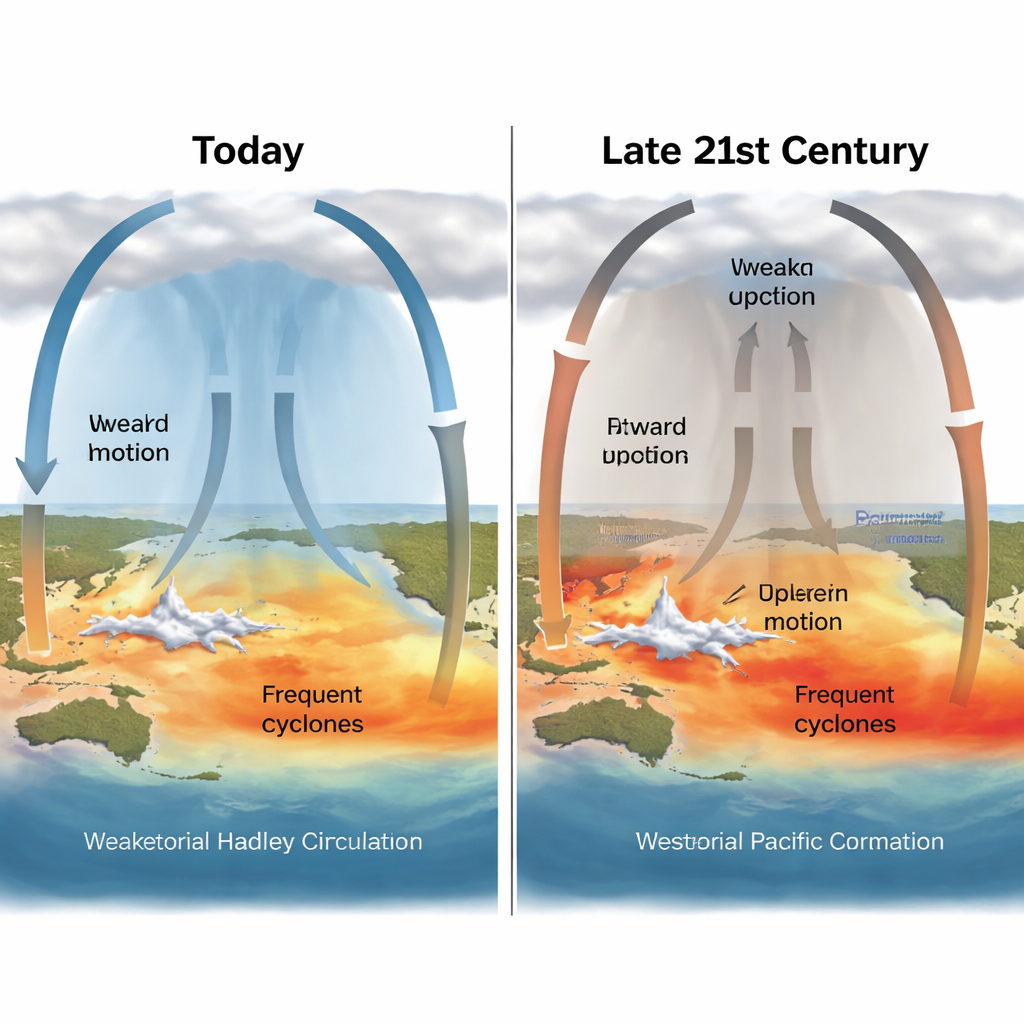
Storms do not form in isolation; they depend on the broader atmosphere and ocean. The team examined two widely used “genesis potential indices” that link large-scale conditions—such as rising air, wind shear, humidity, and ocean energy—to the likelihood of cyclone formation. Both indices show patterns that closely mirror the projected storm changes, strengthening confidence in the results. The biggest driver of fewer cyclones is weaker upward motion in the atmosphere over traditional storm breeding grounds, which makes it harder for thunderstorms to grow and organize into rotating systems. In many regions, mid-level air also becomes relatively drier and more stable, and vertical wind shear (winds changing with height) increases—conditions that disrupt developing storms.
The Shape of Warming Matters
A key finding is that it is not just how much the oceans warm, but where they warm fastest. The models project an “El Niño–like” pattern: especially strong warming in the central and eastern tropical Pacific, along with enhanced warming in the equatorial Atlantic and north Indian Ocean. This uneven heating weakens the usual east–west temperature contrasts that drive the Walker circulation, and it shifts bands of heavy rainfall and rising air—the Intertropical Convergence Zone—closer to the equator. As large-scale air currents adjust, many storm-forming regions experience more sinking air and stronger disruptive winds aloft, reducing their ability to spawn cyclones, even as conditions in the central Pacific become more favorable.
Shifting Global Wind Belts
The study also highlights changes in north–south air circulations, known as Hadley cells. Because land-heavy Northern Hemisphere areas warm faster than the Southern Hemisphere, the temperature difference between hemispheres shrinks. This weakens cross-equatorial air flows, especially over the South Indian Ocean, leading to more downward motion and fewer storms there. At the same time, localized warm patches over the Pacific and Indian Oceans trigger large-scale wave-like responses in the atmosphere that create new zones of rising and sinking motion, further redistributing where cyclones can form.
What This Means for People
For a layperson, the takeaway is that a hotter planet will likely have fewer tropical cyclones overall, but the storms that do form may be stronger and may strike different places than in the past. In particular, risk is projected to decline in some classic storm basins while increasing near the central Pacific. The authors caution that these projections depend sensitively on the exact pattern of sea-surface warming, which current models may not fully capture. Even so, their work clarifies how subtle shifts in global wind and rainfall belts can reshape storm formation, offering valuable guidance for long-term coastal planning and disaster preparedness.
Citation: Zhao, K., Zhao, H., Klotzbach, P.J. et al. Anthropogenic warming projected to drive a decline in global tropical cyclone frequency in CMIP6 simulations. npj Clim Atmos Sci 9, 58 (2026). https://doi.org/10.1038/s41612-026-01330-x
Keywords: tropical cyclones, climate change, El Niño-like warming, global storm frequency, sea surface temperature patterns