Clear Sky Science · en
Accelerated reduction of atmospheric ultrafine particles since China VI vehicle emission standards
Why the Tiniest Car Pollution Matters
Invisible particles from car exhaust are so small that millions could fit on the tip of a needle, yet they can reach deep into our lungs and bloodstream. This study looks at how new vehicle rules and the rise of electric cars in Beijing have sharply cut these ultrafine particles in just a few years, offering a glimpse of how cities can clean their air faster than many thought possible.
The Hidden Dust of City Traffic
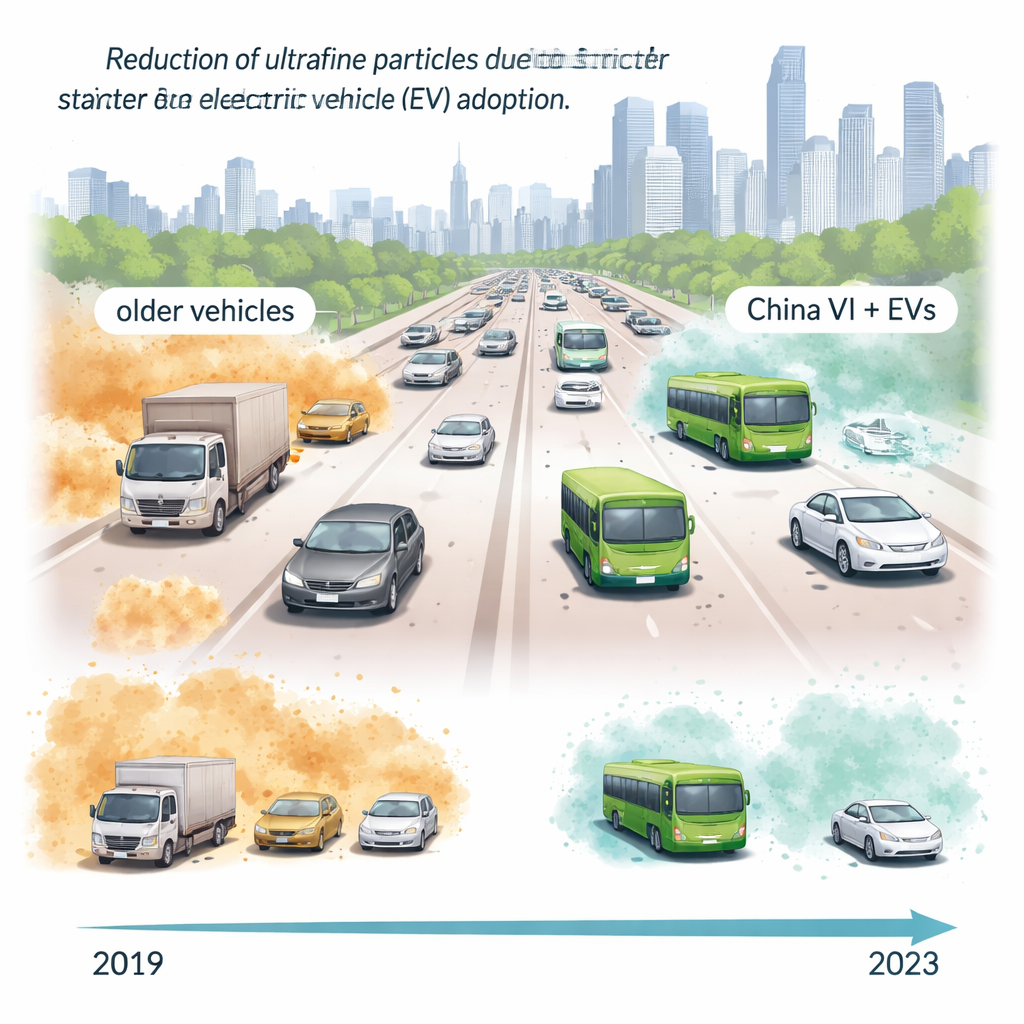
Ultrafine particles are tiny bits of pollution less than one thousandth the width of a human hair. They come from many sources, but in big cities, vehicles are a major contributor. Unlike the more familiar PM2.5, these ultrafine particles have been poorly monitored and barely regulated, even though the World Health Organization has called for closer tracking. Beijing, a megacity with rapidly growing traffic, offered a natural test bed when it introduced one of the world’s strictest vehicle standards—known as China VI—alongside a rapid push for electric vehicles.
A Sharp Drop in the Smallest Particles
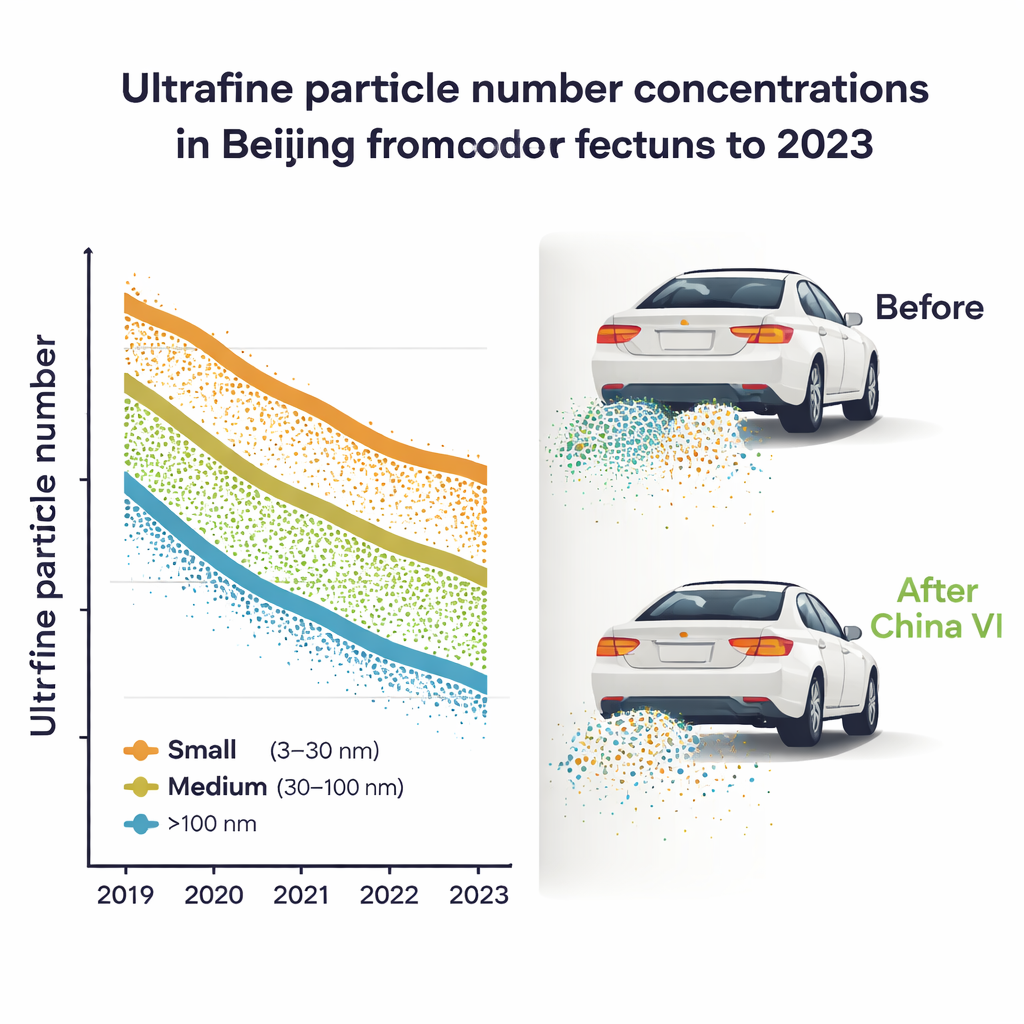
Researchers continuously measured how many particles of different sizes were present in Beijing’s air between 2019 and 2023, focusing on a busy urban campus and comparing with three other sites around the city. They found that the total number of particles in the air fell by nearly 60 percent over these five years. The tiniest ones, between 3 and 30 nanometers across, dropped even more—by about 70 percent. Slightly larger ultrafine particles fell by roughly half, while larger particles shrank by just over 40 percent. In contrast, common pollutants like fine particle mass (PM2.5) and nitrogen dioxide went down by only about 15 to 30 percent, showing that the smallest particles were disappearing fastest.
Linking Morning Traffic to Tiny Particles
To trace these particles back to their sources, the team zoomed in on morning rush hours, when traffic is intense but new particle formation from sunlight-driven chemistry is usually weak. They used a combination of particle counters, detailed chemical analysis of the tiny particles themselves, and statistical tools to separate vehicle exhaust from other urban sources such as cooking. Chemical markers known to come from traffic rose and fell in step with bursts of ultrafine particles during the morning commute, confirming that these spikes were mainly from vehicles. Across multiple years and sites, the calculated emission rates for vehicle-related ultrafine particles in the morning fell by more than 80 percent, mirroring the strong decline seen in the smallest particles in the air.
How New Rules and Electric Cars Drove Change
Measurements alone cannot explain why emissions changed, so the researchers also built a detailed emissions inventory for Beijing and for all of China. They combined real-world emission tests on gasoline and diesel vehicles with data on how many vehicles of each type were on the road and how far they drove. In Beijing, the total number of ultrafine particles emitted from vehicles fell by about 44 percent between 2019 and 2023—more than the 33 percent decline estimated nationwide. The main reasons were early adoption of the China VI standard, which limits particle numbers and cuts hydrocarbon vapors, and a strong push toward electric vehicles. Diesel trucks, though a small share of vehicles, were responsible for most of the particle emissions, and bringing them under the new standard delivered especially large benefits.
What This Means for City Air and Health
Despite more vehicles on the road, Beijing’s air now contains far fewer of the tiniest particles from traffic, and the city has outpaced many regions in Europe and North America in reducing them. Because these particles can penetrate deep into the body and may be particularly harmful to health, targeting them directly—through particle-number limits and cleaner engines, plus electric vehicles—appears to be an efficient way to improve urban air quality. The study also suggests that current rules, which focus mainly on solid particles, could go further by including the volatile particles that form from exhaust vapors. For citizens, the message is simple: strict emission standards and clean vehicle technologies can quickly make the air we breathe less loaded with the most elusive and potentially dangerous particles.
Citation: Wang, H., Wen, Y., Wu, J. et al. Accelerated reduction of atmospheric ultrafine particles since China VI vehicle emission standards. npj Clim Atmos Sci 9, 55 (2026). https://doi.org/10.1038/s41612-026-01327-6
Keywords: ultrafine particles, vehicle emissions, China VI standard, electric vehicles, urban air quality