Clear Sky Science · en
The winter mean NAO: white noise and predictability
Why this matters for winter weather
People living around the North Atlantic know that some winters are stormy and wet while others are calm and cold, and a pattern called the North Atlantic Oscillation (NAO) helps explain these swings. Because the NAO influences European temperatures, rainfall, and storms, scientists have long hoped it could be predicted years in advance. This study asks a deceptively simple question: does the NAO contain any hidden rhythm that could make it predictable on decade-long timescales, or does it behave more like random noise from one winter to the next?
A climate switch over the Atlantic
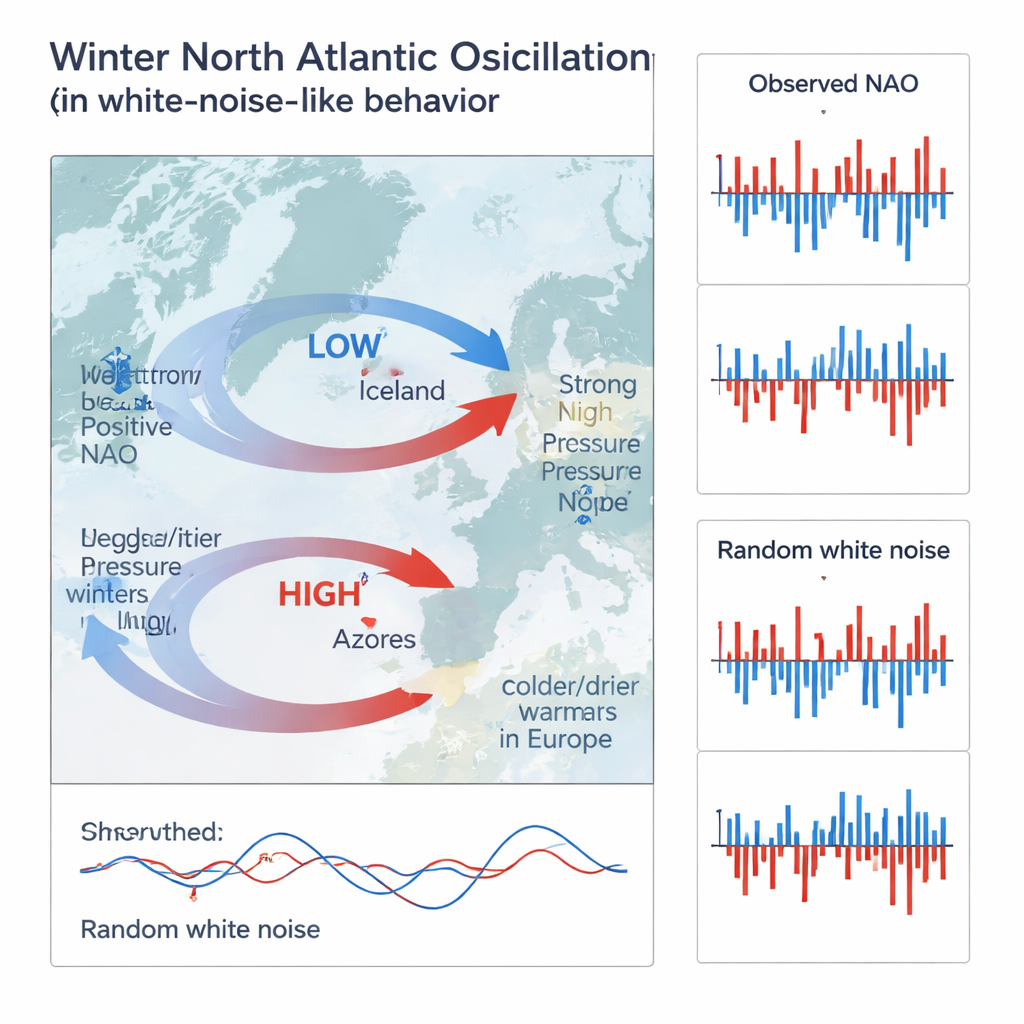
The NAO describes how air pressure differs between roughly Iceland and the Azores. When this pressure contrast is strong (a positive NAO), storm tracks shift northward, bringing mild, wet winters to northern Europe and drier conditions to the south. When it is weak (a negative NAO), the pattern reverses: colder, drier conditions often hit northern Europe while the south becomes wetter. Because this single index captures so much of the North Atlantic winter climate, understanding whether it has any built-in cycles could offer powerful clues about future European winters.
Looking for hidden rhythms
Previous studies suggested that the NAO might wobble with preferred periods of roughly 2–10 years, and especially around 7–8 years. If real and persistent, such peaks in the NAO’s ups and downs would act like a heartbeat, giving forecasters something to lock onto for long-range predictions. The authors revisited this idea using more than 150 years of observations and a large collection of modern climate model simulations. They compared the actual NAO record to thousands of purely random “white noise” time series, using tools that look at how its variability is spread across timescales (spectra and wavelets) and at how each winter relates to the next (autoregressive and other time-series tests).
When climate looks like static
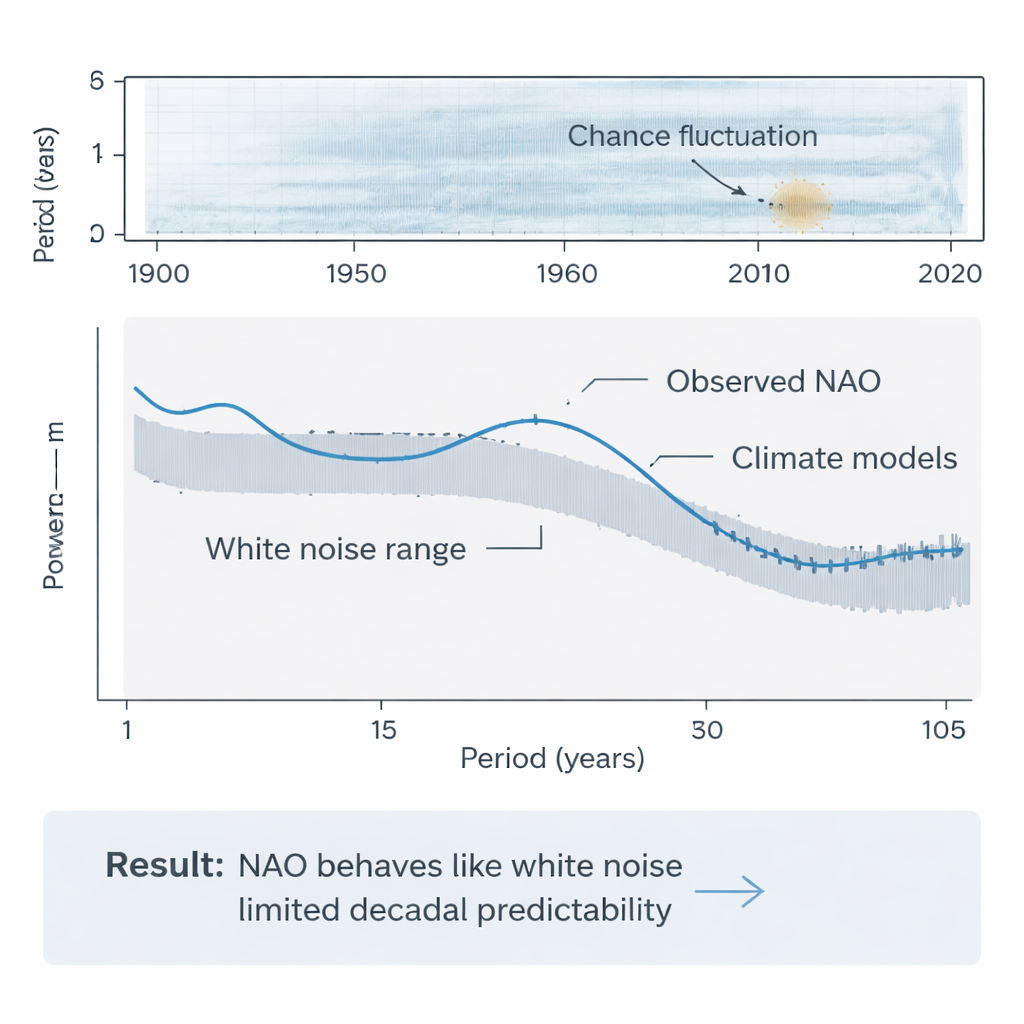
At first glance, the observed NAO and a white-noise series are surprisingly hard to tell apart, even after smoothing the data to emphasize decade-long swings. The researchers found that the often-mentioned 8-year bump in the NAO’s power spectrum does appear in the period after 1950—but not in earlier decades, and not consistently in models. When they looked at the entire range of timescales, the number of seemingly “special” frequencies in observations was no larger than one would expect purely by chance in white noise. Wavelet analyses, which track how power at different periods changes over time, likewise showed that the post‑1950 8‑year feature could easily be a random flare-up rather than a stable cycle.
What climate models say
The team then turned to a large CMIP6 climate-model ensemble: 215 simulations from 45 different models covering the historical period. If real decadal NAO structure existed and models captured it, some models or their ensemble average should show clear peaks at multi-year timescales. Instead, the model spectra were essentially flat—just like white noise—and only about 5 percent of model runs showed statistically unusual features, exactly what random chance would suggest. Tests of how one winter’s NAO value depends on previous winters also found no robust memory in either the observations or the models. Internal year-to-year randomness within each model was far larger than any systematic difference between models, implying that model physics adds little predictable structure to the NAO on these timescales.
Limits to long-range NAO forecasts
Putting all lines of evidence together, the authors conclude that the winter mean NAO is, to a very good approximation, white Gaussian noise on interannual and decadal scales. In plain terms, this means that knowing the NAO over the past few winters gives almost no help in predicting its value several years ahead; the best statistical forecast is basically a long-term average. While there may still be subtle physical connections to slower parts of the climate system or to random external shocks such as volcanic eruptions, these leave little trace in the winter-mean NAO itself. For now, this study suggests that hopes for highly skillful decade-ahead NAO predictions—and the detailed winter outlooks for Europe that would come with them—are likely to remain out of reach.
Citation: Christiansen, B., Yang, S. The winter mean NAO: white noise and predictability. npj Clim Atmos Sci 9, 53 (2026). https://doi.org/10.1038/s41612-026-01326-7
Keywords: North Atlantic Oscillation, climate variability, decadal predictability, white noise, Europe winter climate