Clear Sky Science · en
Breaking the link: warming disrupts early-season rainfall predictability in the Caribbean
Why this matters for Caribbean life
The Caribbean depends on predictable seasonal rains to fill reservoirs, grow food, and prepare for hurricanes. For decades, scientists and forecasters have relied on a simple rule of thumb: when nearby ocean waters warm past a certain point, early-season rains usually follow. This paper shows that in a warming world, that rule is starting to break down. The seas are hotter than ever, yet the early rains many communities count on are not arriving as expected.
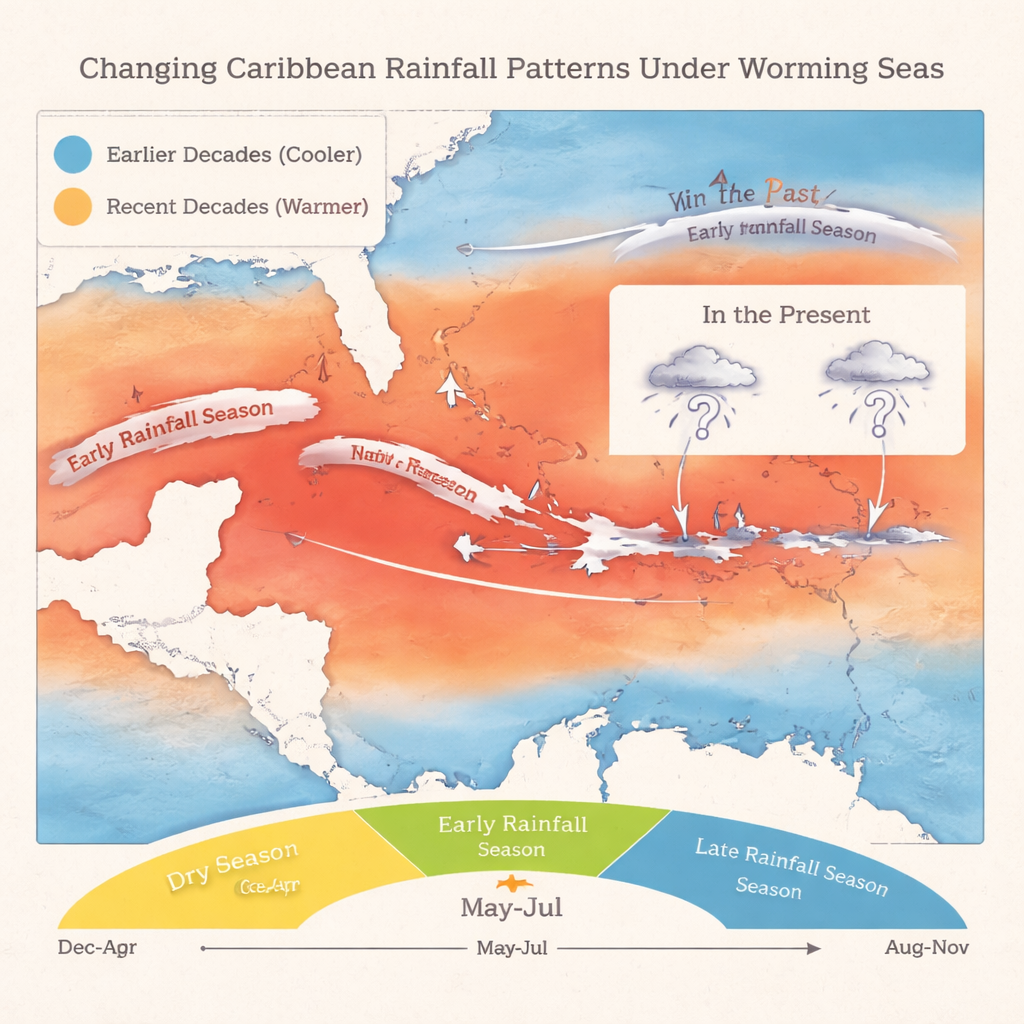
Old rule of thumb: warm seas, more rain
Traditionally, early rains from May to July have been closely linked to sea surface temperatures in the tropical North Atlantic. Once those waters passed a “convective threshold” of about 27–28 °C, the atmosphere tended to become unstable enough for tall storm clouds and steady rainfall to develop. This relationship let scientists use ocean temperature as a practical early-warning tool: warmer-than-usual seas in spring meant a good chance of more early rain, while cooler seas signaled a weaker season.
A new pattern: hotter water, weaker link
Using data from 1979 to 2024, the authors show that this relationship has weakened in recent decades. The Caribbean Sea has warmed steadily, and the threshold temperature is now reached earlier in the year. Yet rainfall at the start of the wet season has not increased; in many places it has even declined slightly. When the authors compared an earlier period (1979–2001) with a more recent one (2002–2024), they found that early-season rainfall used to rise sharply with warmer seas, but that link is now much weaker. The region appears to be shifting into a new regime where the ocean is almost always warm enough for storms, so changes in temperature alone no longer explain when or how much it rains.
A more stable sky and stronger trade winds
Why doesn’t extra warmth at the surface bring extra rain? The study finds that the air higher up in the atmosphere is also warming, in some places as fast or faster than the ocean. This extra warmth aloft makes the atmosphere more stable, like putting a lid on a pot of hot water. Measures of storm-fueling energy (called CAPE) are decreasing, while the energy barrier that must be overcome to start storms (CIN) is rising over much of the eastern Caribbean. At the same time, a key wind feature known as the Caribbean Low-Level Jet – a strong band of easterly trade winds – is becoming more persistent in the early season. These winds help bring in drier air and encourage sinking motion, both of which work against rainfall.
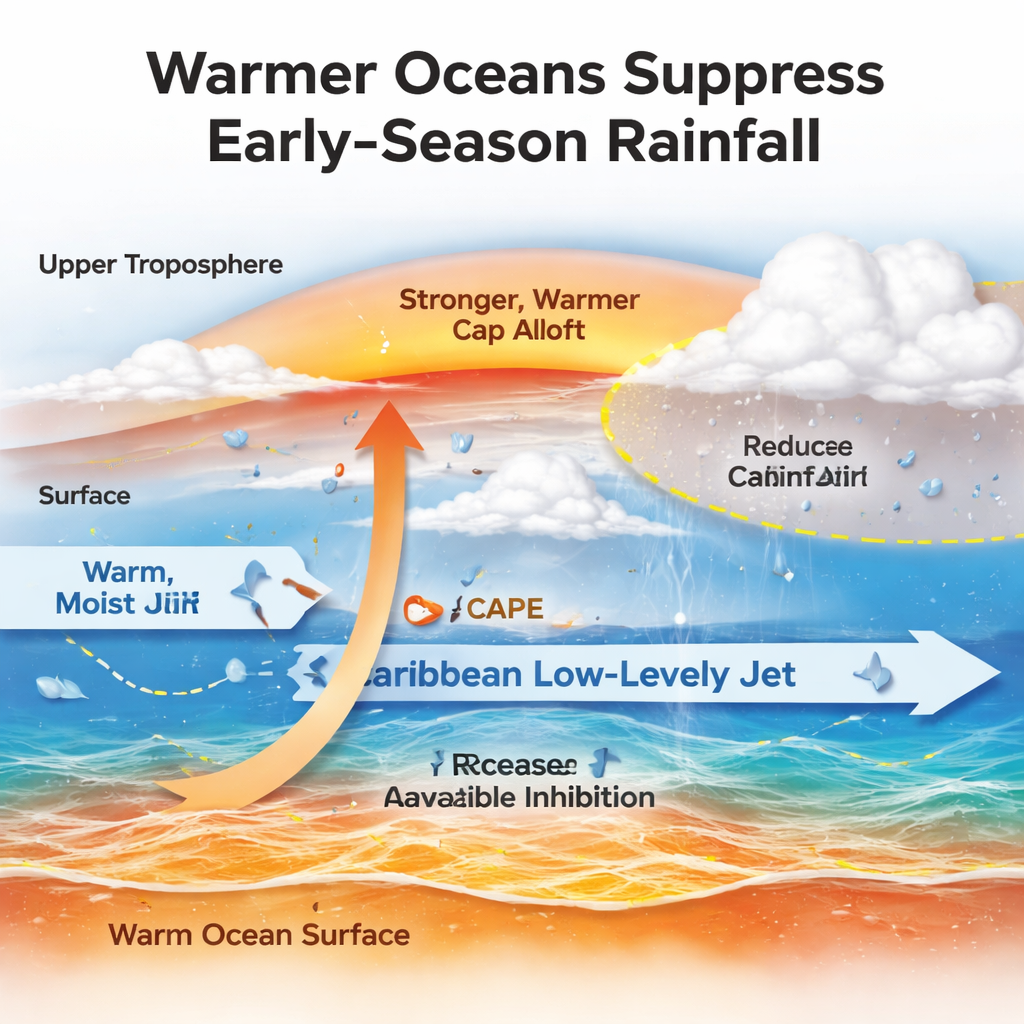
Shifting drivers of rain: winds and contrasts, not just warmth
The authors also show that other factors are taking over as better guides to early-season rainfall. One is the strength of the low-level jet itself, which now correlates more strongly with mid-level humidity and rain than simple sea temperature does. Another is “relative” sea surface temperature – how warm the Caribbean is compared with the nearby tropical Pacific. As the Atlantic has warmed and parts of the Pacific have cooled, these contrasts should favor rising air and rain over the Caribbean. Instead, the westward expansion of the North Atlantic subtropical high-pressure system is diverting moisture away from the eastern Caribbean, reinforcing dryness even over very warm seas.
What this means for people and planning
For farmers, water managers, and disaster planners across Caribbean small island developing states, the takeaway is clear: relying on fixed ocean temperature thresholds to predict early rains is no longer enough. The same warm waters that can fuel intense hurricanes like early-season Hurricane Beryl are no guarantee of the gentle, sustained rains needed to fill reservoirs and nourish crops. Forecasts will need to incorporate changing wind patterns, atmospheric stability, and temperature contrasts between ocean basins to remain useful. In a warming world, understanding these shifting patterns will be essential to safeguarding water security, food production, and resilience across the Caribbean.
Citation: Clarke, L.A., Jones, J.J., Taylor, M.A. et al. Breaking the link: warming disrupts early-season rainfall predictability in the Caribbean. npj Clim Atmos Sci 9, 52 (2026). https://doi.org/10.1038/s41612-026-01325-8
Keywords: Caribbean rainfall, sea surface temperature, climate change, early rainy season, trade winds