Clear Sky Science · en
Mechanisms driving altitude- and latitude-dependent air quality variations from high-altitude NOx emissions
Why High-Flying Planes Matter for the Air We Breathe
Most of us only notice airplanes when they roar overhead or show up on a ticket receipt. But what happens to the exhaust they leave behind, especially when jets cruise far above the clouds, can quietly change the air we breathe at ground level. This study tackles a simple but surprisingly overlooked question: how does the height and location of nitrogen oxide (NOx) emissions from aircraft and other high-altitude sources affect surface air quality, including ozone and harmful fine particles (PM2.5)? The answers are crucial as aviation grows and supersonic and space-related flights move higher into the atmosphere.
Two Types of Pollution with Very Different Health Effects
NOx gases, produced by engines, lightning, and industry, don’t just stay where they are emitted. Once in the air, they trigger chemical reactions that create or destroy ozone and form tiny particles we can inhale. Near the ground, ozone irritates lungs and worsens asthma, while PM2.5 penetrates deep into the body and is linked to heart and lung disease. Regulators already limit NOx from jet engines to protect air around airports, but those rules mostly assume normal subsonic cruising altitudes. This paper asks what happens when the same NOx is released not only at the usual 9–12 km but all the way up to 22 km, and in different latitude bands from the tropics to the poles.
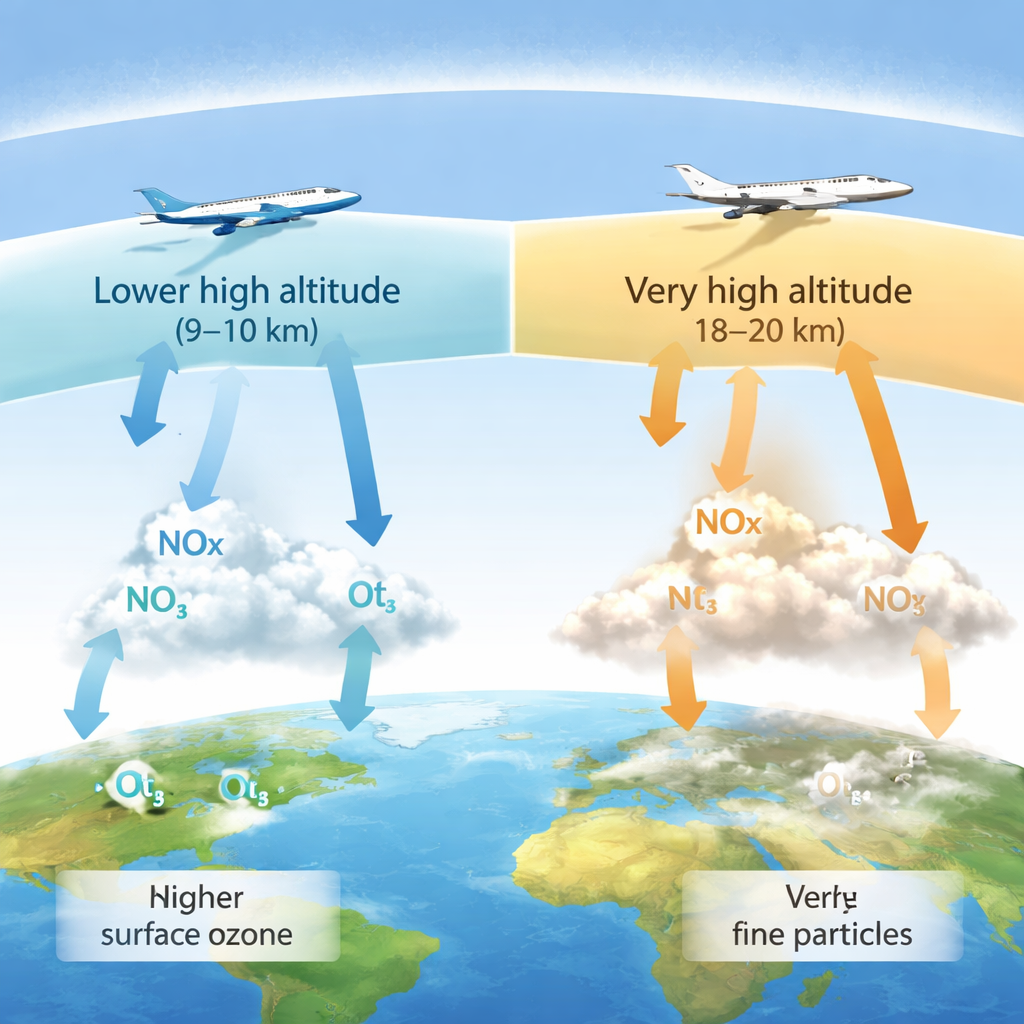
Low High-Altitude Flights Raise Ground-Level Ozone
Using a detailed global chemistry and transport model called GEOS-Chem, the authors simulated releasing the same amount of NOx (1 teragram of nitrogen per year) at many combinations of altitude and latitude. When NOx is emitted at 8–10 km over the mid-latitudes of the Northern Hemisphere (roughly over North America and Europe), it increases ozone in the upper troposphere. That extra ozone is gradually mixed downward, raising surface ozone worldwide. On a population-weighted basis, surface ozone rises by about 0.52 parts per billion, with especially strong increases over high terrain such as the Rocky Mountains and Tibetan Plateau, and over dry, low-NOx regions like the Sahara and nearby oceans where there is less local pollution to destroy incoming ozone.
Very High Flights Cut Ozone but Boost Harmful Particles
Above about 16 km, the picture flips. NOx emissions at 20–22 km cause a net loss of ozone high in the atmosphere, thinning the protective layer that normally screens out ultraviolet (UV) light. More UV then reaches the lower atmosphere, speeding up chemical reactions that both break apart ozone near the surface and create more aggressive oxidants. As a result, surface ozone actually falls—by about 1.7 parts per billion in population-weighted terms for high-altitude mid-latitude emissions—while fine particle levels surge. The model shows PM2.5 increases of about 310 nanograms per cubic meter, roughly nine times larger per unit of NOx than for typical subsonic cruise altitudes. Most of this extra PM2.5 is sulfate formed from sulfur dioxide (mainly emitted at the surface) that is more rapidly converted into particles in the stronger oxidizing environment created by added UV.
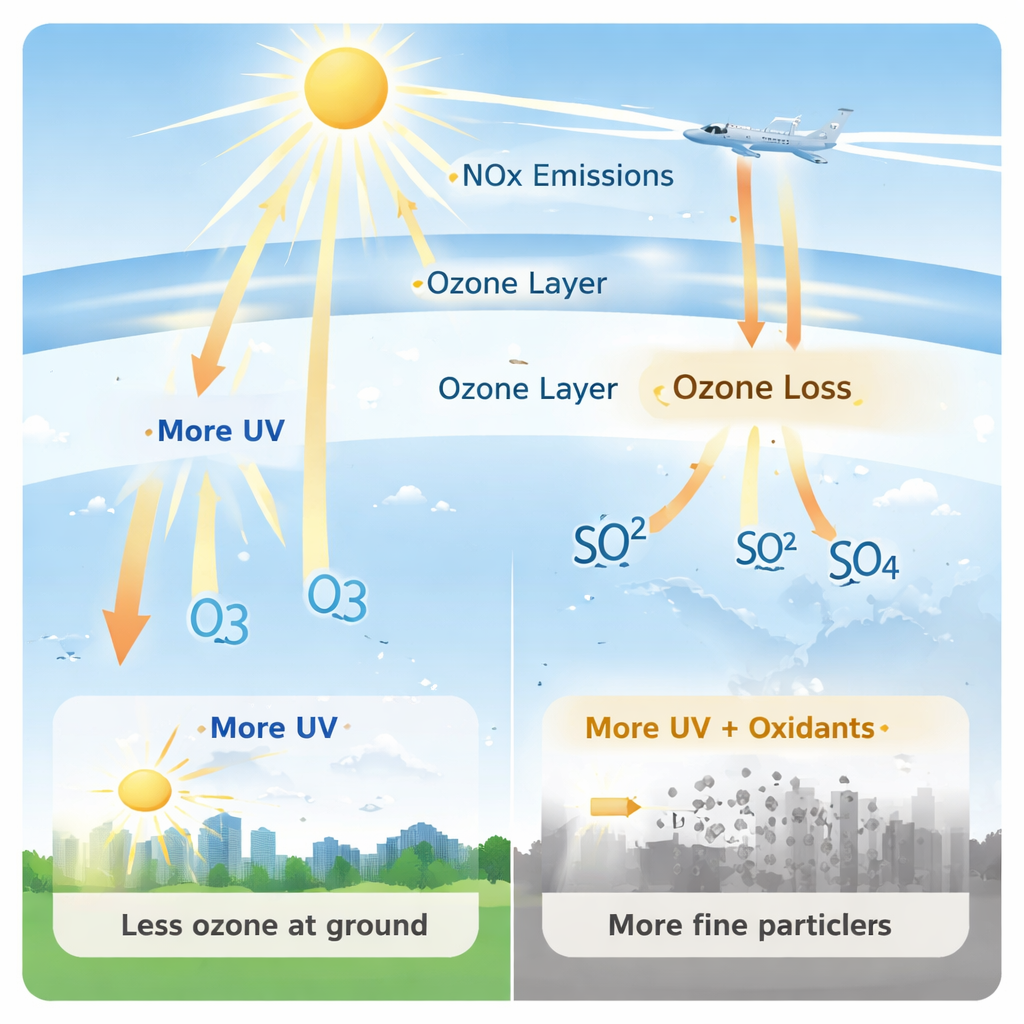
Where You Emit Matters as Much as How High You Fly
Latitude adds another twist. At lower altitudes, the same NOx released in the cleaner Southern Hemisphere creates more ozone than in the more polluted Northern Hemisphere, because the air is less saturated with NOx and chemistry is more efficient. However, population is concentrated in the Northern Hemisphere, so the health impact of a given emission there is larger even when chemical responses are smaller. For very high-altitude NOx, ozone losses and particle increases are strongest over the Northern Hemisphere, in part because starting ozone levels are higher and downwelling air has longer-lived ozone over oceans. This means planned shifts in aviation growth toward the Southern Hemisphere, the possible return of supersonic passenger jets, and increasing rocket and satellite activity could all alter global patterns of surface air quality in complex ways.
What This Means for Future Flight and Our Health
To a layperson, the core message is that “high-altitude exhaust is not all the same.” NOx from today’s subsonic jets tends to increase both ground-level ozone and some particles, while NOx from much higher-flying craft—such as future supersonic planes or rockets—can reduce surface ozone but strongly increase harmful fine particles by altering sunlight and chemistry throughout the atmosphere. Current engine rules, designed around conventional flight levels, do not fully capture these altitude-dependent effects. The study suggests that future policies may need to regulate not only how much NOx aircraft emit, but also where and how high they fly, and to consider the role of surface sulfur emissions in shaping particle pollution triggered by high-altitude activities.
Citation: Oh, L.J., Eastham, S.D. & Barrett, S.R.H. Mechanisms driving altitude- and latitude-dependent air quality variations from high-altitude NOx emissions. npj Clim Atmos Sci 9, 54 (2026). https://doi.org/10.1038/s41612-026-01324-9
Keywords: aviation emissions, high-altitude NOx, surface ozone, fine particulate matter, supersonic aircraft