Clear Sky Science · en
Confidence-calibrated federated graph attention for internet of things agents under latency SLOs
Smarter Networks for Life-Saving Devices
Connected medical gadgets—from hospital monitors to home wearables—are becoming the silent guardians of our health. They spot irregular heartbeats, strange traffic on hospital networks, or failing sensors before people notice. But when these devices raise an alarm, the network must react both correctly and within a fraction of a second. This paper introduces a new way to coordinate many such devices so that their warnings are not only accurate, but also honest about their own uncertainty and fast enough to meet strict response-time promises.
Why Medical Devices Need Both Brains and Nerves
The authors focus on the Internet of Medical Things, where countless devices watch patients and hospital equipment in real time. In this world, a software mistake or a slow response can mean missed alarms or unnecessary shutdowns. Traditional approaches to training models across many devices—known as federated learning—help protect privacy by keeping raw data on each device. However, they often struggle with unreliable network links, uneven data quality, and a lack of insight into how much the models truly “trust” each decision. Existing graph-based models, which are good at capturing relationships between devices, and modern intent-based networking, which turns high-level goals into network actions, have mostly been studied separately.
A Closed Loop from Sensors to Automatic Action
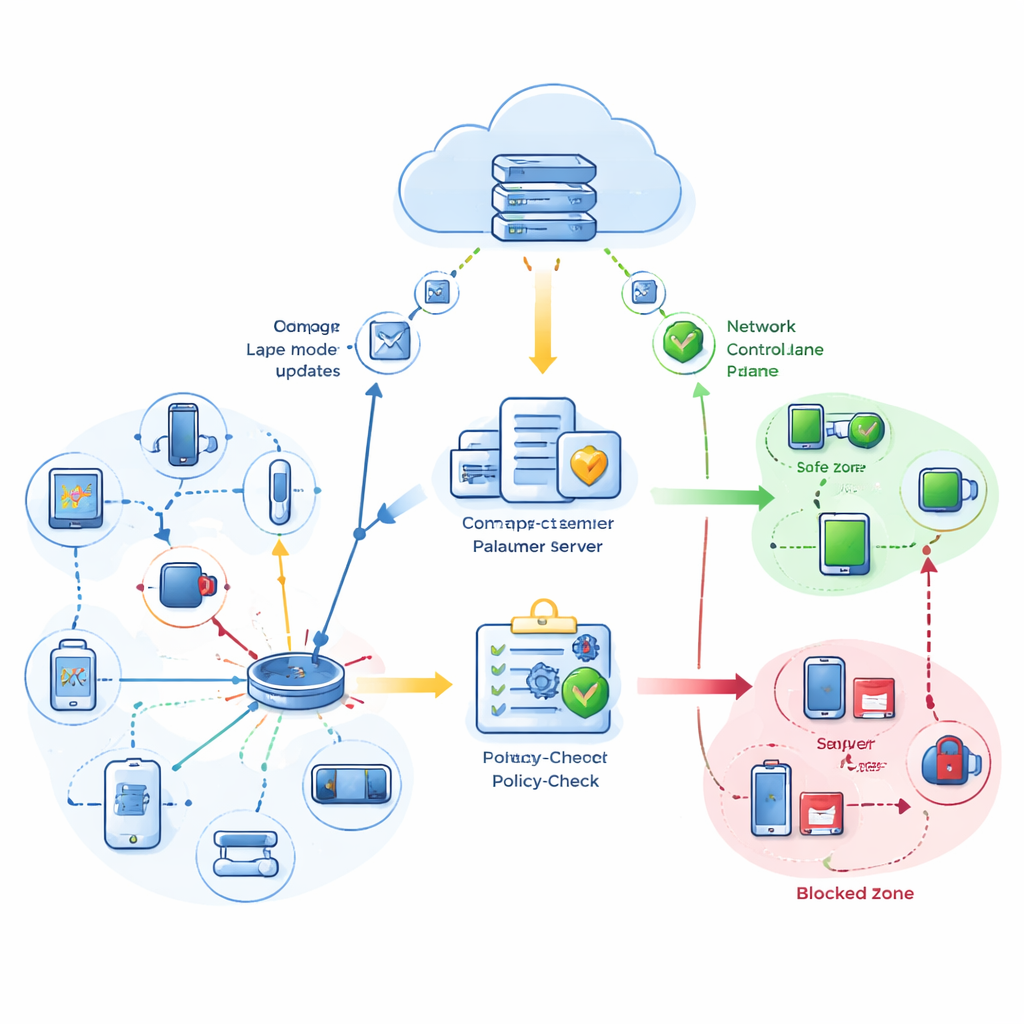
The proposed system, called HP-FedGAT-Trust-IBN, ties these pieces into one continuous control loop. At the edge of the network, nearby to sensors and actuators, a graph-based model looks at how devices are connected and how they behave together. It assigns attention and trust scores to each connection, effectively asking, “Which neighbors should I listen to, and how sure am I?” Instead of sending full models over the network, each device ships compact updates plus a few trust statistics to the cloud, greatly reducing bandwidth. In the cloud, a secure aggregation step combines these updates, giving more weight to devices judged to be more trustworthy or less uncertain.
Turning Confidence into Safer Decisions
What makes this framework distinctive is that it treats confidence—not just accuracy—as a first-class signal. The model is trained to ensure that when it says it is highly sure about a prediction, that confidence is usually justified. These calibrated confidence scores then drive an intent-based network controller. Before any network rule is applied—such as isolating a suspect device, limiting its traffic, or moving it to a protected slice—the intent layer checks both the model’s suggested action and how confident it is. Decisions that pass these checks are enforced automatically, while borderline cases can be slowed, queued, or routed for human review. This connection between confidence and scheduling helps keep the rare, slowest responses within promised limits like 50 or 100 milliseconds.
Proving It Works on Real Hardware
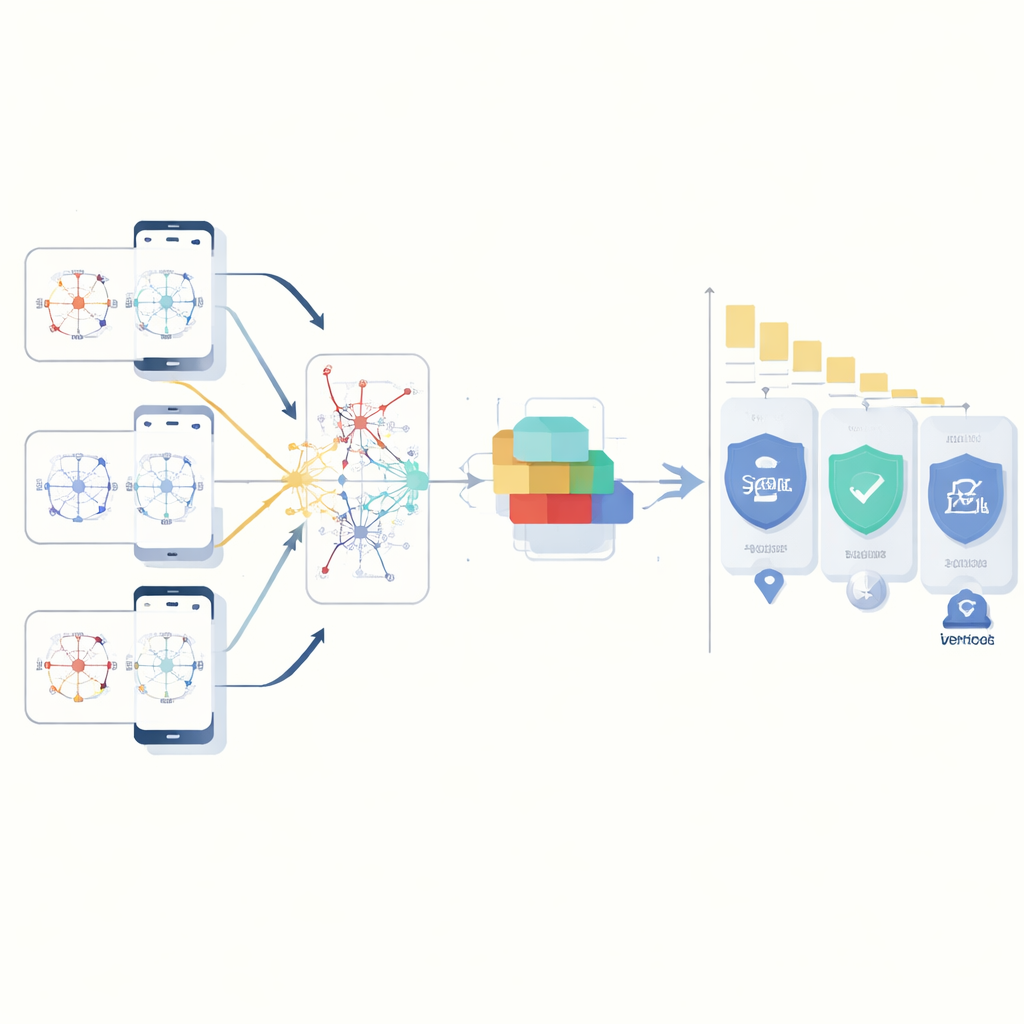
To show that their ideas hold up outside simulations, the authors run a two-part evaluation. First, they simulate 100 virtual clients drawn from several medical and wearable data sets, comparing their method to modern competing systems. Their approach achieves very high ability to distinguish normal from abnormal behavior while keeping its confidence well aligned with reality. Second, they export the trained models to real edge devices, including a Raspberry Pi and a small industrial computer, and measure complete “sensor-to-action” times. Even after counting all extra work for uncertainty estimates and encryption options, the system keeps the slowest one percent of responses well under 100 milliseconds, and it does so while using limited communication, energy, and carbon budget per training round.
What This Means for Everyday Patients
In plain terms, this work outlines how future medical networks can be both cautious and quick. Devices learn together without sharing raw medical data, they explain how much they trust their own alerts, and the network only acts automatically when that trust is warranted and can be enforced on time. By measuring not just accuracy but also honesty about uncertainty, energy use, privacy protections, and worst-case delays, the framework offers hospitals and health providers a practical blueprint: choose settings that keep patients safe, protect their data, and still meet strict response-time obligations.
Citation: Yang, D., Liu, B., Wan, L. et al. Confidence-calibrated federated graph attention for internet of things agents under latency SLOs. Sci Rep 16, 10792 (2026). https://doi.org/10.1038/s41598-026-45662-3
Keywords: internet of medical things, federated learning, graph neural networks, network latency, trust and uncertainty