Clear Sky Science · en
Comparative behavior of steam turbine model for dynamical power system analyses by means of multiple fractional and artificial neural network techniques
Why this matters for everyday energy use
Electricity from many power plants still comes from steam turbines—machines that spin when high‑pressure steam rushes past metal blades. How well we understand and control these turbines affects fuel use, electricity prices, and even how often plants must shut down for repairs. This study asks a simple but important question: can we build smarter mathematical and computer‑based models of steam turbines that capture their real behavior more faithfully, so that plants can run more efficiently and more reliably?
From boiling water to spinning shafts
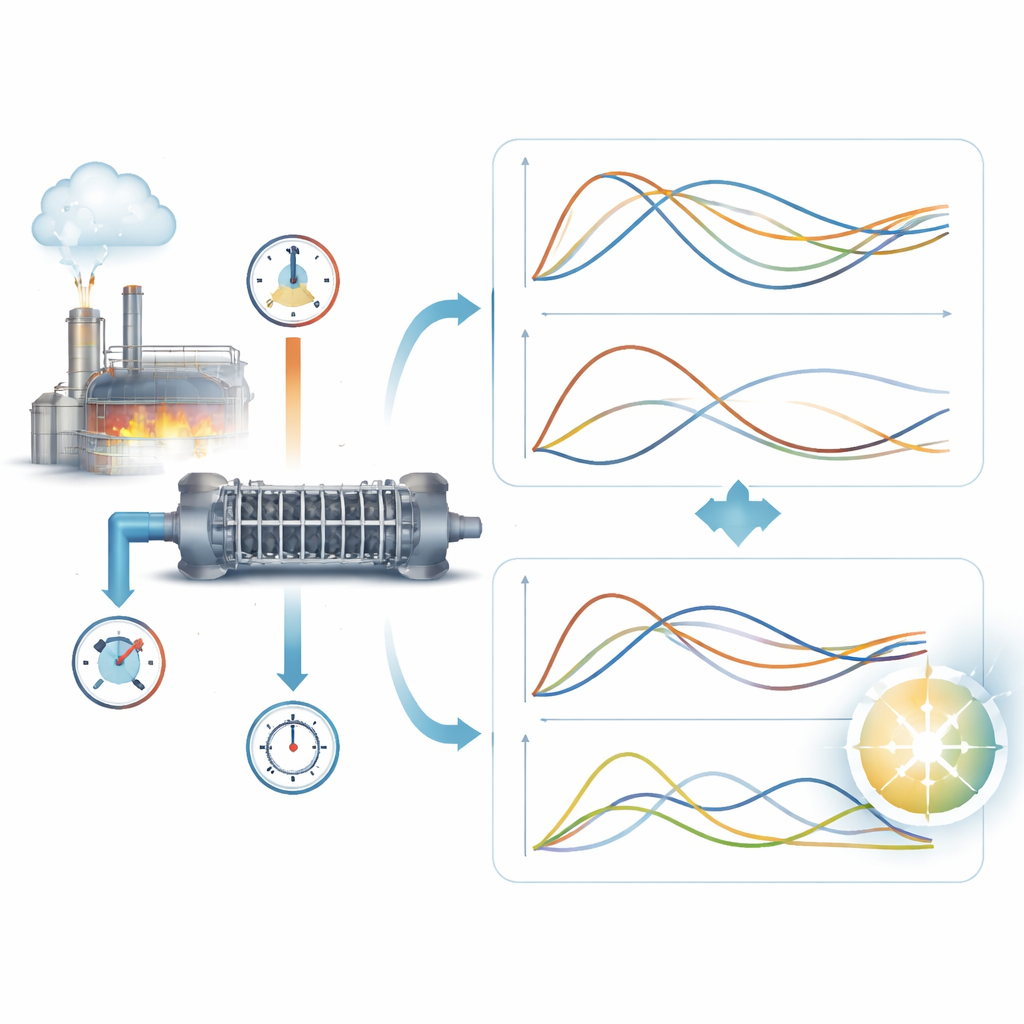
A steam turbine turns heat from steam into spinning motion that drives a generator. In many engineering studies, turbines are represented by fairly simple equations that relate how much steam flows in and out, how pressure changes, and how much power is produced. These traditional models assume that the turbine reacts instantly to changes, without much “memory” of its past. The authors begin by revisiting a standard equation that connects changes in steam mass inside the turbine to inlet and outlet flows and pressure. This basic relationship is then used as the backbone for more advanced descriptions of how the turbine responds over time.
Adding memory to the machine’s math
Real materials and flows often react in a way that depends not just on current conditions, but also on what happened a short while ago—much like how a hot pan cools more slowly if it was heated for a long time. To capture this kind of history dependence, the researchers turn to a family of tools called fractional calculus. Instead of using only ordinary derivatives, they reformulate the turbine equation with four different types of fractional derivatives, each representing a different way that past states can influence the present. For each case, they derive so‑called transfer functions—formulas that describe how the turbine output responds to a change at the input—using two powerful transform methods that convert the time‑based equations into more manageable algebraic forms.
Teaching a neural network to mimic the turbine
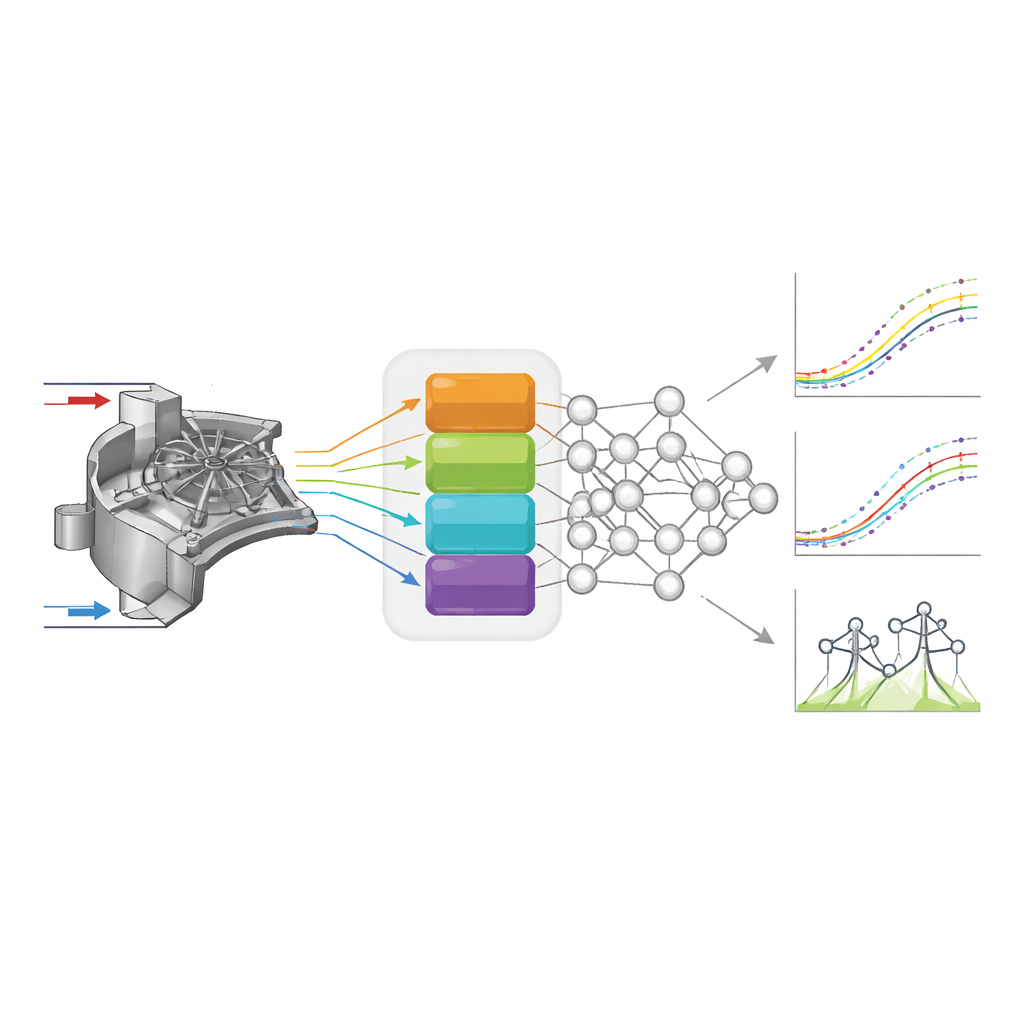
Equations alone do not tell the whole story, especially when data from a real turbine are available. The team therefore builds an artificial neural network—a computer model loosely inspired by the way neurons connect in the brain—to learn how turbine output depends on several key quantities at once. These include steam pressure, flow rate, operating time, and the fractional and “fractal” parameters that control how strong the memory effects are in the new models. Using a standard training method and a popular activation rule, the network is fed a large set of synthesized operating conditions and outcomes. It is then trained, validated, and tested to see how well it predicts the ratio of turbine output to input, a measure of dynamic performance.
What the comparisons reveal
With both the fractional equations and the neural network in hand, the authors compare how different modeling choices behave across a range of pressures, flow rates, and operating times. They find that when the memory strength (the fractional parameter) is low, the turbine response tends to show strong oscillations—signs of less stable behavior. As this parameter increases, the response becomes smoother and more stable. Extra geometric complexity, captured by a “fractal” parameter, can introduce irregular swings at higher pressures, hinting at conditions where the turbine might be harder to control. Overall, certain combinations of fractional operators and transform techniques give more favorable, stable responses than the traditional, memory‑free model.
Sharper predictions and a unifying picture
The neural network’s performance serves as a reality check on the math. Measures of error between predicted and target values remain very small, and the predicted outputs line up closely with the targets across training, validation, and test data sets. This indicates that the combined fractional‑plus‑neural‑network framework can track turbine behavior with high accuracy under many operating scenarios. When the fractional orders are set back to ordinary values, all the advanced models collapse to the classical turbine description, showing that the new approach is a true extension rather than a replacement. In plain terms, the study shows that giving the turbine model a “memory” and letting a data‑driven network fine‑tune it can offer power plant operators more reliable tools for squeezing extra efficiency and stability out of existing machinery.
Citation: Abro, K.A., Souayeh, B. & Flah, A. Comparative behavior of steam turbine model for dynamical power system analyses by means of multiple fractional and artificial neural network techniques. Sci Rep 16, 10882 (2026). https://doi.org/10.1038/s41598-026-45449-6
Keywords: steam turbine modeling, fractional calculus, neural networks, power plant dynamics, energy efficiency