Clear Sky Science · en
Environmental noise exposure in schools in São Paulo, Brazil: potential noise sources and health impacts among teachers
Why the sound around schools matters
Most of us picture schools as lively but safe places, yet few stop to think about how loud they can be. In a huge city like São Paulo, Brazil, teachers spend their days surrounded by traffic, playground shouts, and echoing classrooms. This study asks a simple but important question: are these everyday sounds just part of the job, or are they quietly harming teachers’ health and wellbeing? By carefully measuring noise around several public preschools and comparing it with teachers’ own reports of health, sleep, and stress, the researchers show that the soundscape of a school is more than a nuisance—it can shape how healthy teachers feel.
Listening to schools from the outside in
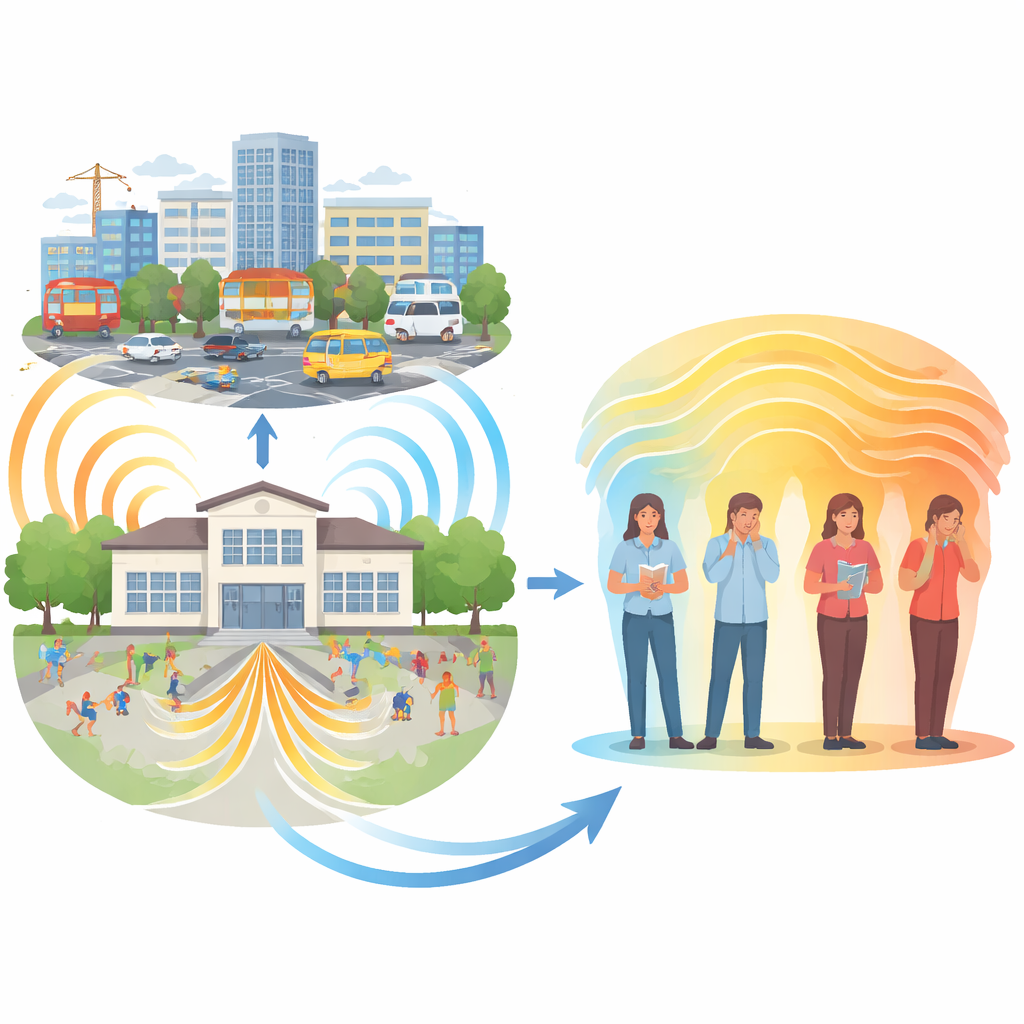
The research team focused on seven public schools in the western part of São Paulo, a fast-growing, traffic-heavy region. Instead of briefly checking noise once or twice, they installed calibrated sound meters outside the most exposed walls of each school and recorded sound levels continuously over an entire week. They zoomed in on typical school hours—from 7 a.m. to 7 p.m.—and looked at both average noise throughout the day and the loudest peaks. At the same time, 85 teachers filled in detailed questionnaires about how sensitive they were to noise, how annoyed they felt by different sounds, and how they rated their own health, sleep quality, and sense of wellbeing.
What makes school environments so loud
The measurements revealed that the schools were not just a bit noisy—they were consistently louder than health guidelines recommend. On school days, typical outdoor sound levels around the buildings reached about 70 decibels, with short bursts climbing into the mid-90s, levels considered potentially harmful over time. Some of this noise came from within the schools themselves: every extra 50 students was linked to an increase of more than 3 decibels in average noise. Outside the gates, nearby restaurants, shops, and other busy spots tended to push levels even higher. Traffic patterns were more complex; a school hemmed in by several roads was not always the loudest, suggesting that distance from streets, building design, and nearby parks or green areas can either intensify or soften the noise that reaches classrooms.
How constant noise reaches teachers’ minds and bodies
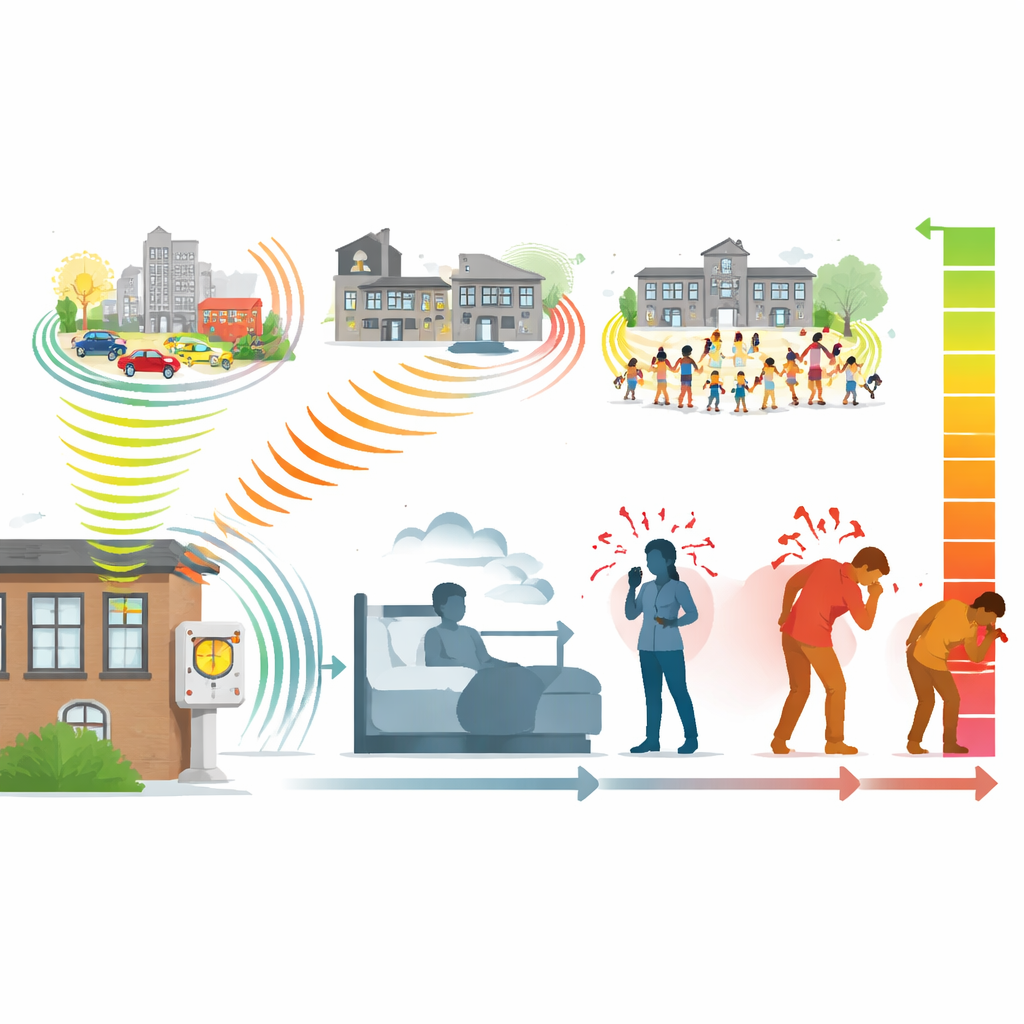
The teachers’ answers paint a human picture that matches the meter readings. Nearly half reported being strongly bothered by children’s shouting and off-topic chatter, about a third by road noise, and another third by neighboring schools. More than 60 percent saw themselves as highly sensitive to noise while at work. On average, teachers in their forties and fifties reported the worst health indicators. When the researchers combined sound data with these responses, they found that a 10-decibel rise in average daytime noise was linked to more than four times higher odds that a teacher would rate their own health as fair or poor rather than good. Higher noise was also tied to stronger feelings of noise sensitivity, more annoyance from children’s loud behavior, and signs of disturbed sleep, echoing past research that connects environmental noise with stress, heart problems, and mood disorders.
Why this matters beyond one city
Although the sound measurements were taken outside, not inside, the buildings, the study treats noise as a shared condition that affects everyone working in the school. The participating schools lacked sound insulation and relied on open windows for cooling, making it easy for traffic and playground din to spill into classrooms and staff rooms. Because similar conditions are common in many low- and middle-income cities, the findings offer a warning that goes far beyond these seven schools. They show that school noise is not just an annoyance to be endured, but a modifiable part of the work environment that can influence sleep, stress, and how healthy teachers feel.
Turning down the volume for healthier schools
In simple terms, the study concludes that many teachers in São Paulo are working in noise levels that are too high, and that this is linked to worse self-rated health, poorer sleep, and greater sensitivity and irritation. The loudness comes from both inside and outside the school, meaning solutions must be broad: better building design and soundproofing, smarter urban planning around schools, and classroom practices that help keep noise in check. By treating the acoustic environment as part of basic school infrastructure—much like lighting, air quality, or safety—cities can protect teachers’ wellbeing and create calmer spaces that benefit both those who teach and those who learn.
Citation: de Andrade, C.Q., Vincens, N., Nardocci, A.C. et al. Environmental noise exposure in schools in São Paulo, Brazil: potential noise sources and health impacts among teachers. Sci Rep 16, 9979 (2026). https://doi.org/10.1038/s41598-026-45322-6
Keywords: school noise, teacher health, urban sound environment, sleep and wellbeing, São Paulo schools