Clear Sky Science · en
Cannabis intoxication does not impair eyewitness recall with the Sketch Cognitive Interview but increases confidence in lineup errors
Why this matters for everyday justice
As cannabis becomes more common in many countries, police are increasingly likely to encounter witnesses who are high when a crime happens or when they are later questioned. Courts often treat intoxicated eyewitnesses as unreliable, but this study asks a more precise question: if investigators use a careful, evidence-based interview technique that lets witnesses draw what they remember, do cannabis users actually give worse accounts of what they saw, and how sure should we be about their later identifications of a suspect?
What the researchers set out to test
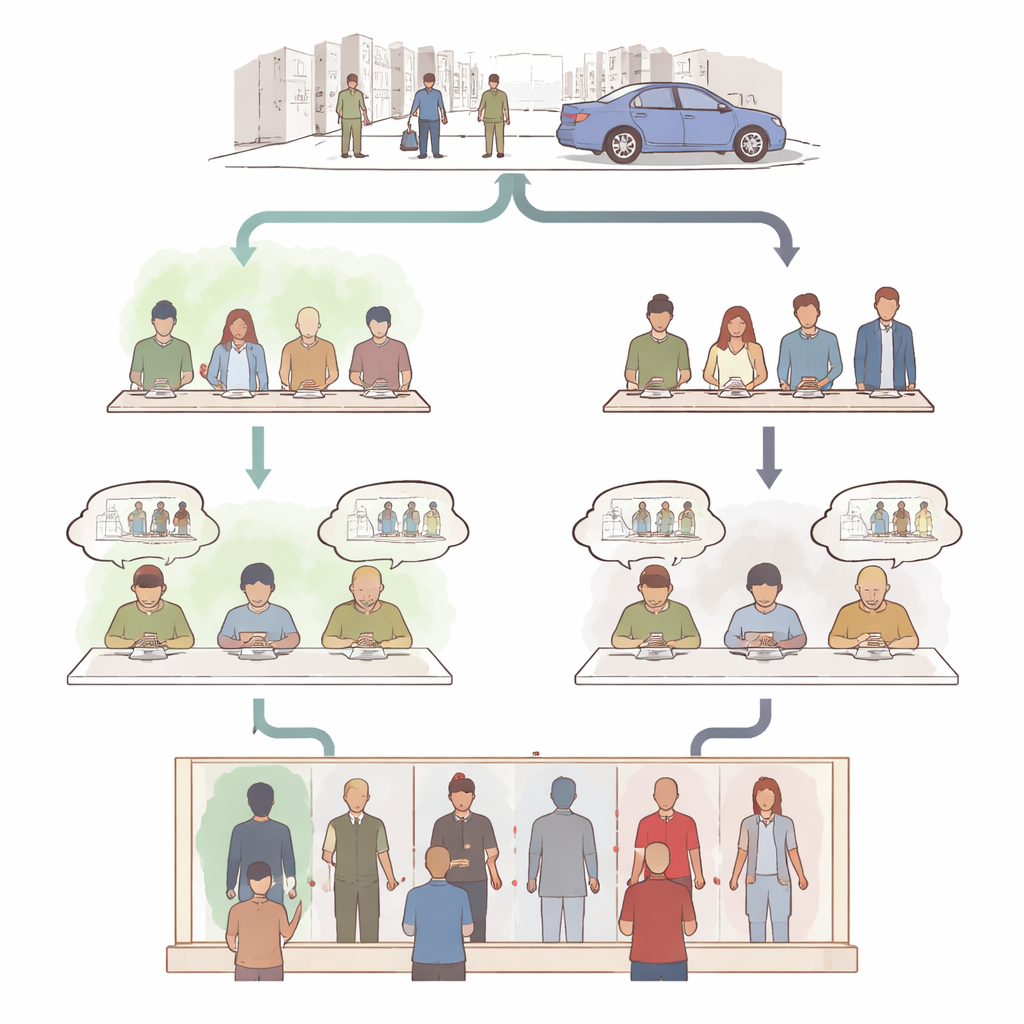
The team recruited 131 adults and divided them into four groups: regular cannabis users who were high while watching a mock crime and high again during questioning, users who were sober during the crime but high only during questioning, regular users who stayed sober throughout, and non-users who also stayed sober. Everyone watched a short video of a theft, then took part in a structured “sketch” interview over video call. Later, they faced three police-style lineups that did not actually contain the real culprit, giving the researchers a safe way to see who would mistakenly pick an innocent person.
How the sketch interview technique works
Instead of simply asking people to tell the story from memory, interviewers used the Sketch Cognitive Interview. First, they built rapport and set simple ground rules like “report everything” and “don’t guess.” Then participants drew the crime scene while talking through what they were sketching. This drawing phase is designed to help people recreate the sights and layout of the event without complicated mental instructions. Afterward, witnesses gave a free-flowing verbal account, and interviewers followed up with open prompts about topics the witness had already mentioned. The method aims to gently support memory without leading questions.
What they found about memory for the crime
When the researchers counted how many correct details, incorrect details, and entirely made-up elements each person reported, a striking pattern emerged: the four groups did not differ significantly. Whether participants were high at the time of the crime, high only during the interview, sober users, or non-users, they recalled similar amounts of information, with similar accuracy and completeness. Advanced statistical checks even suggested the data better fit a “no difference” explanation than one in which cannabis condition changed recall. However, the story changed when the researchers looked at how high individual participants felt. People who rated themselves as more intoxicated tended to remember fewer correct details, provide less complete accounts, and in some cases make more errors.
What they found about suspect lineups
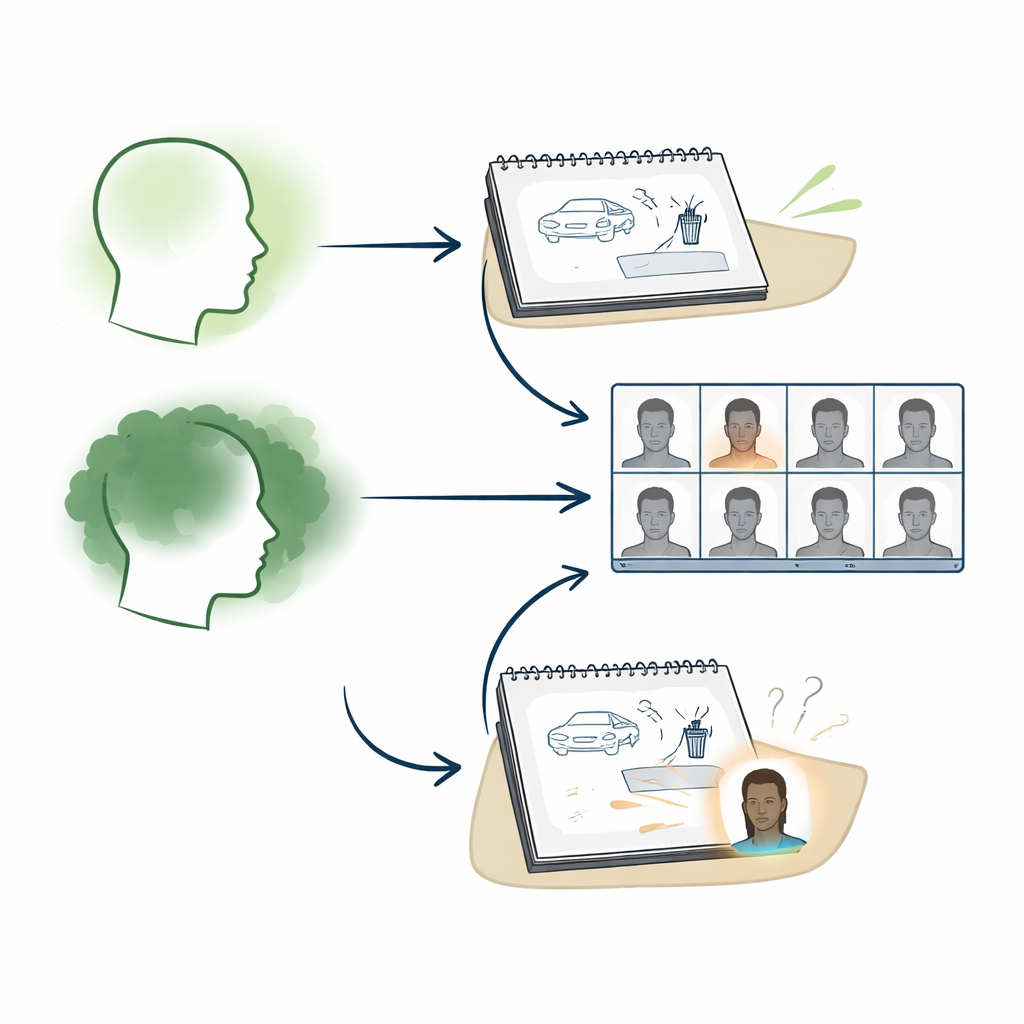
In the lineup phase, participants were asked three times to decide whether a pictured person was the culprit, even though the real perpetrator was never present. Overall, the rate of correct decisions (rejecting the lineup) did not clearly differ between the four groups. But confidence did: those who had been high both when watching the crime and when later questioned were noticeably more confident when they made a wrong choice in the lineup than sober users and non-users were. In other words, being high across both stages did not necessarily make people choose the wrong face more often, but when they were wrong, they tended to feel more sure of themselves.
What this means for real-world cases
For lay readers and legal practitioners, the findings carry a mixed message. On one hand, an interview built around drawing, open questions, and strong rapport may help cannabis-using witnesses provide accounts that are about as detailed and accurate as those from sober people, at least shortly after a clear, simple event. On the other hand, how high a person feels still matters: greater subjective intoxication was linked to weaker memory, and witnesses who were high throughout were especially overconfident when they misidentified someone in a lineup. The study suggests that rather than dismissing all “highwitnesses,” police and courts should focus on using supportive interview methods while treating their identification confidence with extra caution, especially when the person reports feeling very intoxicated.
Citation: Kloft-Heller, L., Junk, A., Dando, C.J. et al. Cannabis intoxication does not impair eyewitness recall with the Sketch Cognitive Interview but increases confidence in lineup errors. Sci Rep 16, 10203 (2026). https://doi.org/10.1038/s41598-026-45069-0
Keywords: cannabis intoxication, eyewitness memory, cognitive interview, police lineups, false identification