Clear Sky Science · en
Application of a two-dimensional phase unwrapping algorithm to lubricant film thickness measurement
Why the Hidden Life of Oil Films Matters
Every time a car engine turns over or a wind turbine spins, metal parts slide and roll against each other separated only by a microscopic layer of oil. This ultra-thin film is all that stands between smooth motion and destructive wear. Measuring the shape and thickness of that film in real time is surprisingly difficult: the structures are nanometers thick and constantly changing. This paper presents a new image-processing method that reads subtle light patterns to map these invisible oil films more accurately and reliably, even under noisy, real-world conditions.
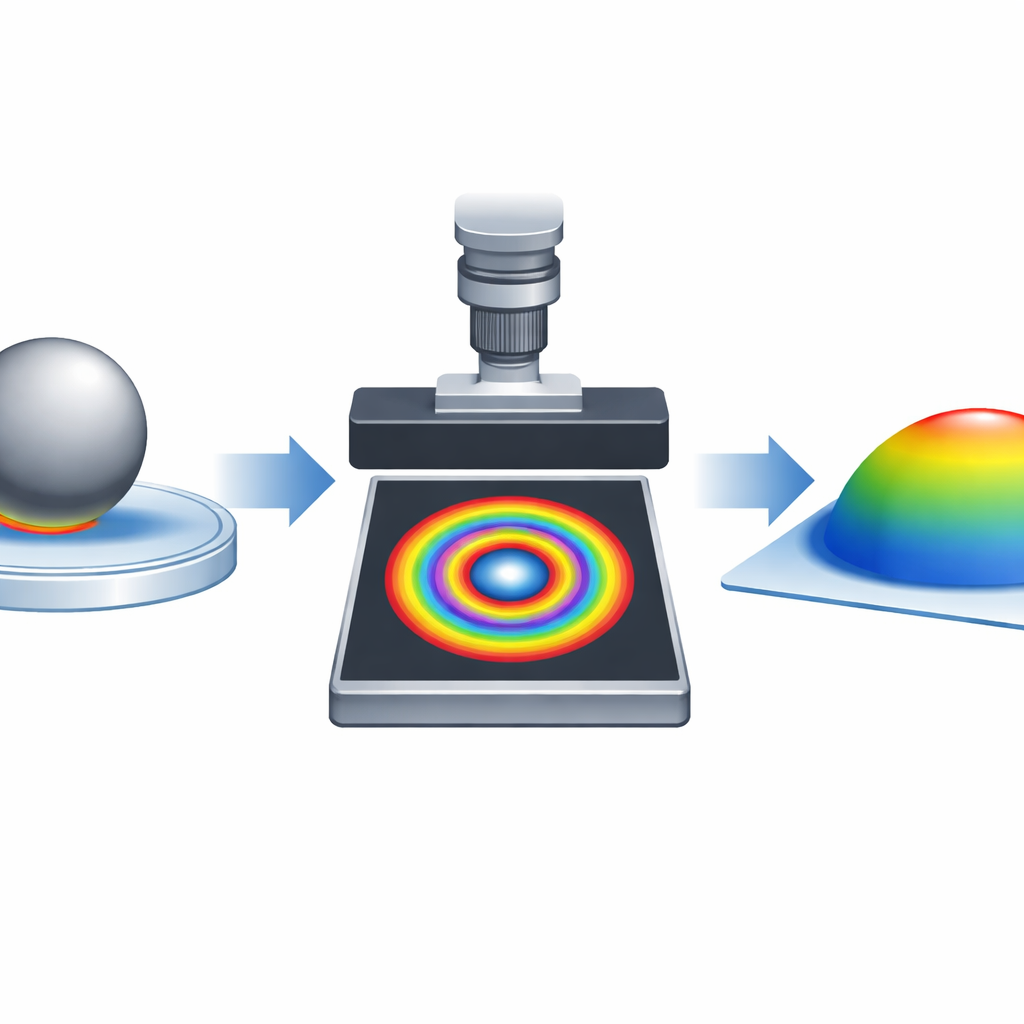
Seeing Thickness with Colored Rings of Light
The study builds on a classic optical trick: shining white light through a glass disk, a thin layer of lubricant, and a steel ball pressed together. Light reflecting from the top and bottom of the oil layer interferes with itself, producing colored rings similar to those seen in soap bubbles. The exact color and brightness at each point depend on how far the light has traveled, which in turn depends on the local thickness of the oil film. A microscope and camera capture these colorful patterns, creating an image where color encodes thickness—if that color information can be decoded correctly.
From Color Maps to Clean Height Profiles
To turn colors into thickness, the authors first convert the image into a hue map, isolating the dominant color at each pixel. Hue behaves like an angle that wraps around every full cycle, much like the hand of a clock. This “wrapped” angle changes smoothly where the film is smooth, but it jumps abruptly whenever it crosses its maximum value. A process called phase unwrapping is needed to convert these wrapped angles into a continuous landscape that reflects the true oil-film profile. Conventional unwrapping methods struggle when the image is noisy, edges are blurred, or the film’s shape changes rapidly—exactly the conditions found in practical lubrication tests.
Teaching the Algorithm What to Trust
The heart of the work is an improved unwrapping strategy built on a known method called SRNCP, which unwraps the image by following a path through the most reliable pixels first. The key innovation is a new way to judge which pixels are trustworthy. Instead of looking only at how quickly the phase appears to change from pixel to pixel, the authors also estimate the local noise level in a small neighborhood. They combine both pieces of information into a composite “quality map” that favors regions where the underlying pattern is smooth and the noise is low. The algorithm then builds its unwrapping path by connecting pixels along the most reliable edges, avoiding degraded areas until later and greatly reducing error spread.
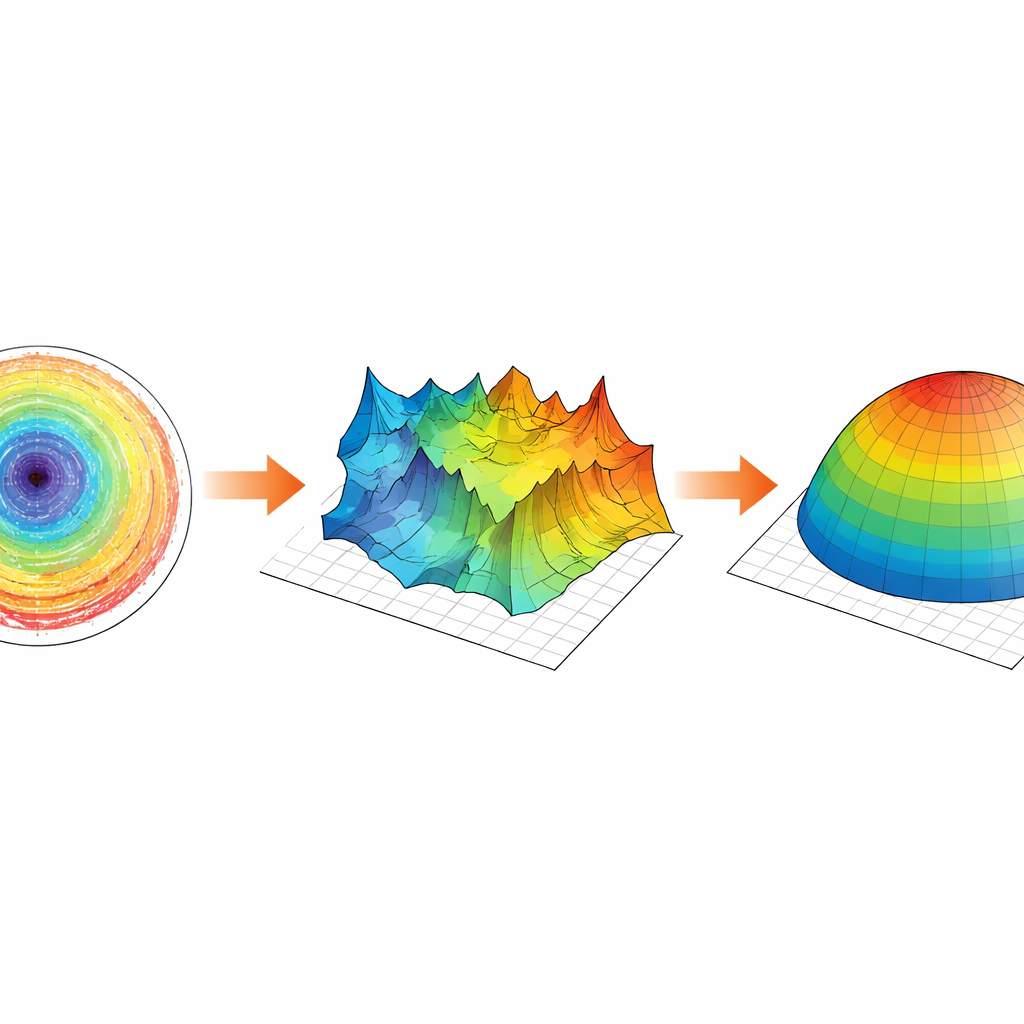
Proving It Works in the Lab
The researchers validate their method in several stages. On simulated images where a noisy patch is deliberately added, the new approach recovers a smooth three-dimensional phase surface with far fewer errors than four widely used alternatives, and it does so more quickly. On real interferometric images taken from a custom-built microscope setup, the improved algorithm unwraps a larger usable area, produces smoother phase maps, and shows far fewer false jumps. When these unwrapped phases are converted into oil-film thickness and compared with predictions from Hertzian contact theory, the new method achieves the smallest deviations and the best agreement with the expected shape of the contact zone, including the maximum film thickness and the detailed profile in the center of the contact.
What This Means for Machines and Measurements
In plain terms, the study delivers a more reliable way to read the “fingerprints” that light leaves when it reflects from a microscopic oil film. By being smarter about which parts of the image to trust and in what order to process them, the algorithm can reconstruct the three-dimensional thickness of the lubricant layer with higher accuracy and fewer artifacts, even when the machine is moving faster and the images are blurrier. This makes it easier for engineers and researchers to monitor how oil films form, evolve, and sometimes fail inside real mechanical systems, supporting better designs, longer-lasting components, and more efficient use of energy.
Citation: Xie, L., Li, Z. & Lin, L. Application of a two-dimensional phase unwrapping algorithm to lubricant film thickness measurement. Sci Rep 16, 10745 (2026). https://doi.org/10.1038/s41598-026-44783-z
Keywords: lubricant film thickness, optical interferometry, phase unwrapping, elastohydrodynamic lubrication, image reconstruction