Clear Sky Science · en
Bicarbonate buffer enhances functional sperm selection compared to Zwitterionic buffers in sperm preparation
Why the Right Lab Fluid Matters for Fertility Treatment
When couples turn to fertility clinics for help conceiving, much of the work happens in the lab, where sperm are carefully prepared before being used in treatments such as in vitro fertilization or insemination. This study asks a deceptively simple question with big practical consequences: does the type of fluid used to wash and select sperm in the lab change how well those sperm are likely to perform? The answer, the researchers find, is yes—and a common, body-like ingredient called bicarbonate appears to give sperm a clear edge over popular synthetic alternatives.
Setting the Stage in the Fertility Lab
Inside an assisted reproduction laboratory, sperm must be handled outside the body, where they are vulnerable to changes in acidity, temperature, and other stresses. To keep conditions stable, technicians use “buffers” in the liquid that surrounds sperm. Bicarbonate is a natural component of reproductive fluids in both men and women and is known to help prepare sperm for fertilizing an egg. However, bicarbonate’s behavior depends on carbon dioxide, which can be hard to control when samples are handled outside specialized incubators. To make life easier at the bench, many clinics rely on synthetic “zwitterionic” buffers such as HEPES and MOPS, which hold the acidity level steady without needing carbon dioxide—but may not be as friendly to living cells.
How the Researchers Compared Lab Fluids
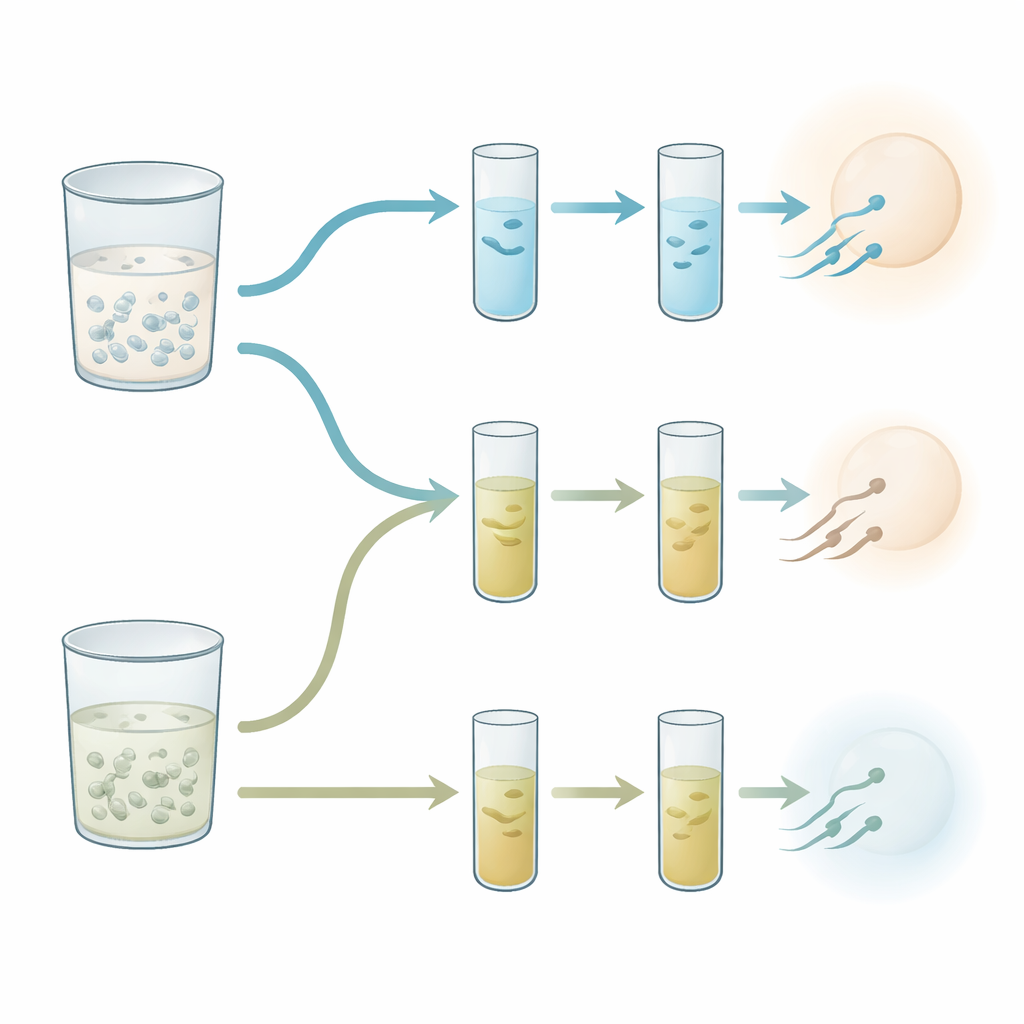
The team studied semen from 54 men attending a fertility clinic, half with typical sperm quality and half with reduced counts or motility. Each sample was split into six portions and processed in different media: one with bicarbonate alone; two with HEPES or MOPS alone; two where sperm were first exposed to HEPES or MOPS and then moved into bicarbonate for the key “swim-up” step that lets the most active sperm rise; and an untreated portion as a reference. After this preparation, the scientists measured how many sperm were moving, how strongly and in what patterns they swam, how healthy their energy-producing mitochondria appeared, and whether their DNA and outer cap (the acrosome, important for penetrating the egg) were intact.
What Happened to Sperm in Different Fluids
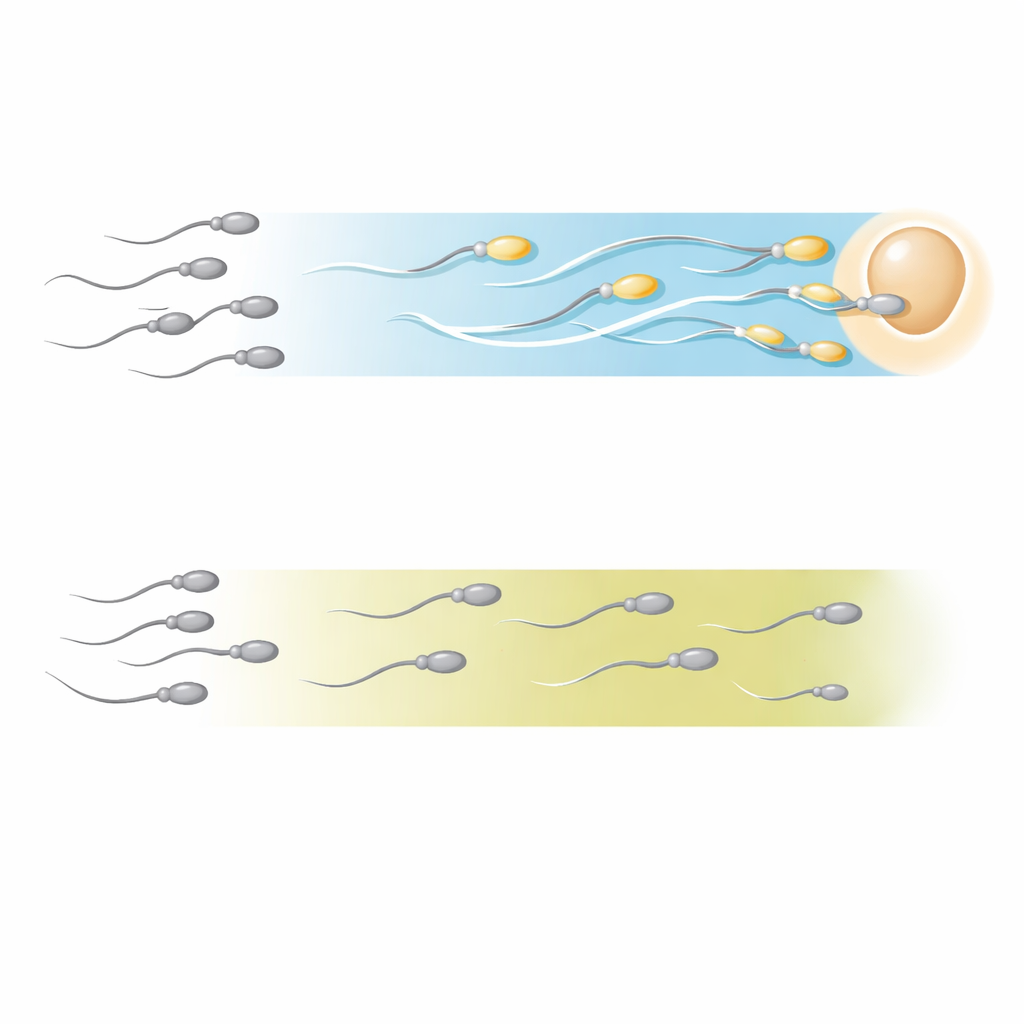
Bicarbonate stood out as the clear winner for picking out lively sperm. In men with poorer semen quality, sperm prepared in bicarbonate showed higher total and forward movement than those in HEPES or MOPS. Even in men with normal semen, the share of strongly forward-moving sperm was roughly doubled with bicarbonate compared with the synthetic buffers. Measures of swimming behavior confirmed that sperm in bicarbonate moved faster along more efficient paths. Crucially, more sperm in the bicarbonate group had bright, active mitochondria—the tiny power plants that drive motion—while HEPES and MOPS were associated with a drop in mitochondrial activity. When these synthetic buffers were combined with bicarbonate for the final selection step, some of the harm was reversed, suggesting that the presence of bicarbonate during swim-up is particularly important.
Cell Health Beyond Swimming Power
The researchers also looked at two other aspects of sperm health. First, they tested the acrosome reaction, a controlled release from a cap-like structure on the sperm head that is needed to penetrate the egg. Bicarbonate-containing media supported a stronger, triggered acrosome reaction than the untreated semen, hinting that sperm were better primed for fertilization. Second, they examined DNA packaging using a method that reveals breaks in the genetic material. Here, all media performed similarly after the swim-up step: most damaged sperm had already been filtered out, and the choice of buffer did not further change DNA fragmentation levels. This suggests that the main differences between buffers lie in how well they preserve motility and energy production, rather than in how they affect DNA integrity during the short preparation period.
What This Means for People Seeking Fertility Care
For patients, the work underscores that seemingly minor technical details in the IVF lab can shape the quality of the sperm ultimately used to try to create an embryo. By showing that a natural, bicarbonate-based buffer helps labs select more energetic, mitochondria-healthy sperm than commonly used synthetic buffers, the study argues for aligning lab conditions more closely with the body’s own chemistry. While the research did not directly track pregnancy or birth outcomes, it provides experimental evidence that the choice of buffering system during sperm preparation is more than a convenience issue—it may influence how functionally capable sperm are when they meet the egg, and thus is a key parameter for clinics to consider and optimize.
Citation: Meitei, H.Y., Predheepan, D., Uppangala, S. et al. Bicarbonate buffer enhances functional sperm selection compared to Zwitterionic buffers in sperm preparation. Sci Rep 16, 9332 (2026). https://doi.org/10.1038/s41598-026-44733-9
Keywords: assisted reproduction, sperm preparation, bicarbonate buffer, male infertility, IVF laboratory