Clear Sky Science · en
Integrated transcriptomic and targeted triterpenoid profiling reveals key enzymes in triterpenoid biosynthesis of Oplopanax elatus
Why this rare forest shrub matters
The forest shrub Oplopanax elatus is a little-known relative of ginseng that has long been used in traditional medicine for conditions ranging from fatigue to diabetes. It makes a group of plant chemicals called triterpenoids that show promise against cancer, inflammation and metabolic diseases. Because the plant is endangered and grows slowly, simply harvesting it from nature is not a sustainable way to obtain these compounds. This study asks a practical question with big implications: can we understand, at the genetic and chemical level, how O. elatus makes these valuable molecules, so that we can one day produce them more efficiently without further endangering the species?
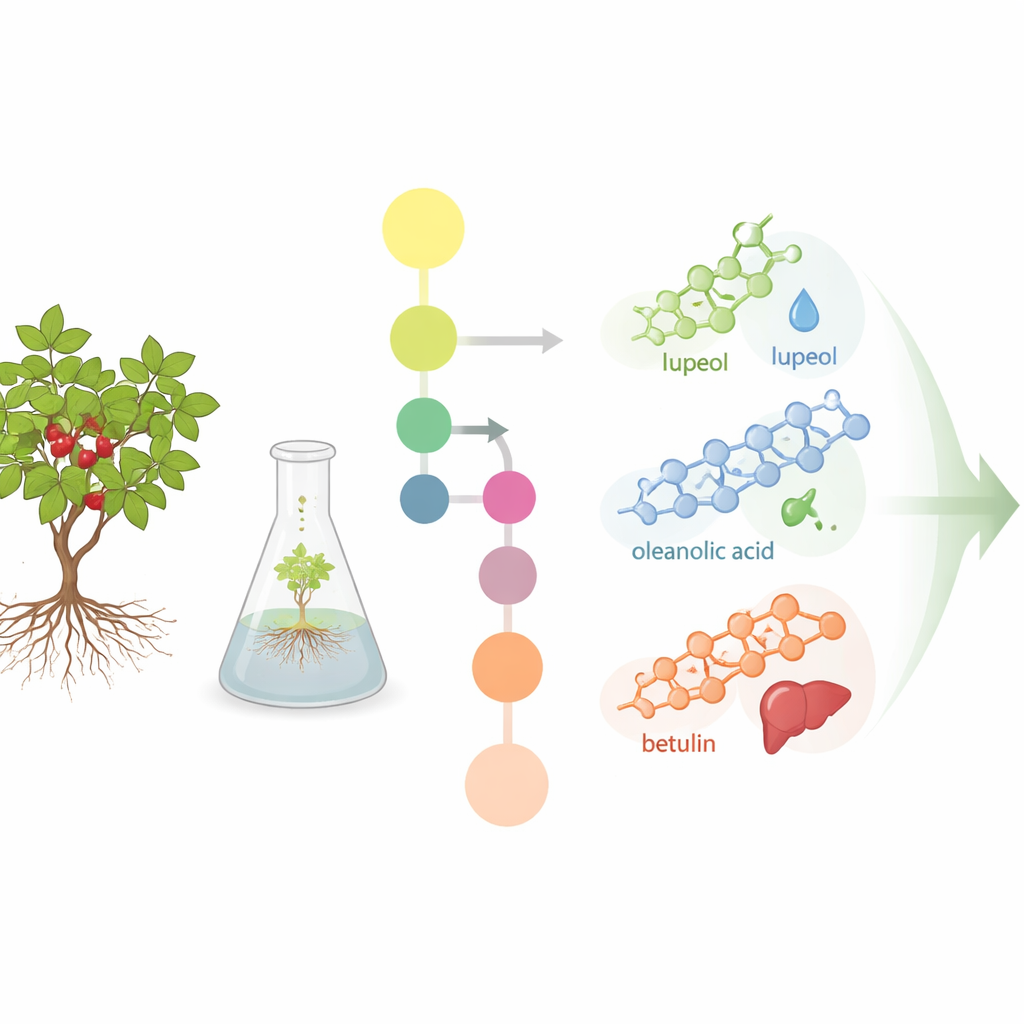
Growing medicine in a flask
Instead of collecting plants from the wild, the researchers worked with roots maintained in sterile culture and then allowed them to regenerate into whole plantlets over eight weeks. They carefully measured three representative triterpenoids—lupeol, oleanolic acid and betulin—in the original roots and in the regenerated plants using a sensitive separation technique (HPLC). All three compounds increased noticeably in the regenerated material, with betulin more than doubling. This simple comparison showed that the lab-grown shoots are not only viable, but actually richer sources of the desired medicinal ingredients than the starting roots.
Reading the plant’s instruction manual
To find out why the regenerated plants make more triterpenoids, the team turned to transcriptomics, a way of surveying which genes are switched on and how strongly. They re-analyzed an existing RNA sequencing dataset comparing the original roots with regenerated plantlets. Focusing on genes involved in the known triterpenoid pathway, they built heat maps of gene activity and then confirmed key results with a more targeted method, quantitative PCR. Several genes that feed raw materials into the pathway were more active in the regenerated plants, suggesting that the biochemical assembly line for these compounds was running faster overall.
Pinpointing the crucial turning points
Within this assembly line, one of the most important junctions is formed by enzymes called oxidosqualene cyclases. These act as molecular sculptors, folding a simple chain-like molecule into different complex ring structures that become the backbone of numerous triterpenoids. The researchers identified two stand-out genes, dubbed Gene_22342T and Gene_05624T, whose activity jumped threefold and thirtyfold, respectively, in regenerated tissues. By comparing the amino-acid sequences of their encoded proteins with similar enzymes from other plants, and by examining characteristic short sequence motifs, the team showed that one gene closely matches known beta-amyrin synthases and the other matches lupeol synthases—two key sculptors that direct the pathway toward different triterpenoid families.
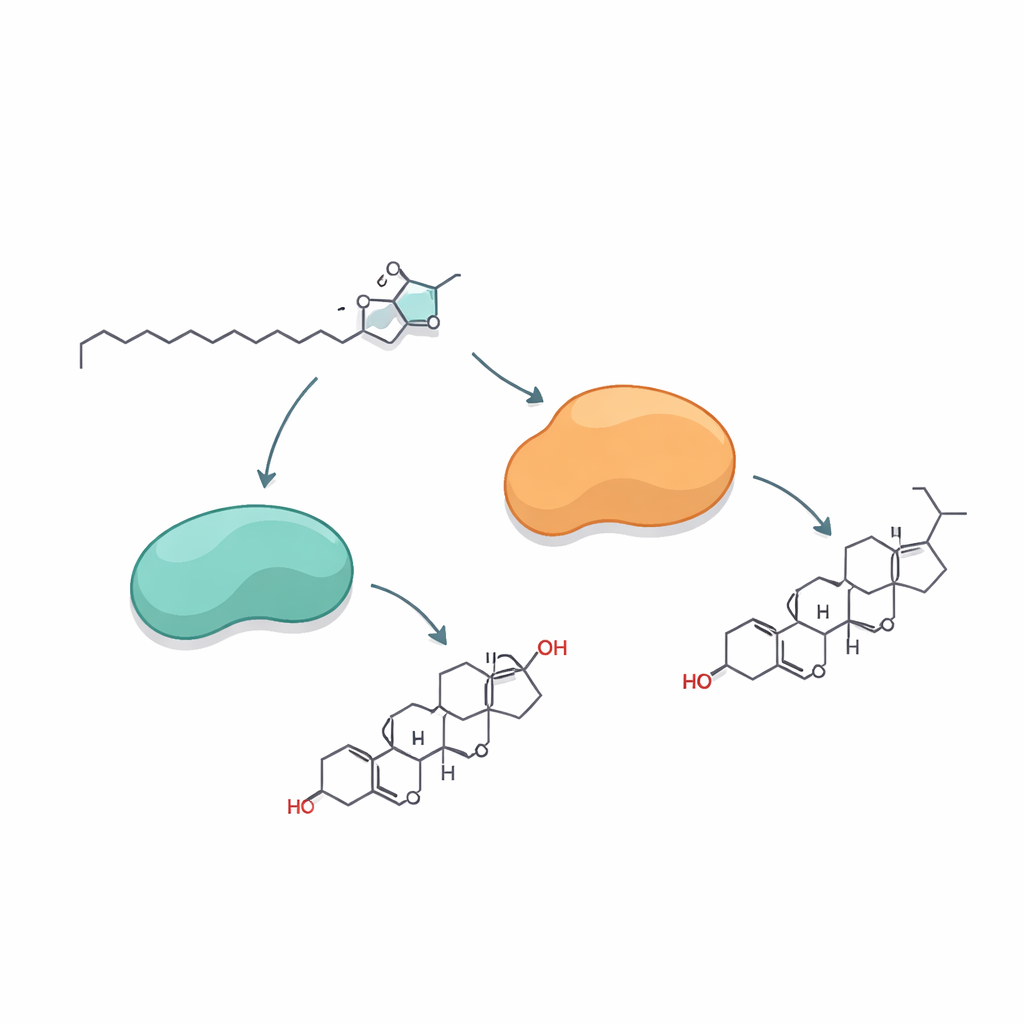
Seeing molecules dock like puzzle pieces
To further test whether these candidate enzymes truly recognize the right molecules, the researchers created three-dimensional models of the proteins and used computer docking to simulate how the triterpenoid products fit into their active sites. In both cases, the modeled compounds nestled into the enzymes with many stabilizing interactions, and the calculated binding energies indicated strong and specific pairing. While these simulations do not replace laboratory enzyme tests, they provide an additional line of evidence that Gene_22342T behaves like a beta-amyrin–forming enzyme and Gene_05624T like a lupeol-forming enzyme in O. elatus.
What this means for future remedies
Taken together, the chemical measurements, gene activity patterns, sequence comparisons and docking models paint a coherent picture: regenerated O. elatus plantlets boost the production of valuable triterpenoids in part because two key enzymes, a beta-amyrin synthase and a lupeol synthase, are strongly switched on. For non-specialists, the takeaway is that scientists are beginning to map the precise steps by which this endangered plant manufactures promising medicinal compounds. That knowledge is a necessary foundation for future strategies such as engineering microbes or cultured plant tissues to produce lupeol, oleanolic acid and betulin at scale, potentially easing pressure on wild populations while preserving access to their therapeutic potential.
Citation: Choi, H.J., Seo, J.W., Park, J. et al. Integrated transcriptomic and targeted triterpenoid profiling reveals key enzymes in triterpenoid biosynthesis of Oplopanax elatus. Sci Rep 16, 11246 (2026). https://doi.org/10.1038/s41598-026-44725-9
Keywords: Oplopanax elatus, triterpenoids, medicinal plants, plant biosynthesis, metabolic engineering