Clear Sky Science · en
All-digital aliasing-free PWM transmitter with reduced filtering requirements
Why cleaner radios matter
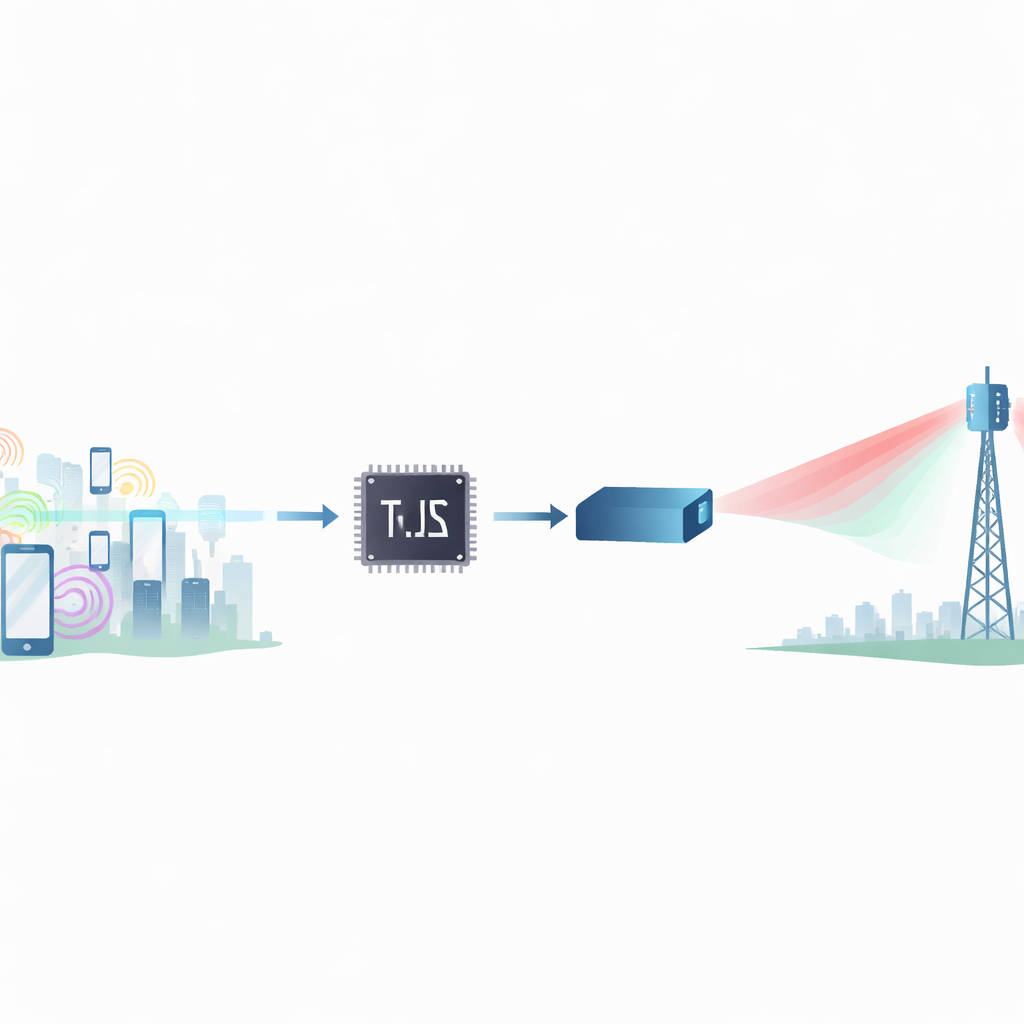
Every time you stream a video or join a video call, your phone’s radio must squeeze more and more information through crowded airwaves. To do this efficiently, modern wireless systems like 4G and 5G rely on complex signals that are hard to transmit without creating unwanted noise and interference. This paper introduces a new kind of fully digital transmitter that can handle these demanding signals while using simpler, more efficient hardware and needing less analog filtering after the signal is generated.
The challenge of noisy digital radios
Traditional software-defined radios turn digital data into radio waves using high‑precision digital-to-analog converters and carefully designed amplifiers. Another approach, popular for its efficiency, uses pulses whose width encodes the strength of the signal, and a separate path to encode its phase. These pulse-based transmitters switch the power amplifier fully on or off, which is very power‑efficient. However, because their pulses contain many harmonic components, they naturally create extra “ghost” copies of the signal at other frequencies. In digital implementations, this also leads to aliasing, where unwanted spectral images fold back into the band of interest, degrading signal quality and causing more interference to neighboring channels.
A new path: all-digital, aliasing-free pulses
The authors build on earlier work that showed how specially shaped pulse patterns can avoid these aliasing and imaging problems. Those earlier schemes, however, produced signals with many amplitude levels, which forced the use of high‑resolution converters and very linear power amplifiers, undermining some of the efficiency benefits. The new design, called an all-digital aliasing-free PWM transmitter, keeps the clean spectral behavior of those advanced pulse patterns but reshapes them into a simple two-level signal that can be generated directly by a field‑programmable gate array (FPGA) transceiver and then fed to a switched‑mode power amplifier.
How the building blocks work together
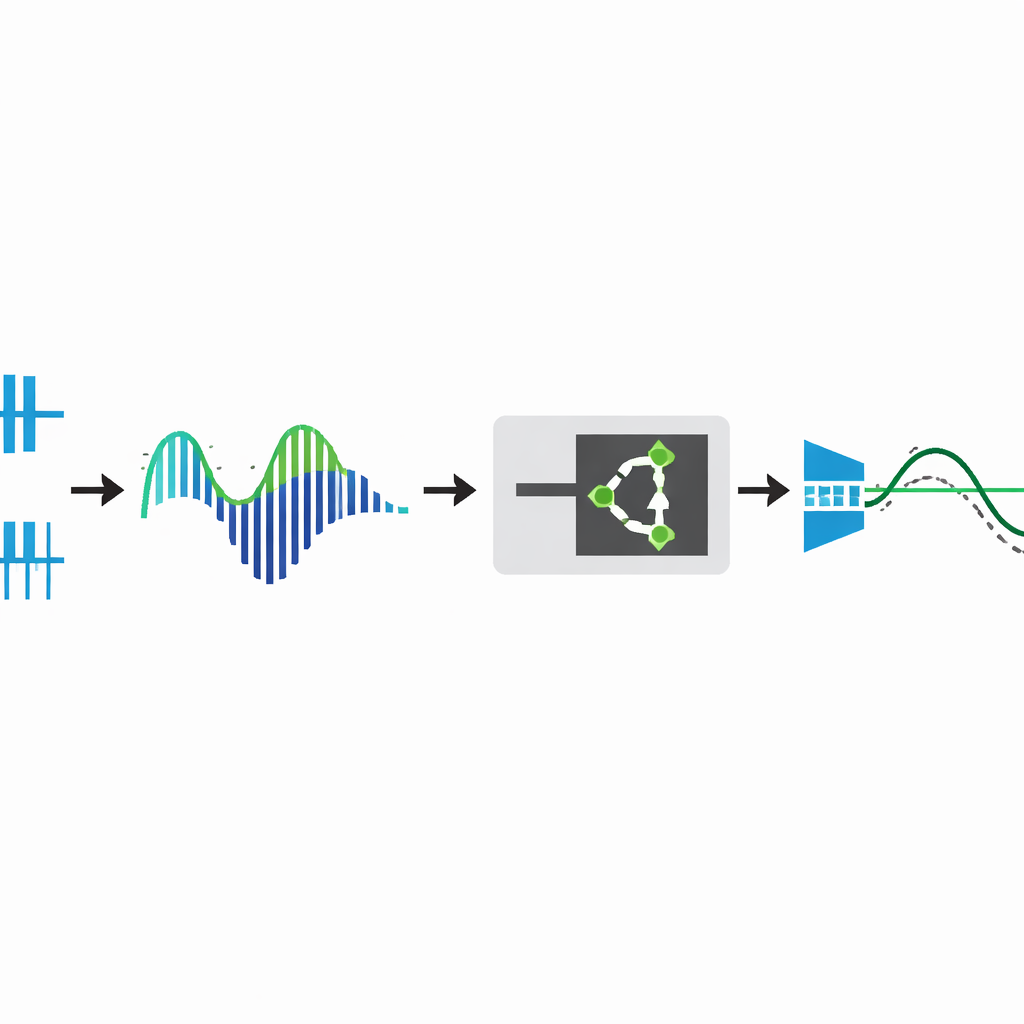
Inside the transmitter, the usual in‑phase and quadrature (I/Q) baseband signals are first converted into a more intuitive amplitude‑and‑phase description. The amplitude drives a multi‑phase, band‑limited pulse generator, which produces several synchronized pulse streams whose combined effect is a smooth, controlled spectrum with only a finite number of harmonics. This multi‑phase arrangement shifts unwanted harmonics farther away from the useful signal and reduces their strength. A second block then translates the varying amplitude of this multi‑phase waveform into carefully arranged two‑level radio‑frequency pulses, using many possible pulse combinations in time to represent different amplitudes and phases without resorting to intermediate voltage levels.
From theory to working hardware
The team implemented the entire scheme on a commercial FPGA board that includes very fast serial transceivers. Instead of computing every pulse from scratch in real time, they precomputed the necessary pulse patterns for both the band‑limited pulses and the two‑level radio‑frequency pulses, storing them in on‑chip memory. Simple digital logic maps the desired amplitude and phase at each instant to the correct stored pattern, which is then serialized at multi‑gigabit rates to form the final two‑level output. In tests, the transmitter drove a compact class‑D power amplifier chip at 720 MHz and also operated directly at 1.75 GHz without an external amplifier, using realistic 5G New Radio and LTE waveforms over bandwidths up to 20 MHz.
Cleaner signals with simpler filtering
Measurements show that the new transmitter produces significantly cleaner spectra than a conventional polar pulse‑width modulation design implemented on the same FPGA. For both 5G and LTE signals, the unwanted emissions in adjacent channels are much lower, and the error between the intended and received signal constellation remains around or below one percent. Importantly, the strongest unwanted harmonic appears much farther away from the main signal than in earlier designs, which means that the final analog filter can be simpler and less demanding. Compared with other advanced pulse‑based approaches that rely on low‑resolution digital‑to‑analog converters and multiple amplifiers, this architecture achieves better signal quality with a single switching amplifier and no DAC at all.
What this means for future wireless gear
For a non‑specialist, the main takeaway is that the authors show how to build a highly efficient radio transmitter that lives almost entirely in the digital domain while still sending very clean 4G and 5G signals. By eliminating aliasing and imaging at their source and pushing remaining distortion far from the band of interest, the design relaxes the burden on analog filtering and power amplifiers. This could make future base stations and possibly even user devices more flexible, easier to reconfigure by software, and more power‑efficient, all while coexisting more peacefully with neighboring channels in an increasingly crowded radio spectrum.
Citation: Haque, M.F.U., Ahmed, H. & Johansson, T. All-digital aliasing-free PWM transmitter with reduced filtering requirements. Sci Rep 16, 9235 (2026). https://doi.org/10.1038/s41598-026-44436-1
Keywords: software-defined radio, digital transmitter, 5G New Radio, pulse-width modulation, power amplifier