Clear Sky Science · en
Spatiotemporal evolution and driving mechanisms of multiple scales ecological security in Shanxi Province from the perspective of service, risk and health
Why This Matters for People and Places
The landscapes of Shanxi Province in northern China do double duty: they supply coal that powers cities and, at the same time, hills, rivers, and forests that protect soil, store carbon, and clean water. This study asks a simple but urgent question with broad relevance: as a region develops economically, is its natural safety net getting stronger or weaker? By tracking how nature’s benefits, environmental dangers, and overall ecosystem condition have changed over more than two decades, the authors offer a window into the trade-offs many resource-dependent regions face worldwide.
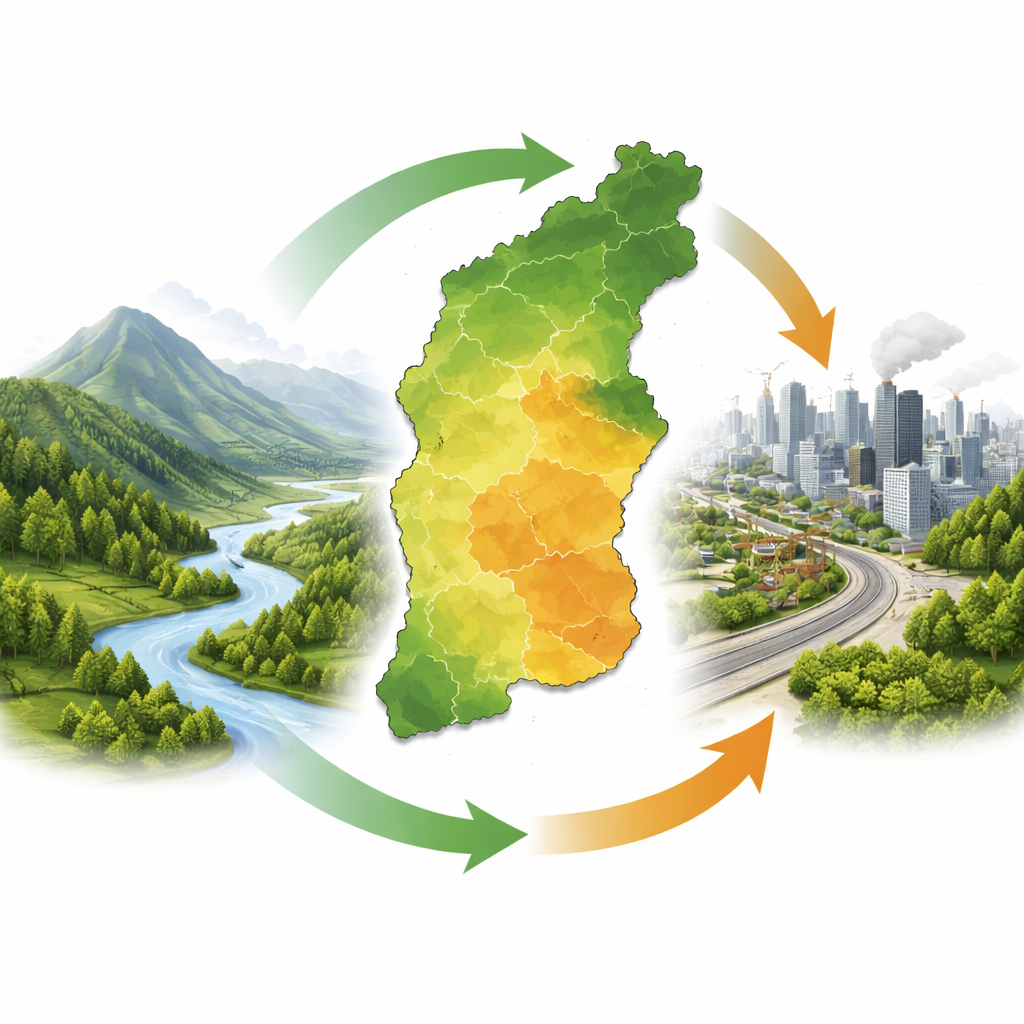
Looking at Nature’s Gifts, Pressures, and Overall Health
Instead of treating the environment as a single score, the researchers break ecological security into three down-to-earth ideas. First are the services nature provides, such as crop production, clean water, soil protection, habitat for wildlife, carbon storage, and outdoor recreation. Second are risks, like landscape fragmentation, heavy construction, and intensive land use that make ecosystems more fragile. Third is health, which reflects how well the land’s living systems hold together and bounce back from disturbance. Using satellite images, climate records, land-use maps, and population and economic data, the team built a “service–risk–health” framework to evaluate Shanxi’s ecological security on a fine grid and at the county scale from 2000 to 2023.
How Shanxi’s Landscape Has Changed Over Time
The picture that emerges is mixed. On the positive side, ecosystem services show a steady improvement. Mountain ranges such as the Taihang and Lüliang remain strongholds of forest and grassland, and large programs to convert steep farmland back to forest and grass help these areas provide more water regulation, soil conservation, and carbon storage. Low-service zones in central basins have shrunk as restoration projects take hold. At the same time, ecological risk has crept upward overall, especially in basins and plains where cities, roads, and industry sprawl across once-continuous habitats. These places experience intense human activity and highly fragmented landscapes.
Hidden Strain Beneath Surface Improvements
Most worrying is the trend in ecosystem health. Despite gains in services, the overall health index for Shanxi’s ecosystems has dropped by about one-fifth since 2000, following an “M-shaped” decline. High health is still confined to rugged, well-vegetated mountain areas; much of the central basin, with dense populations and coal mining, shows medium to low health. When all three dimensions are combined, Shanxi’s overall ecological security level shows only a slight upward trend over time and a stable pattern of “higher in the southeast, lower in the northwest.” A calculated center of ecological security wobbles within a small area northwest of Qixian County, subtly tracing how the balance between nature and development shifts as urban clusters expand.
What Drives the Gains and Losses
To understand what shapes these patterns, the authors examine a dozen influences, from rainfall and temperature to population density, building coverage, and vegetation greenness. Three stand out. Plant cover, captured by a vegetation index, reflects the strength of the natural base. The share of land covered by buildings tracks development pressure. Population density represents the intensity of human use. Over time, vegetation and construction land take turns as the main driver of ecological security, with population forming a third, steady pole of influence. When any two factors act together—for example, dense building development in low-vegetation zones—their combined impact on ecological security is stronger than either alone, revealing a powerful, nonlinear tug-of-war between natural resilience and human activity.
What This Means for Future Choices
For non-specialists, the study’s bottom line is clear: restoration projects can boost some of nature’s benefits even while deep structural damage accumulates quietly in the background. Shanxi’s experience shows that mountain forests and river corridors can still act as ecological “shields,” but unchecked expansion of construction land and heavy industry can steadily erode the land’s underlying health. The authors argue that safeguarding ecological security in resource-based regions like Shanxi will require tightening limits on new development in fragile zones, investing in targeted restoration where ecosystems waver, and using continuous monitoring to sound early warnings. In short, true ecological security means not just more services today, but a landscape whose living systems remain strong enough to support both people and nature in the long run.
Citation: Dang, G., Li, G. & Hu, J. Spatiotemporal evolution and driving mechanisms of multiple scales ecological security in Shanxi Province from the perspective of service, risk and health. Sci Rep 16, 11626 (2026). https://doi.org/10.1038/s41598-026-44386-8
Keywords: ecological security, land-use change, ecosystem health, Yellow River Basin, resource-based regions