Clear Sky Science · en
Field-based evaluation of trunk strength using a novel in-chair assessment system in elite wheelchair athletes
Stronger cores for faster wheels
For athletes who play sports in a wheelchair, the power of the torso can make the difference between cutting past a defender and tipping over during a hard collision. Yet until now, there has been no simple way to measure how strong an athlete’s trunk really is while they sit in their own sports chair. This study introduces a new field-ready testing system that lets coaches and scientists measure trunk strength directly on the court, and shows how this information can help guide training and fair competition in wheelchair basketball.
Why trunk power matters
The muscles around the spine and hips do more than keep us upright; they transmit force between the upper and lower body, help maintain balance, and protect against injury. In wheelchair sports, the trunk becomes the key link between a player’s arms and the chair. When athletes sprint, change direction, or absorb contact, their ability to lean, twist, and recover depends heavily on trunk control and strength. Previous research has linked better trunk function to faster starts, higher speeds, and more stable ball handling, and it also plays a central role in how athletes are assigned to functional classes that are meant to reflect the impact of their impairment on performance.
A new way to test strength in the chair
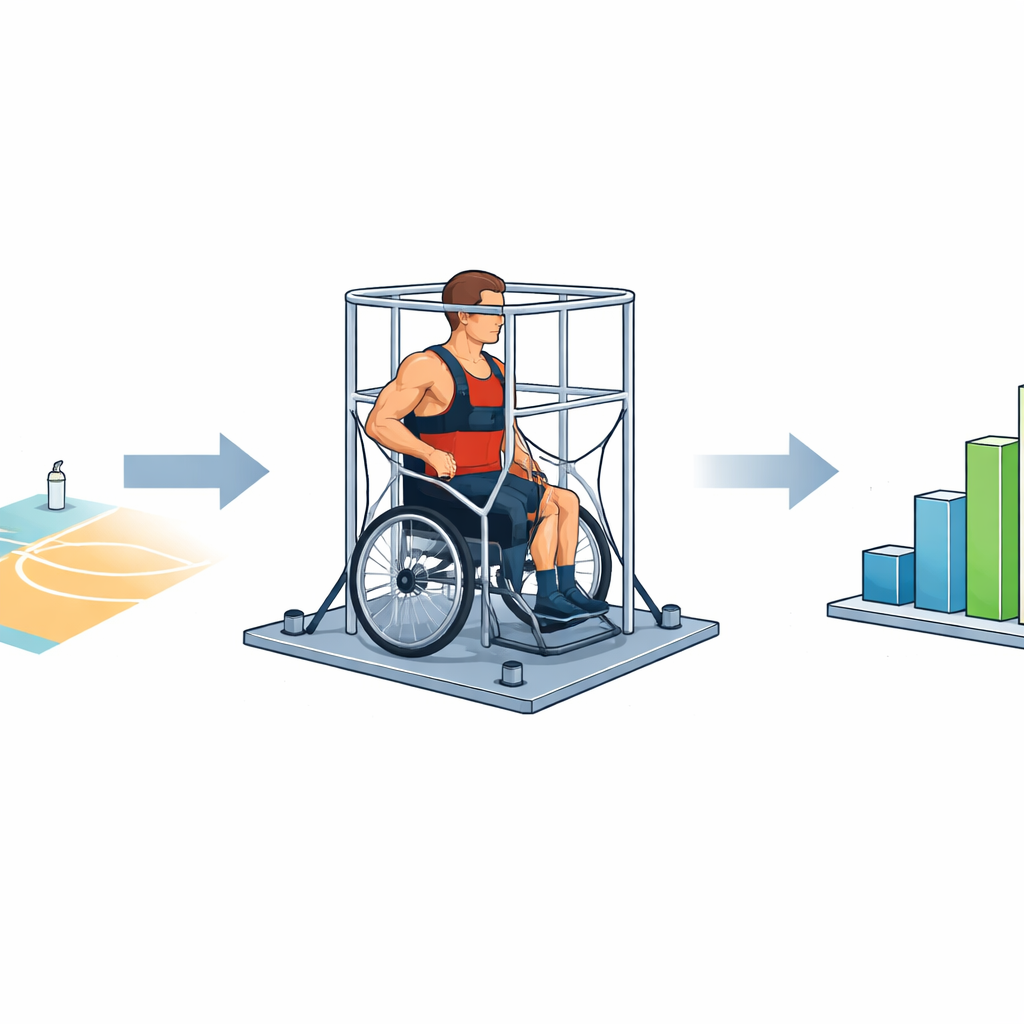
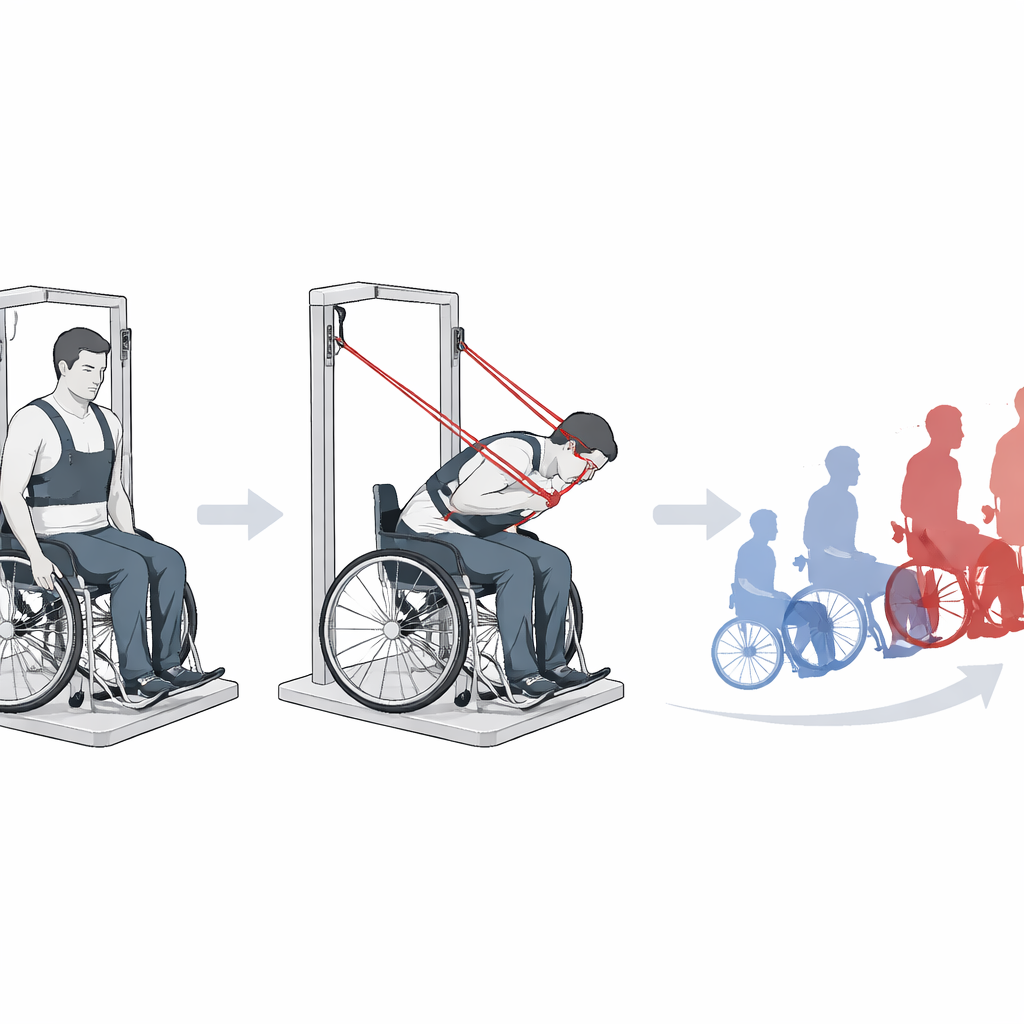
Traditional devices that measure trunk strength are large, stationary machines found in laboratories. They are difficult to move, cannot easily accommodate different types of impairments, and, crucially, do not include the athlete’s own wheelchair – even though the player and chair act as a single unit in real games. To bridge this gap, the researchers built a portable wooden platform with a metal frame that surrounds the wheelchair. The chair is strapped firmly to the base, and the athlete wears a chest harness connected by ropes to force sensors placed around the frame. By pulling against these ropes without moving – leaning forward, backward, or sideways – the athlete generates measurable forces in four directions of trunk effort while remaining seated in their usual sports chair.
Putting the device to the test
The team first checked whether the new system gave consistent results. They tested able-bodied volunteers seated in a test wheelchair, and elite wheelchair basketball players measured in their own sports chairs, on two separate days. Across all four directions of effort, the day-to-day results were highly similar in both groups, with small variation and no meaningful bias toward one test day. This showed that the device was reliable enough for repeated use in training or research. Next, the researchers measured trunk strength in 55 wheelchair basketball players spread across the sport’s functional classes, which range from athletes with high levels of trunk impairment to those with minimal limitations. They found clear differences: players in higher classes consistently produced greater forces than those in lower classes, and trunk strength rose steadily with classification level.
Comparing wheelchair athletes and non-disabled peers
The study also compared the players’ trunk strength with that of the able-bodied group. As expected, athletes with more severe impairments (the lower classes) produced much less force than able-bodied participants in most directions. However, the picture changed for athletes with the least trunk involvement. In the highest class, players showed trunk forces similar to, and in forward bending even greater than, those of the able-bodied volunteers. This suggests that years of sport-specific training in wheelchair basketball can lead to exceptional trunk flexion strength, likely because these movements are used repeatedly in propulsion, ball control, and maintaining stability during aggressive play.
What this means for sport and fairness
To a non-specialist, the main message is that this new testing system offers a practical and realistic way to measure how strongly wheelchair athletes can use their trunk while actually sitting in their own chair. The device is portable, works in real training halls, and captures the combined action of trunk, hips, and other supporting muscles that athletes rely on in competition. Because it reliably distinguishes between players with different functional levels and highlights how impairment shapes performance, it could become a valuable tool for tailoring training, optimizing chair setups, and refining the classification rules that aim to keep wheelchair sports both competitive and fair.
Citation: Schaaf, K., Nquiti, M., Lassner, P. et al. Field-based evaluation of trunk strength using a novel in-chair assessment system in elite wheelchair athletes. Sci Rep 16, 8967 (2026). https://doi.org/10.1038/s41598-026-44257-2
Keywords: wheelchair basketball, trunk strength, para sport performance, field-based assessment, functional classification