Clear Sky Science · en
Cognitive and motor inhibition in balance-related tasks: task-specific associations with executive and physical functions in young and older adults
Why stopping your steps matters
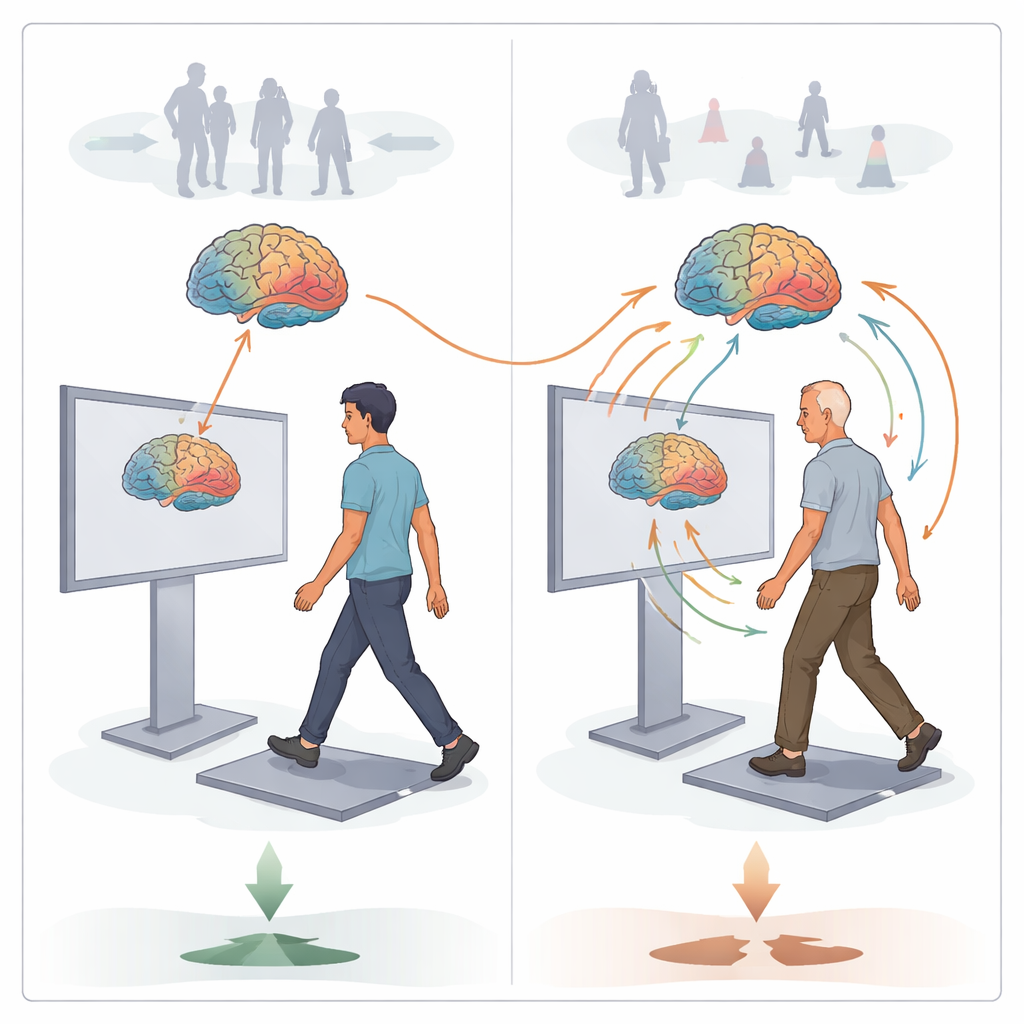
Everyday movements like walking through a busy street or dodging a suddenly opened door demand more than strong legs—they rely on the brain’s ability to quickly stop, change, or fine‑tune our steps. This study explores how younger and older adults control these “braking” processes while standing and stepping, and asks a practical question: do the mental skills that help us press a button at the right moment also help us keep our balance and avoid falls in real-world situations?
Two kinds of mental brakes
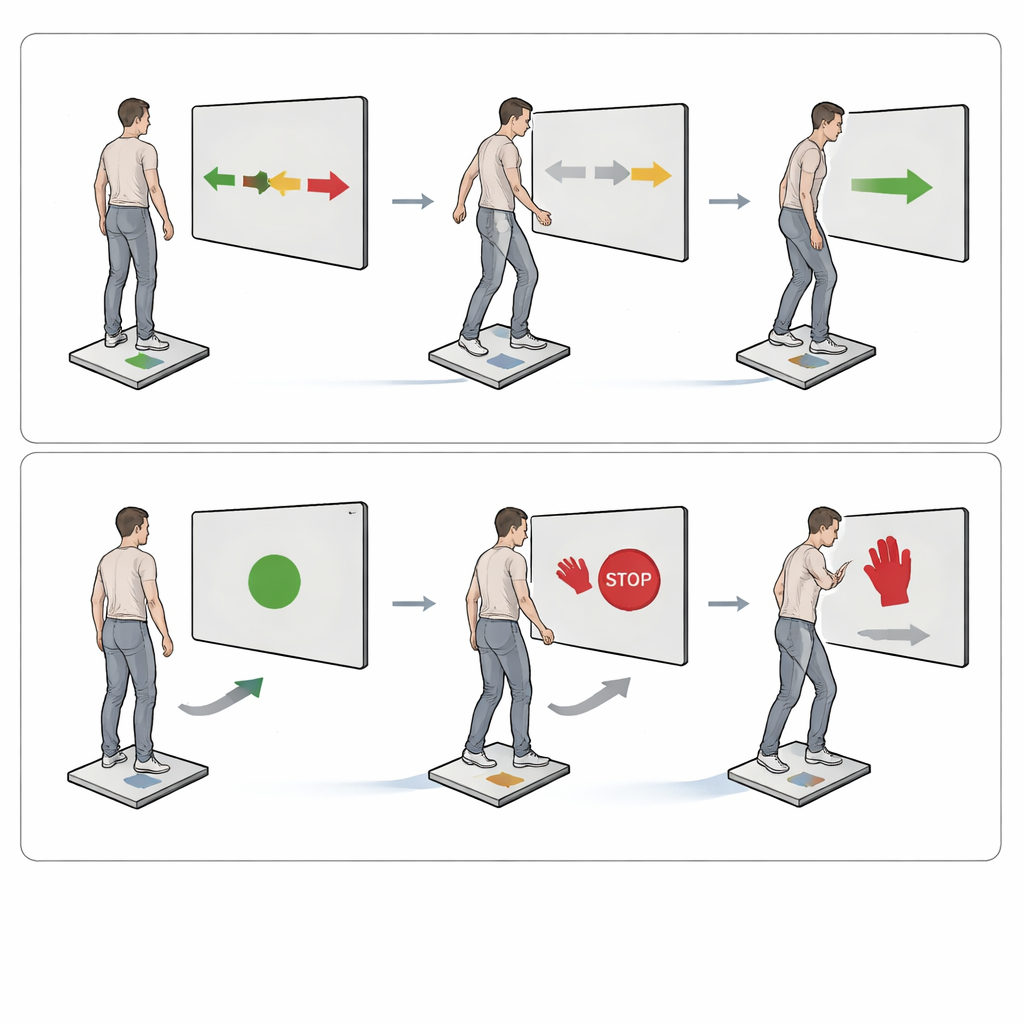
The researchers focused on two related but distinct abilities. The first is “cognitive stopping,” the capacity to ignore misleading information and choose the correct response—like stepping the right way when a signal is confusing. The second is “motor stopping,” the ability to halt a movement that has already been prepared—such as freezing a step when someone suddenly crosses your path. To study these, they created two balance-related tasks: a stepping task that forced participants to step in different directions in response to tricky visual cues, and a gait initiation-stop task in which people had to begin walking when signaled but abruptly stop when the signal changed.
How the experiments were set up
Healthy young adults in their twenties and older adults around seventy stood on a force plate in front of a screen. The plate measured how their weight shifted before and during each step, while motion-capture cameras tracked leg movements. On a separate day, the same people completed common computer and paper tests of mental skills, including tasks that measure pure stopping ability with hand responses, mental flexibility, and working memory, as well as standard balance and mobility tests. This design allowed the team to ask whether balance tasks that involve quick stepping and stopping really tap into the same mental brakes measured by traditional button-press tests.
What differed between young and older adults
Older adults, although generally fit and active, were slower on most mental and physical tests than younger adults, but they made a similar number of mistakes on simple stopping tasks performed while seated. In the stepping task, older adults took longer overall to complete their steps, yet the extra delay caused specifically by misleading visual cues was similar across ages. In the gait initiation-stop task, however, older adults were less successful at halting their step once it was underway and showed weaker signs of motor stopping in the force-plate signals, pointing to a clearer age-related decline when it comes to cancelling movement.
Hidden links between brain tests and balance tasks
For younger adults, the picture was relatively clear. Measures of cognitive stopping in the stepping task were strongly related to their performance on classic hand-based stopping tests, and measures of motor stopping in the gait initiation-stop task lined up with their performance on a different hand-based motor stop test. In other words, when young people’s mental brakes were stronger in simple lab tests, they also handled the more complex standing and stepping challenges better. Their overall performance in both new balance tasks was explained largely by mental speed and flexibility, while traditional measures of strength and everyday balance played a smaller role. For older adults, these neat links largely disappeared: their performance in the standing and stepping tasks did not reliably track with standard stopping tests, and the new tasks were harder to predict from either mental or physical scores.
What this means for staying on your feet
The findings suggest that the two new balance tasks truly capture different types of mental braking—one about choosing the right step, the other about cancelling it once it has begun—at least in younger adults. In older adults, the lack of tidy connections hints that the brain may be recruiting many extra regions to cope, blurring the link between simple tests and real-life balance control. For everyday life, this work underscores that fall risk is not just about walking speed or leg strength: how quickly and precisely the brain can pause or redirect a step in complex situations may be just as important. Carefully designed tasks that mimic real-world stepping and stopping, like those used here, could help build better tools to identify who is at risk of falling and to design training that keeps people safely on their feet as they age.
Citation: Kwag, E., Zijlstra, W. Cognitive and motor inhibition in balance-related tasks: task-specific associations with executive and physical functions in young and older adults. Sci Rep 16, 9234 (2026). https://doi.org/10.1038/s41598-026-44189-x
Keywords: balance control, inhibitory control, falls in older adults, gait and stepping, executive function