Clear Sky Science · en
Bonding strength and fatigue survival of conventional, additive and subtractive complete dentures
Why the Grip Between Teeth and Gums Matters
For millions of people who rely on full dentures, one of the most frustrating problems is when an artificial tooth suddenly pops off the pink base that mimics the gums. This doesn’t just look bad; it can make eating difficult, lead to repeated repairs, and add costs and stress—especially for older adults. As dentistry moves from traditional handcrafted techniques to computer‑guided milling and 3D printing, a key question emerges: do these new digital dentures hold their teeth as securely, and for as long, as the old methods?
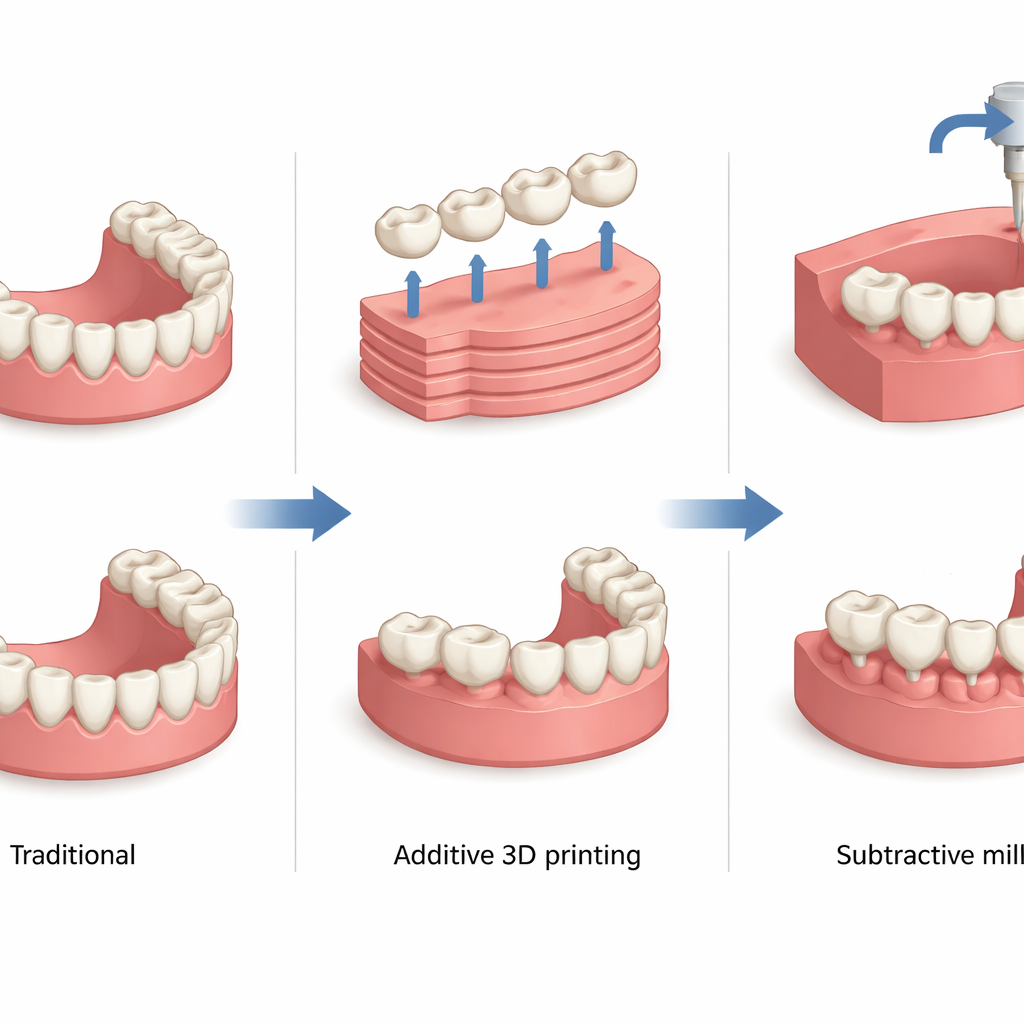
Old Craft Versus New Digital Dentures
The study compared three ways of making complete dentures: the long‑established heat‑cured plastic method; additive 3D printing, where the base is built layer by layer; and subtractive milling, where the base is carved from a solid industrial block. Each base was combined either with off‑the‑shelf teeth or with teeth made by the same digital process. The team focused on the “glue line” where tooth and base meet, because this hidden junction often decides whether a denture lasts for years or fails under daily chewing.
Putting Dentures Through a Simulated Lifetime
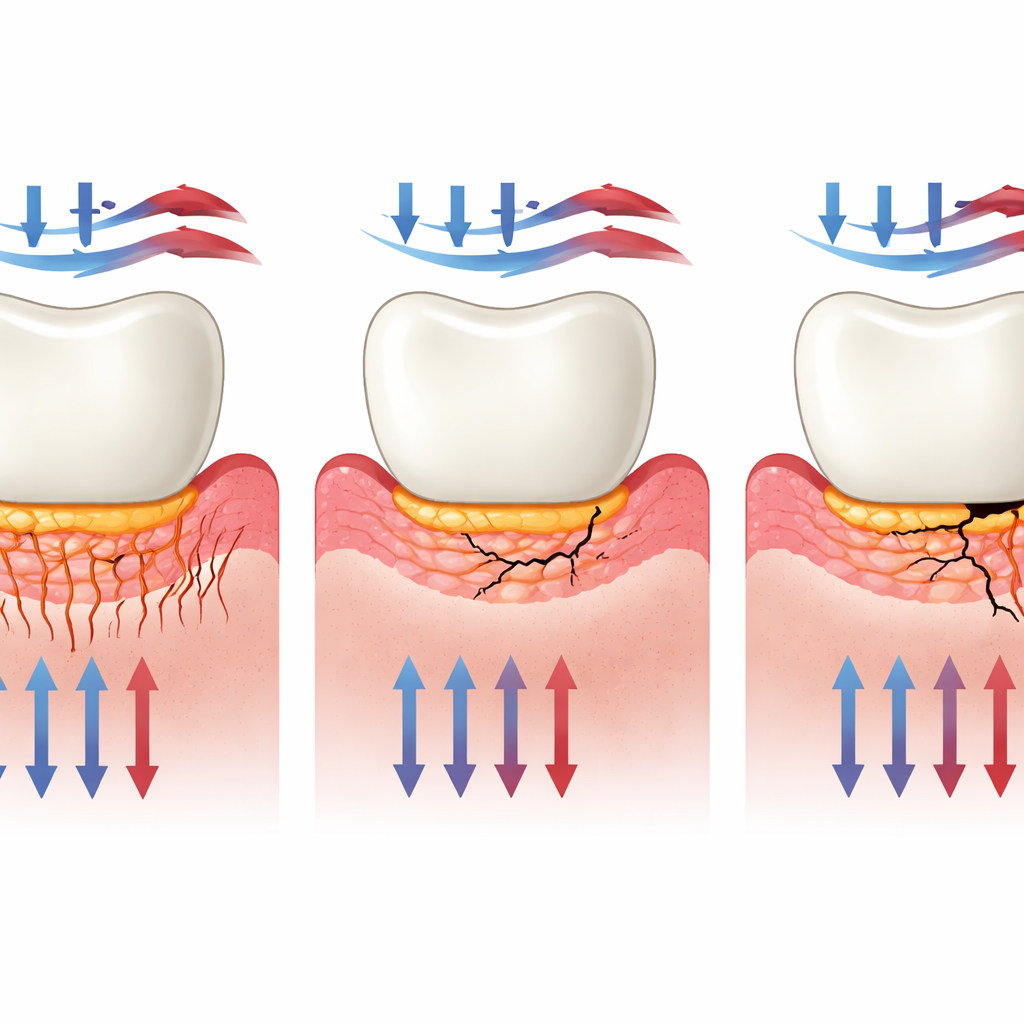
To mimic years of use in the mouth, small tooth‑and‑base blocks were cycled 1.2 million times in a chewing machine while being alternately bathed in cold and hot water. After this harsh treatment, each specimen was pushed until the tooth broke away or the base itself fractured. The researchers also examined how rough the prepared surfaces were and how completely the plastics had hardened, both of which influence how well materials can lock together at the microscopic level.
Who Held Fast and Who Let Go
The clear winner was the conventional approach in which prefabricated teeth are built directly into a slowly heat‑cured base resin. These specimens showed the highest forces before and after ageing, with no sample failures and fractures running through the tooth or base rather than along the joint—signs of a very strong connection. Additively manufactured dentures, made by 3D printing, showed bond strengths that approached the traditional benchmark. Their failures tended to occur within the tooth or base material as well, suggesting that the interface itself was reasonably robust. However, after extended hot‑cold cycling, one 3D‑printed group lost over half its strength, revealing that some printable plastics are more vulnerable to long‑term water and temperature damage than others.
Weak Links in Milled Dentures
Milled dentures, carved from highly cured industrial blocks, fared worst under fatigue. After ageing, only about half to two‑thirds of these samples survived the full chewing simulation. When they did fail, the break almost always ran right along the tooth‑base junction, indicating that this interface was the weak link. Because these factory‑made blocks are already very fully hardened, they offer few reactive “hooks” for new material to grab onto, making it difficult to form a deep, interwoven connection. Even with modern bonding agents and sandblasting of the surfaces, the joint often peeled apart under repeated loading and temperature swings.
What This Means for Patients and Dentists
For now, the study supports what many clinicians already suspect: carefully made, heat‑cured dentures with compatible prefabricated teeth remain the most reliable option when it comes to keeping teeth firmly attached over time. Well‑designed 3D‑printed systems are catching up and can perform similarly before ageing, but their long‑term success depends heavily on the exact resin recipe and post‑curing steps. In contrast, milled dentures may offer precision and convenience yet need better strategies to strengthen the tooth‑to‑base connection. For patients, this work means that the choice of denture material and manufacturing method can directly influence how often repairs are needed and how confidently they can bite into everyday foods.
Citation: Lüchtenborg, J., Keßler, A., Schneider, F. et al. Bonding strength and fatigue survival of conventional, additive and subtractive complete dentures. Sci Rep 16, 9335 (2026). https://doi.org/10.1038/s41598-026-44101-7
Keywords: complete dentures, 3D printed dentures, CAD/CAM dentistry, denture bond strength, prosthetic fatigue testing