Clear Sky Science · en
A digital twin framework for forensic reconstruction of alcohol intake via fast and slow metabolite kinetics
Why this matters for everyday life
When alcohol is involved in a crash or crime, what really happened often comes down to one question: when, and how much, did someone drink? Self-reported stories are unreliable, and common breath or blood tests only capture a brief snapshot. This study presents a new way to piece together a person’s drinking history using a “digital twin” of their body—a computer model that mimics how alcohol moves and is broken down—opening the door to fairer court decisions and more precise medical care.
From simple tests to a full-body picture
Traditional tools like blood alcohol concentration (BAC) and breath alcohol concentration (BrAC) rise and fall quickly. That makes them excellent for checking if someone is currently impaired but poor at reconstructing whether they drank before or after an incident—the core of the so‑called “hipflask” defence, where a driver claims they only drank after a crash. Slower markers exist, such as alcohol breakdown products in blood and urine, but they have mostly been studied in isolation. The authors argue that the real power lies in looking at all these signals together, then using physiology-based mathematics to interpret them.
Building a virtual body for alcohol
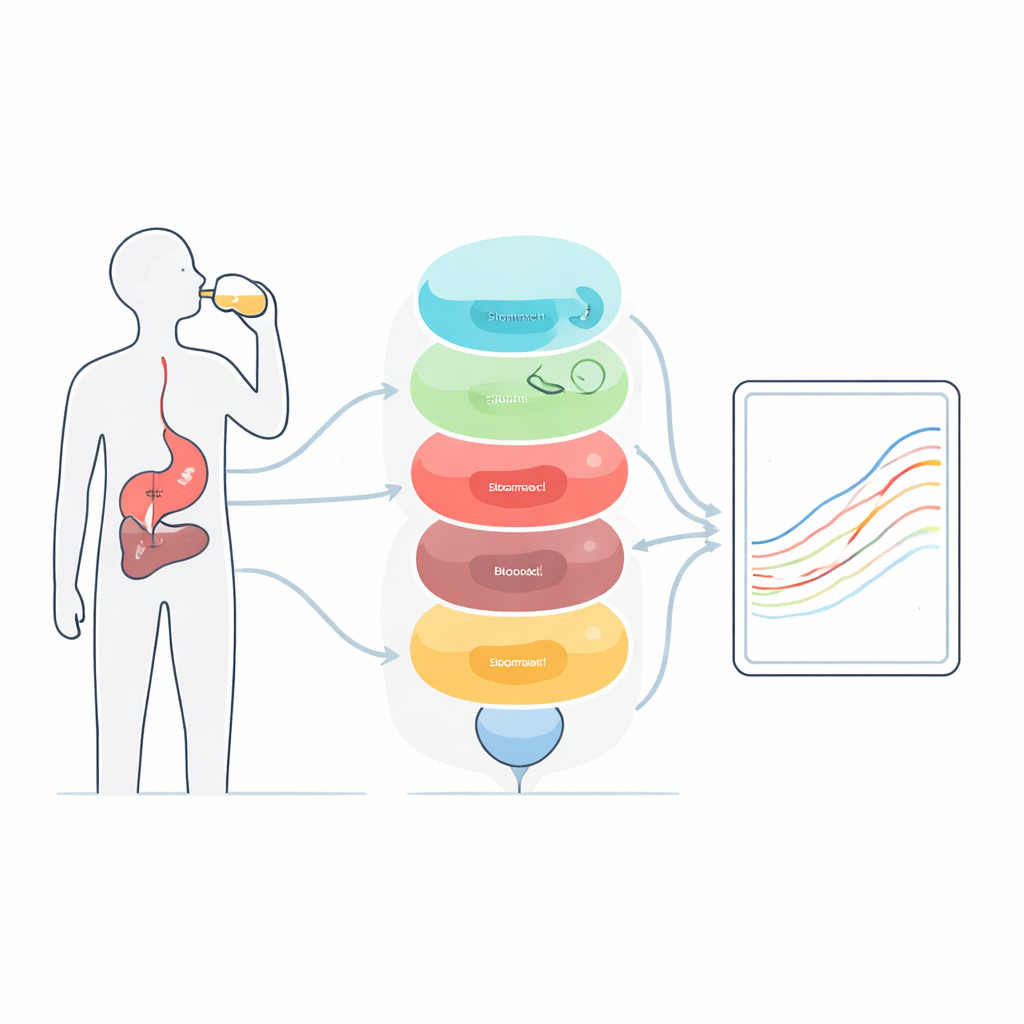
The researchers expanded an earlier digital twin of alcohol metabolism into a detailed virtual body that tracks both fast and slow alcohol markers. The model represents key organs and fluids—the stomach, intestines, blood, liver, tissues, lungs and bladder—and how drinks, food, body size, and sex affect alcohol movement. It simulates standard BAC and BrAC, as well as urine alcohol levels and two slower blood substances, ethyl glucuronide (EtG) and ethyl sulphate (EtS). All these markers are tied together by the same underlying biology of absorption, distribution, chemical conversion, and elimination.
Testing the twin against real people
To check that the virtual body behaves like real ones, the team trained and validated the model on data from ten previous studies in which volunteers consumed different kinds and amounts of alcohol with various meals. They showed that the model could reproduce the rise and fall of BAC, UAC (urine alcohol), EtG, EtS, and a longer-term blood marker across many drinking patterns. It also held up when challenged with an independent study not used during training, and when the researchers varied age, weight, height, and body composition to mimic a broad adult population. Although some fine details—especially for the slower metabolites—were not perfect, the overall match was strong enough to pass strict statistical tests.
Personalized predictions and tricky scenarios
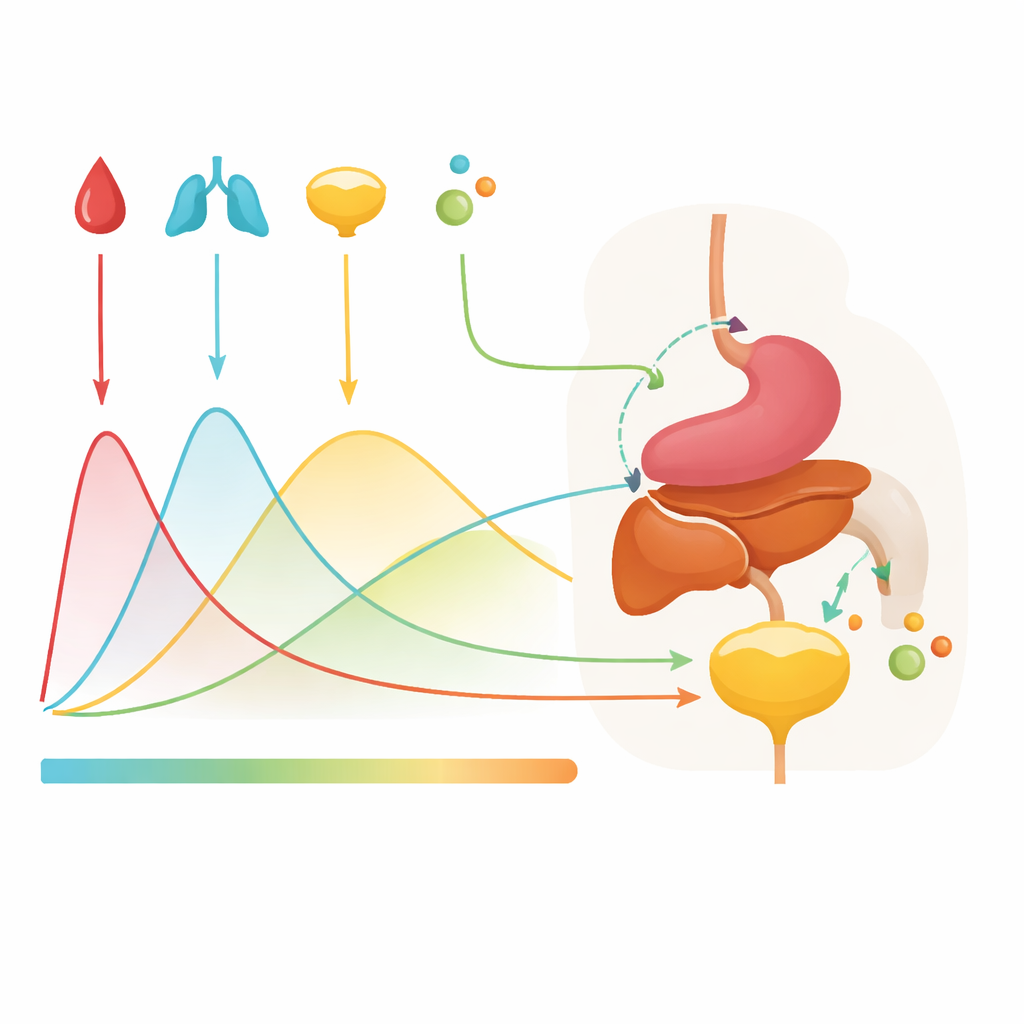
Next, the authors applied the digital twin to newly collected data from a large man and a smaller woman who completed a challenging two‑drink session involving wine, vodka, and several meals. By tuning only basic personal traits such as body weight, height, and sex, the model closely predicted their blood and urine alcohol patterns and reasonably captured the slower metabolites. The team then asked a more forensic question: could a different, simpler drinking pattern—a single large vodka drink—produce similar test results? On the surface, some parts of the blood alcohol curve looked almost identical, making the two scenarios hard to tell apart using BAC alone. But when all markers were considered together, the combined patterns diverged in specific time windows, allowing the model to flag the alternative story as implausible.
What this means for courts and clinics
This work shows that a unified, physiology-based digital twin can reconstruct a wide range of drinking scenarios by weaving together several kinds of alcohol tests. Instead of relying only on a single blood or breath value, investigators could compare claimed drinking stories against what the model says is realistically possible for that person, given their test results and body characteristics. The authors emphasize that the tool is designed to judge plausibility, not to deliver one exact answer, and that uncertainty in the inputs is transparently reflected in wider prediction bands. Alongside an interactive web tool that lets users explore hypothetical cases, this framework could strengthen evaluations of disputed post‑incident drinking, support fairer handling of drunk‑driving cases, and eventually aid personalized health monitoring around alcohol use.
Citation: Podéus, H., Simonsson, C., Jakobsson, G. et al. A digital twin framework for forensic reconstruction of alcohol intake via fast and slow metabolite kinetics. Sci Rep 16, 9336 (2026). https://doi.org/10.1038/s41598-026-44093-4
Keywords: digital twin, alcohol metabolism, forensic toxicology, blood alcohol concentration, biomarkers