Clear Sky Science · en
Interactive effects of biochar and microbial biofertilizers on sandy soil fertility and cowpea yield in Egyptian agroecosystems
Turning Desert Sand into Productive Farmland
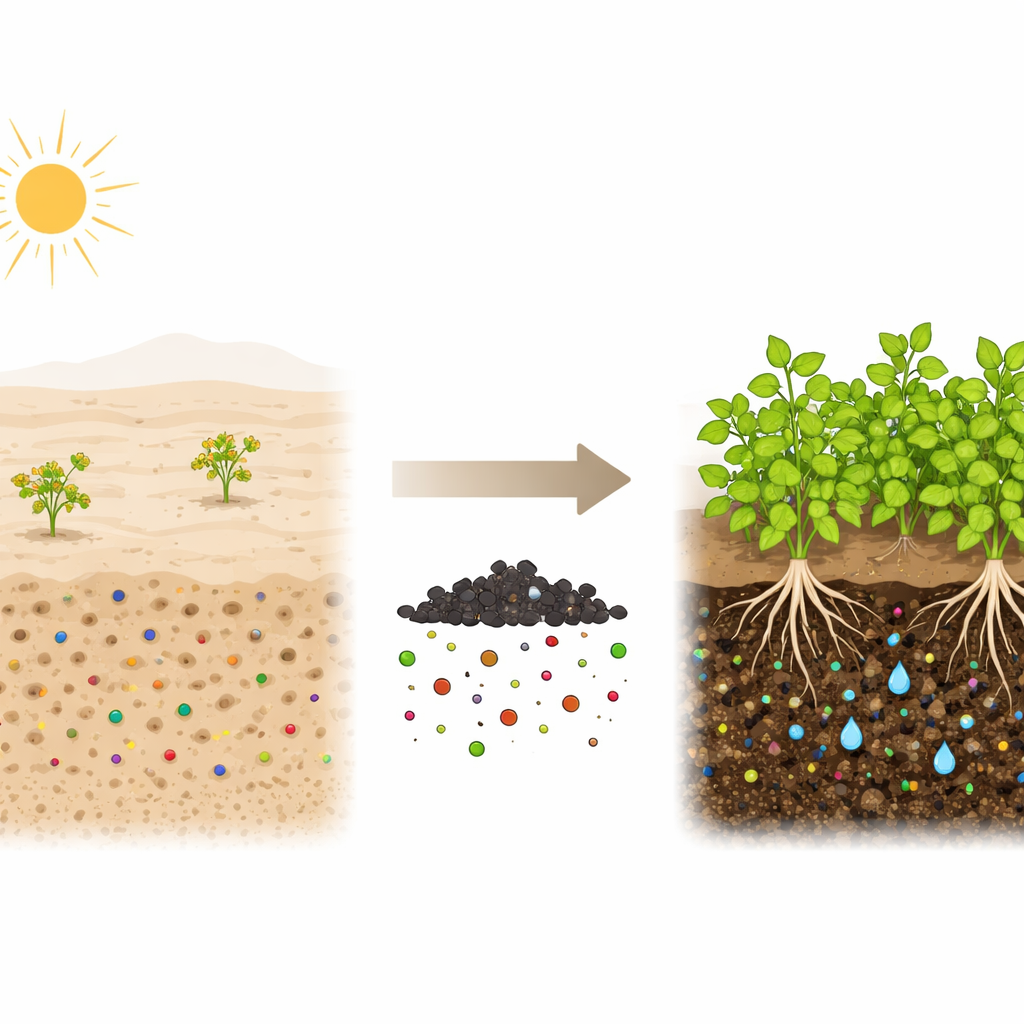
Across much of Egypt, farmers struggle with sandy soils that behave more like beach sand than garden earth: water drains away quickly, nutrients do not stick around, and crops remain stunted. This study explores whether two low‑cost tools—charcoal‑like "biochar" made from crop residues and tiny helper organisms called microbial biofertilizers—can team up to transform these poor soils and boost harvests of cowpea, a nutritious bean well suited to hot, dry climates.
Why Sandy Soils Hold Back Farmers
Sandy soils common in Egypt’s new desert farms have several major drawbacks. They contain very little organic matter, the dark, spongy fraction of soil that holds water and nutrients. Their loose structure lets precious irrigation water and fertilizer wash away, and they host fewer helpful microbes that break down organic material and feed plants. Cowpea is a hardy legume that can cope with drought and even help add nitrogen to the soil, but in such depleted ground its potential is never fully realized. Traditional fixes—heavy doses of chemical fertilizer or bulky manure—either cost too much, harm the environment, or are not available in the needed quantities.
A New Team: Charcoal and Friendly Microbes
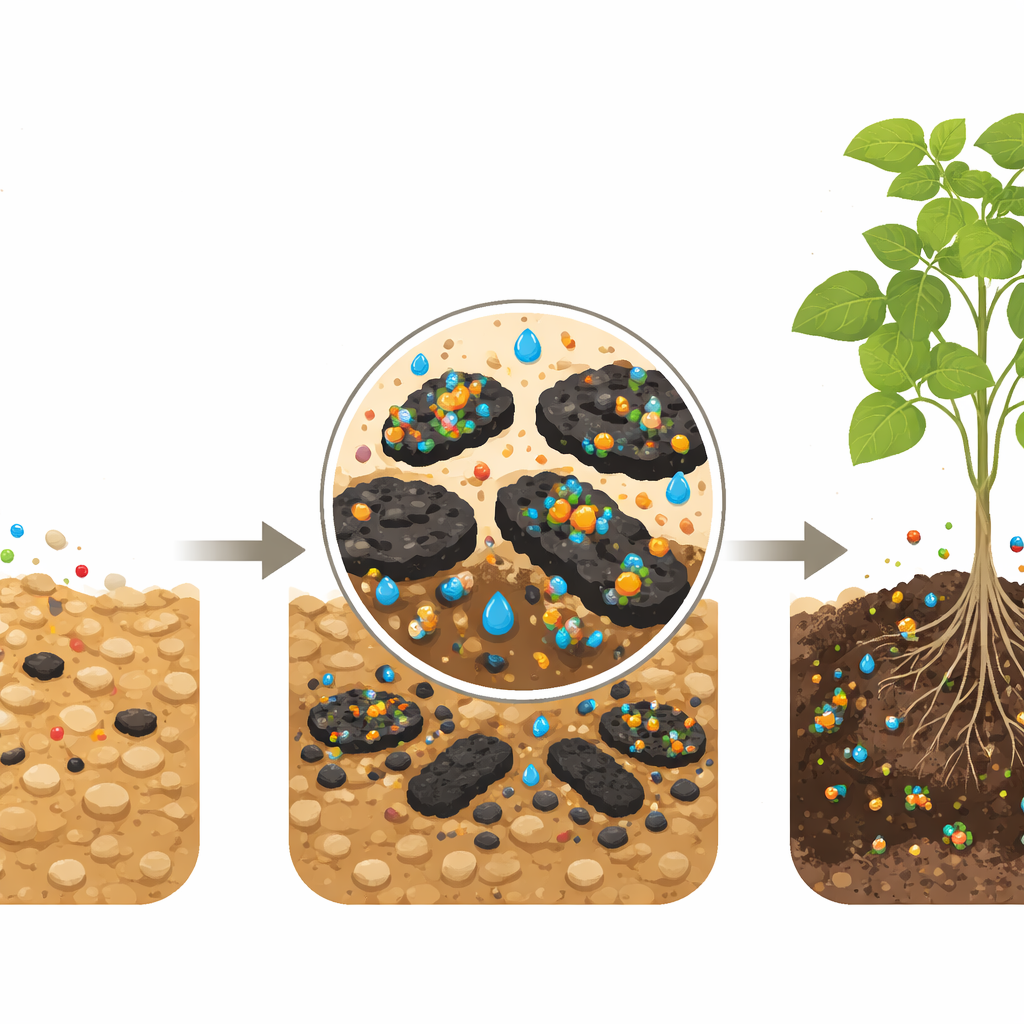
The researchers tested a more sustainable recipe: mixing biochar with two kinds of beneficial microbes, a bacterium (Bacillus amyloliquefaciens) and a yeast (Saccharomyces cerevisiae). Biochar is produced by heating plant wastes with little oxygen, creating a highly porous, stable form of carbon that can lodge in soil for years. Its sponge‑like structure can trap water and nutrients and provide sheltered niches for microbes. The microbial inoculants, applied with irrigation water, are known to release plant‑friendly compounds, make nutrients more available, and help protect roots. Over two growing seasons, the team compared many combinations of biochar, microbes, and standard nitrogen fertilizer in cowpea fields in Egypt’s Ismailia Governorate.
Healthier Underground Life and Better Soil Structure
Where biochar and microbes were combined, the hidden world below ground changed dramatically. Total microbial populations rose by as much as about two‑thirds, and the activity of a key soil enzyme linked to microbial breathing and nutrient cycling jumped by more than 40 percent. At the same time, the soil became physically friendlier to roots: bulk density, a measure of how compact the soil is, fell by roughly one‑fifth, while total pore space increased by more than one‑fifth. Organic matter content climbed by roughly a third, and the amounts of plant‑available nitrogen, phosphorus, and potassium each rose notably compared with untreated plots. Together, these shifts meant that the sandy soil began to act less like a sieve and more like a living, nutrient‑holding medium.
Greener Leaves and Bigger Harvests
The cowpea plants responded clearly to these underground improvements. Leaves contained far more green pigments and protective yellow‑orange carotenoids, signs of stronger photosynthesis and better stress tolerance. Plants in the best treatment—combining biochar with both microbial partners—were roughly twice as tall as those in untreated soil, produced about twice as many branches and leaves, and accumulated double the dry weight. Seed yield increased by about one‑third relative to the control. Importantly, many of these gains were achieved while relying on reduced amounts of chemical nitrogen fertilizer, suggesting that farmers could maintain or improve yields with lower input costs and less risk of fertilizer runoff.
What This Means for Dryland Farming
For readers concerned about food security and sustainable agriculture in a warming, drying world, this work offers a hopeful message: by recycling plant wastes into biochar and harnessing naturally occurring microbes, it may be possible to upgrade poor sandy soils without relying solely on costly chemicals. In this Egyptian case study, the biochar–microbe partnership turned weak, leaky soil into a more fertile, biologically active foundation for cowpea, boosting growth and yield. While longer‑term and broader trials are still needed, the findings point toward a practical, eco‑friendly strategy to help farmers coax more food from marginal lands while rebuilding soil health over time.
Citation: Khalifa, D.M., Hewait, H.M., Stanciu, AS. et al. Interactive effects of biochar and microbial biofertilizers on sandy soil fertility and cowpea yield in Egyptian agroecosystems. Sci Rep 16, 8735 (2026). https://doi.org/10.1038/s41598-026-44003-8
Keywords: biochar, microbial biofertilizer, cowpea, sandy soil, sustainable agriculture