Clear Sky Science · en
Neuronal correlates of spatial memory updating: c-Fos and GAD67 expression in the object-place recognition task
How the Brain Updates Its Inner Map
Finding your keys after someone has moved them seems effortless, but it actually requires your brain to update an internal map of the world. This study explores how a rat’s brain adjusts its memory of where things are when familiar objects suddenly appear in new spots. By teasing apart simple remembering from active updating, the researchers show that brain circuits do something subtler than just “turn up” their activity—they fine-tune it through targeted braking signals.
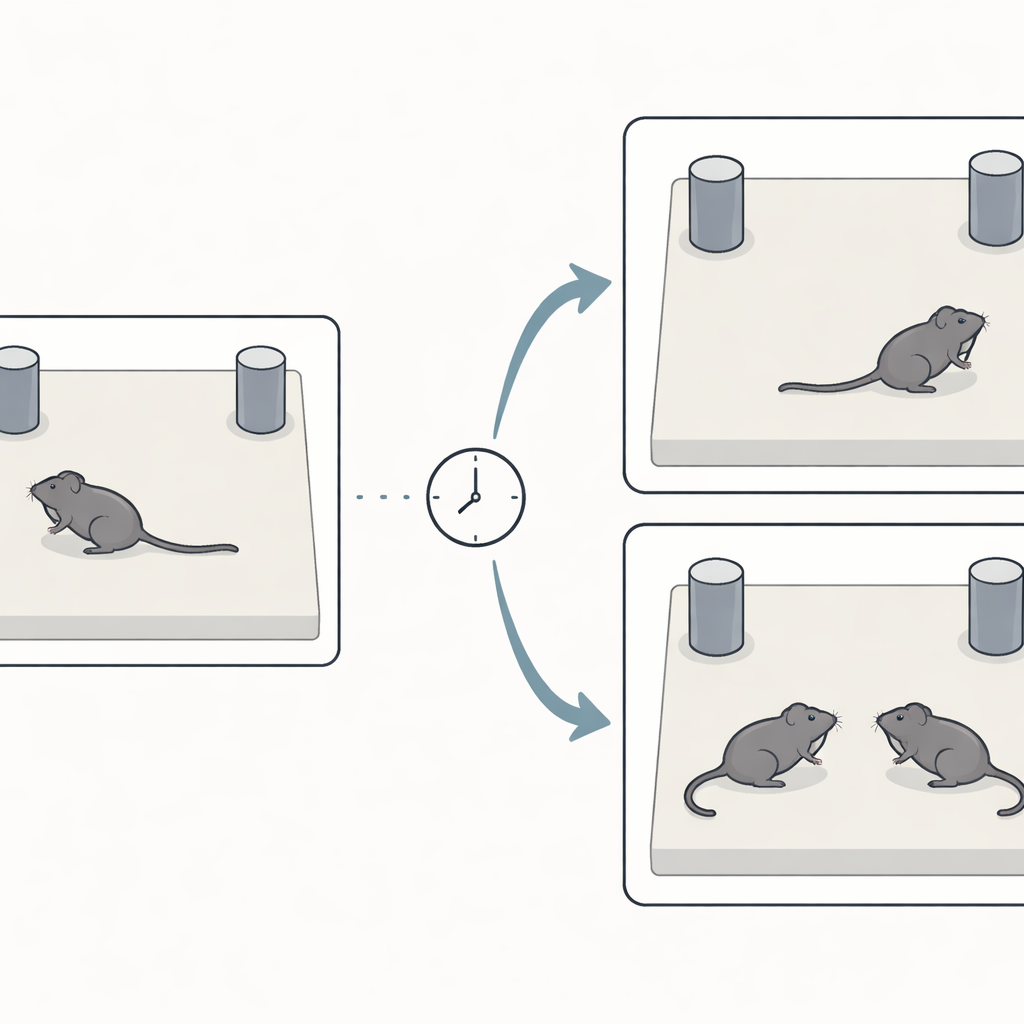
Rats, Objects, and a Moving World
To probe spatial memory, the team used a classic setup in which rats explore two identical objects in a square arena. After this first encounter, the animals rest for a few hours. When they return, one of two things happens: in the “updating” situation, one object has been shifted to a new location; in the control situation, both objects remain exactly where they were. Because rats naturally investigate change, spending more time at the moved object reveals that they remember the original layout and notice the new mismatch.
Behavior That Signals Memory Updating
Rats in the updating condition showed a clear preference for the displaced object, spending more time exploring it than its unmoved twin. They also spent longer periods rearing up on their hind legs, as if scanning the environment, a behavior known to increase when the spatial layout has changed. In contrast, rats in the no-change condition explored the two objects more evenly and reared less, even though overall movement and total exploration time were similar. Together, these behaviors indicate that only when the scene changed did the animals actively refresh the stored map of where things were.
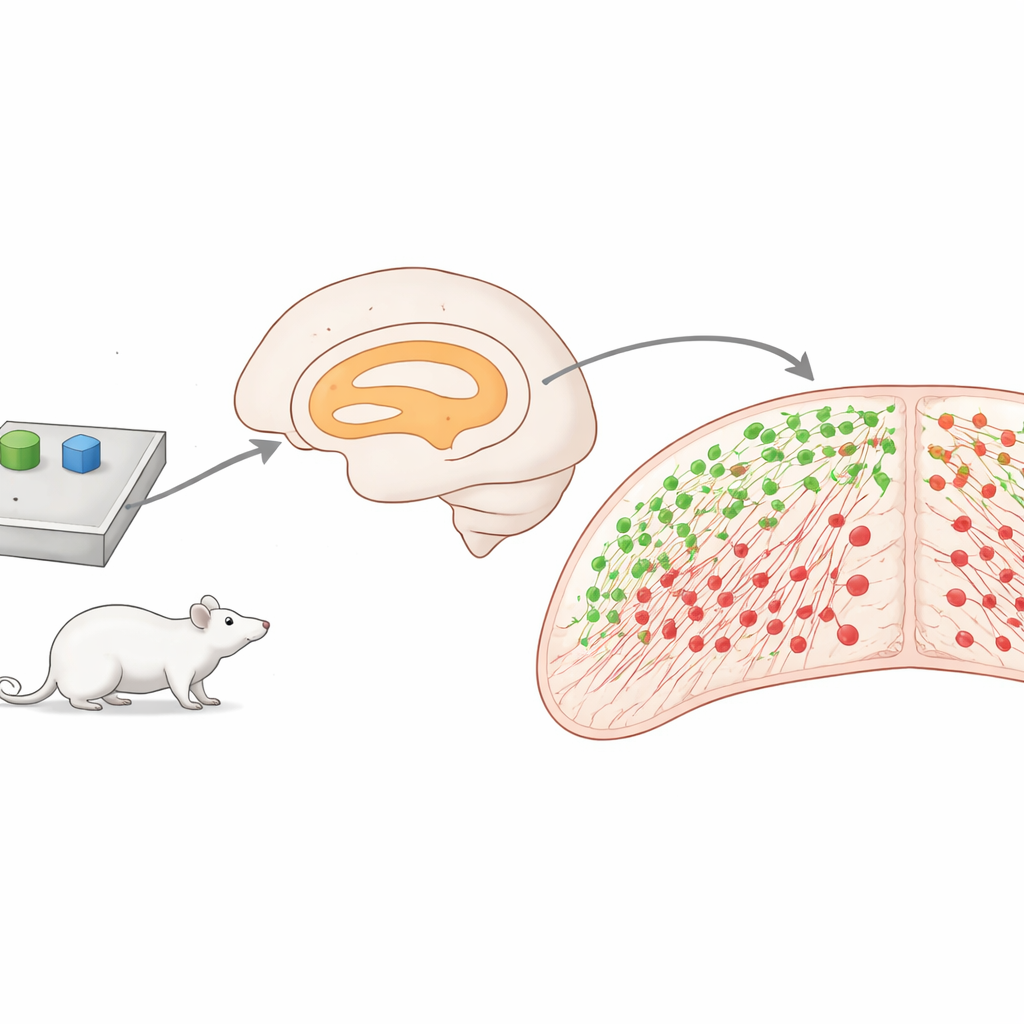
Looking Inside the Memory Circuits
To see what was happening in the brain, the researchers examined activity in several regions known to support spatial memory, including the hippocampus, frontal areas, and parts of the thalamus and posterior cortex. They used two molecular markers: one (c-Fos) flags recently active cells in general, while another (GAD67) identifies inhibitory cells—neurons that act as brakes within the circuit. Surprisingly, the overall level of c-Fos activity across these regions was similar whether or not an object had been moved. Simply needing to update the memory did not produce a broad surge of excitation in the memory network.
Targeted Brakes in a Key Hippocampal Zone
The key difference emerged when the team focused on inhibitory cells within the hippocampus, a structure central to building internal maps of space. In a specific part of the hippocampus called proximal CA1, the proportion of active inhibitory neurons was higher when rats had to detect and adjust to the moved object than when everything stayed the same. Other nearby zones, and other brain regions, did not show this shift. This pattern suggests that, rather than turning the whole hippocampus “up” during updating, the brain recruits extra local inhibition in one strategic subregion to sharpen the comparison between old and new layouts.
Networks That May Coordinate Updating
Beyond local changes, the researchers also looked at how strongly different brain areas tended to be active together, a rough indication of network coordination. They found a tendency—though not a firm statistical difference—for more tightly linked activity across hippocampal, frontal, thalamic, and posterior cortical areas when rats were updating their spatial memory compared with when they were merely re-exposed to the same scene. This hints that updating may engage a more synchronized memory network, even if overall activity levels remain modest.
What This Means for Everyday Memory
For a layperson, the central message is that updating a memory map is not just about firing more neurons. Instead, the brain appears to rely on carefully placed inhibitory signals in a precise part of the hippocampus, likely helping to filter out noise and focus on the meaningful change—like a single moved object in an otherwise familiar room. This targeted “braking” mechanism, possibly supported by broader network coordination, may be a general strategy the brain uses whenever we notice that something in a known environment is not quite where we left it.
Citation: Polanczyk, R., Dimitrov, S., Shan, X. et al. Neuronal correlates of spatial memory updating: c-Fos and GAD67 expression in the object-place recognition task. Sci Rep 16, 8966 (2026). https://doi.org/10.1038/s41598-026-43986-8
Keywords: spatial memory, hippocampus, inhibitory neurons, object-place recognition, memory updating