Clear Sky Science · en
Smart and efficient waste management through wireless IoT-enabled deep learning
Why high-tech trash sorting matters
Most of us toss our rubbish into a bin and forget about it, but what happens next shapes our environment, our health, and even our city budgets. Around the world, growing piles of mixed garbage make recycling harder and landfills fuller. This paper explores how cameras, wireless sensors, and a type of artificial intelligence can team up to spot what kind of waste we throw away and automatically send it to the right place, making the journey of our trash much smarter and safer.
The rising challenge of everyday garbage
Cities now generate billions of tons of solid waste each year, and that amount is expected to climb sharply by mid‑century. In many regions, workers still sort waste by hand, a slow, costly, and risky task that exposes them to sharp objects, fumes, and disease. Existing computer‑based tools have tried to help, but many struggle when faced with the messy, varied look of real trash. They may assume that data behave in simple, neat ways, or they are too heavy and slow to run in practical systems placed in bins, trucks, or sorting plants.
Smart eyes and connected machines
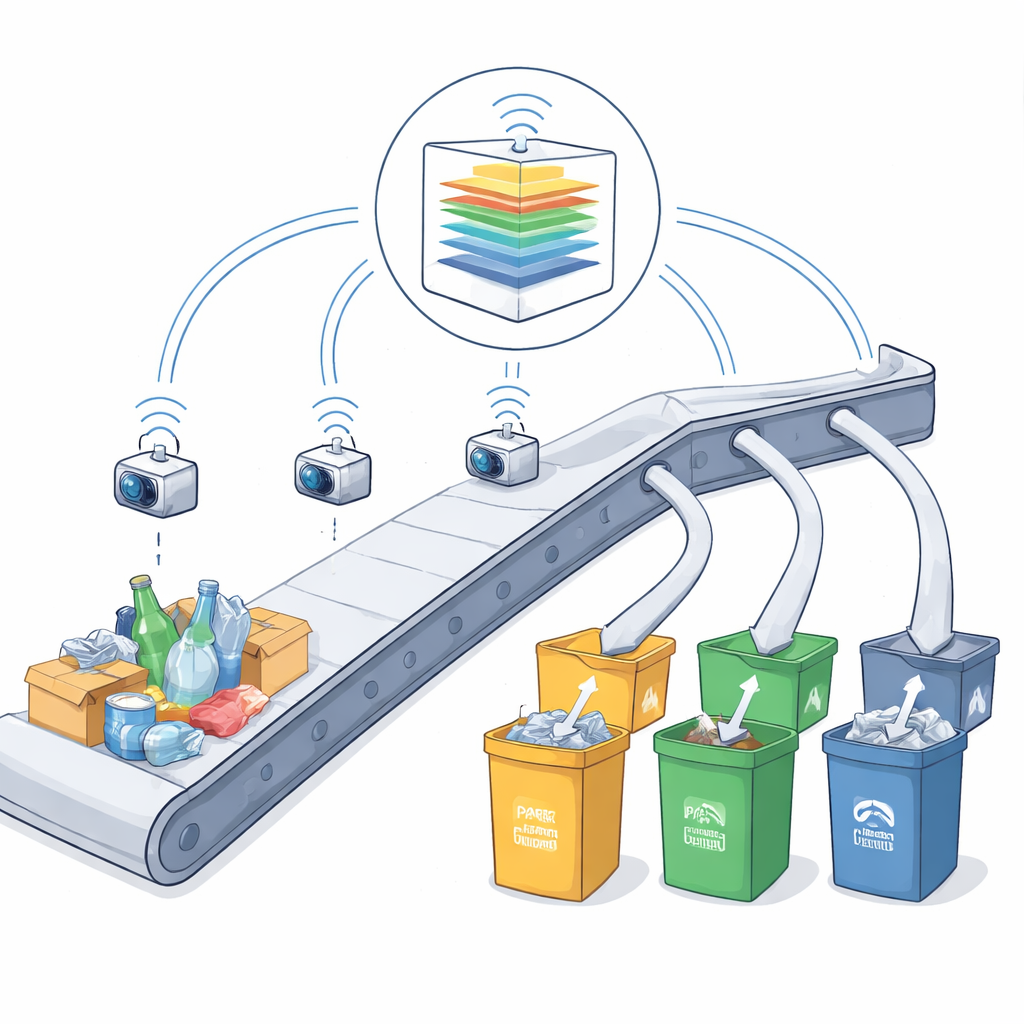
The study proposes a complete waste sorting setup that combines three main ingredients: networked cameras, a central computer, and a mechanical sorting line. High‑resolution cameras placed near collection points capture images of each item moving along a conveyor. A nearby microcontroller cleans up these images and sends them wirelessly to a more powerful computer. There, an image‑recognition model looks at each picture and decides whether it shows cardboard, glass, metal, paper, plastic, or general trash. Based on that decision, control signals move flaps, conveyors, or robotic arms so that each item drops into the right bin, all in real time without human handling.
How the learning engine sees your trash
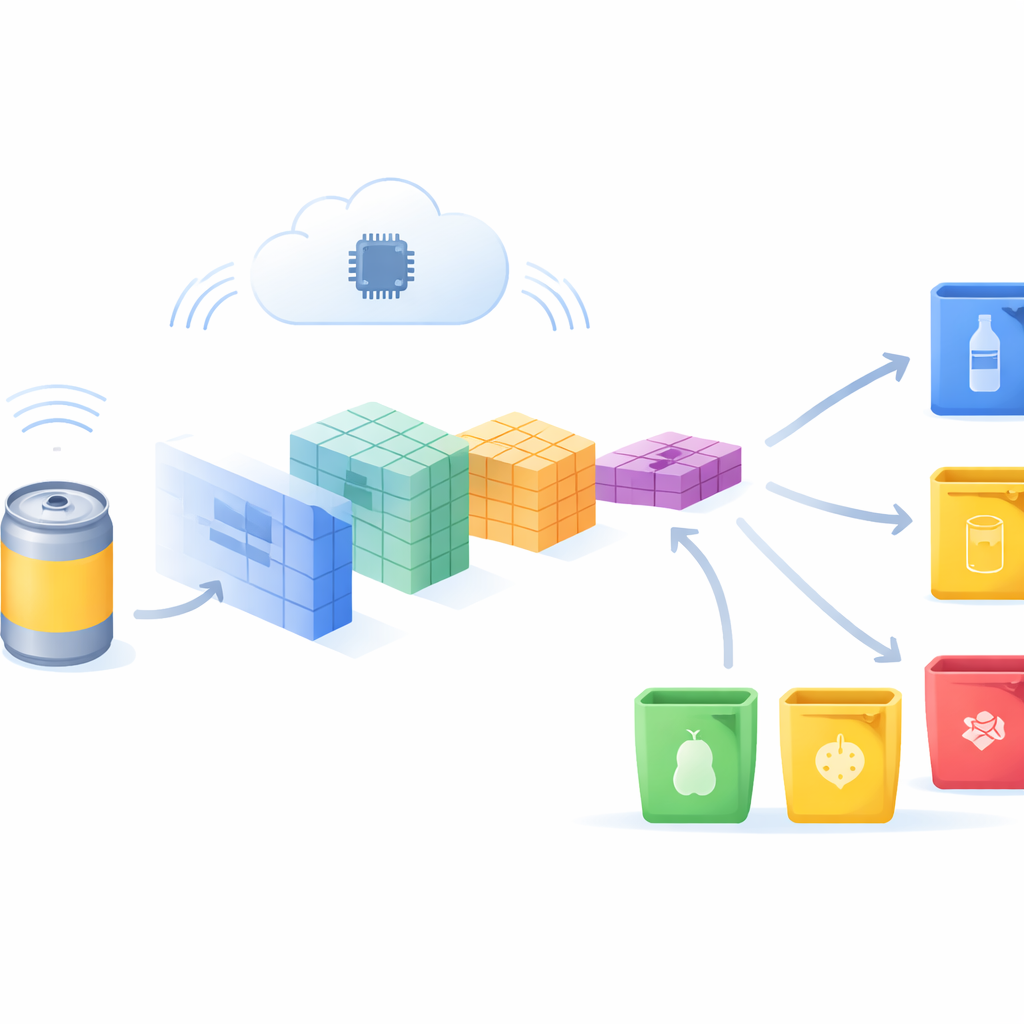
At the heart of the system is a layered pattern‑spotting engine inspired by how vision works in animals. Early layers in this engine focus on simple features such as edges and textures, while deeper layers combine these into more complex shapes that match bottles, cans, and boxes. The researchers trained this engine on a public collection of over 2,400 labeled photos showing the six types of waste in many shapes, sizes, and lighting conditions. During training, they repeatedly showed it these examples, slightly altered with rotations, zooms, and flips, so it would not be fooled by small changes in viewpoint. They also used regularization tricks that randomly switch off parts of the model during training to keep it from memorizing the dataset and help it cope with new, unseen images.
What worked well and what still trips it up
When tested on separate images, the system correctly labeled just over half of all items overall—modest at first glance, but a clear step up from many older approaches built on simpler rules or models. It was particularly strong at spotting cardboard and paper items, catching most of them and rarely raising false alarms. The system found metal, glass, and mixed trash reasonably well, but struggled more with plastic, where it often confused items with other shiny or crumpled materials. A closer look at the error patterns showed that objects that look alike to the human eye—such as metal cans and glass bottles, or different kinds of plastic packaging—are also hard for the model to tease apart using only standard color images.
Looking ahead to cleaner, smarter cities
In plain terms, this work shows that a camera‑based, wirelessly connected sorting line driven by modern pattern‑recognition software can already take over much of the dirty work of separating household waste. While the current version is not perfect, especially for tricky plastics, it proves that such systems can run continuously, scale to large waste streams, and be tuned to new conditions. With richer training data, improved model designs, and possibly extra sensing methods, future versions could sort more accurately and reliably. That would mean less contamination in recycling, fewer dangers for workers, and a more sustainable path for the ordinary bags of rubbish we put out each day.
Citation: Latha, P., Benni, N.S., Asuti, M.G. et al. Smart and efficient waste management through wireless IoT-enabled deep learning. Sci Rep 16, 11118 (2026). https://doi.org/10.1038/s41598-026-43827-8
Keywords: smart waste management, IoT, deep learning, automated recycling, image-based waste sorting