Clear Sky Science · en
Identifying key gait features in stroke patients using wearable inertial sensors and supervised and unsupervised machine learning
Why Walking After Stroke Matters
Stroke often turns a simple walk across the room into a daily struggle. For many survivors, how well they move their legs, trunk, and head determines whether they can live independently, avoid falls, and return to work or social life. This study explores how small wearable sensors and smart computer programs can capture the hidden signatures of post-stroke walking, helping clinicians see more than the naked eye can and paving the way for more targeted rehabilitation.
Measuring Steps With Tiny Wearable Devices
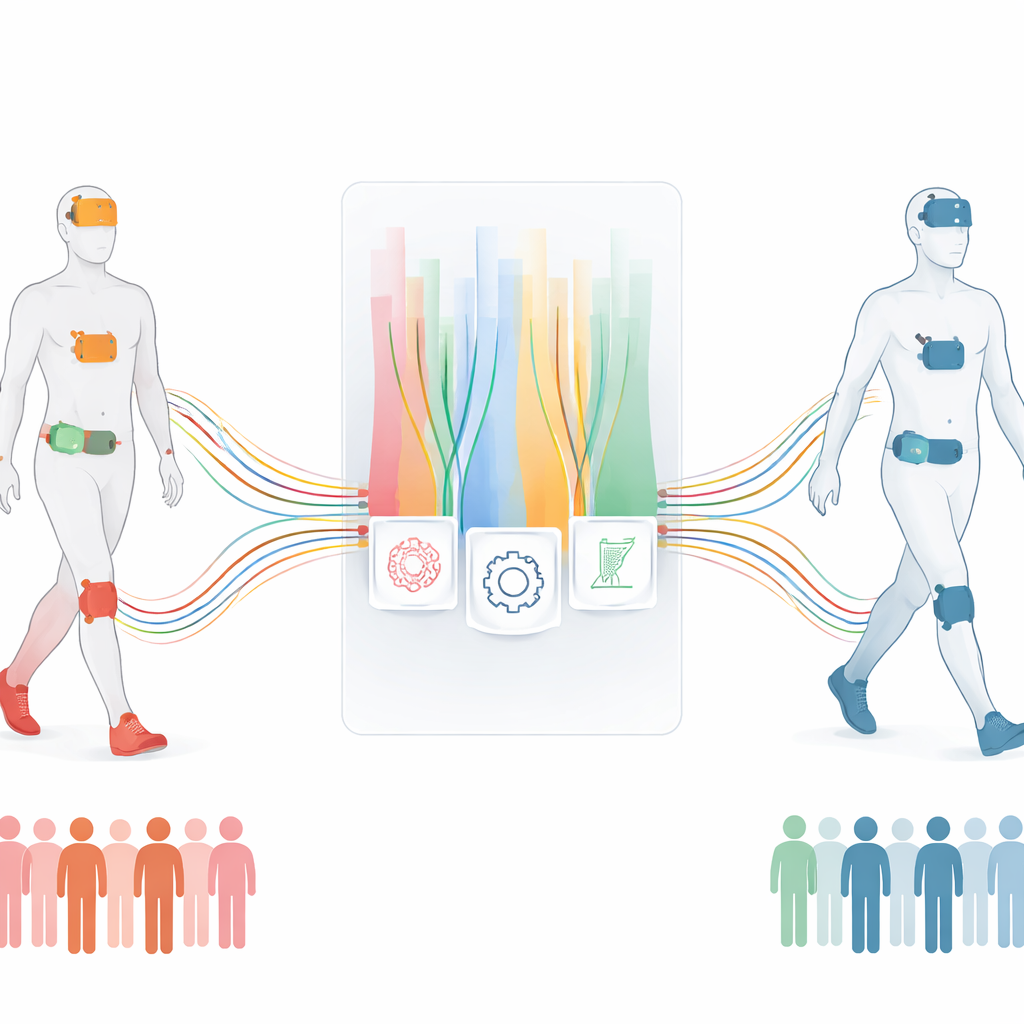
The researchers equipped 85 people who had experienced a stroke and 97 healthy volunteers with five coin-sized motion sensors. These were placed on the forehead, chest, lower back, and both shanks, and participants walked back and forth over ten meters at their usual pace. The sensors recorded how the body moved in three dimensions, capturing not just speed and step length but also how smooth and stable the trunk and head were, and how evenly the legs shared the work. From these recordings, the team computed 79 different measures describing timing, symmetry between legs, variability from step to step, and how smoothly and steadily the upper body moved.
Teaching Computers to Spot Problem Gait
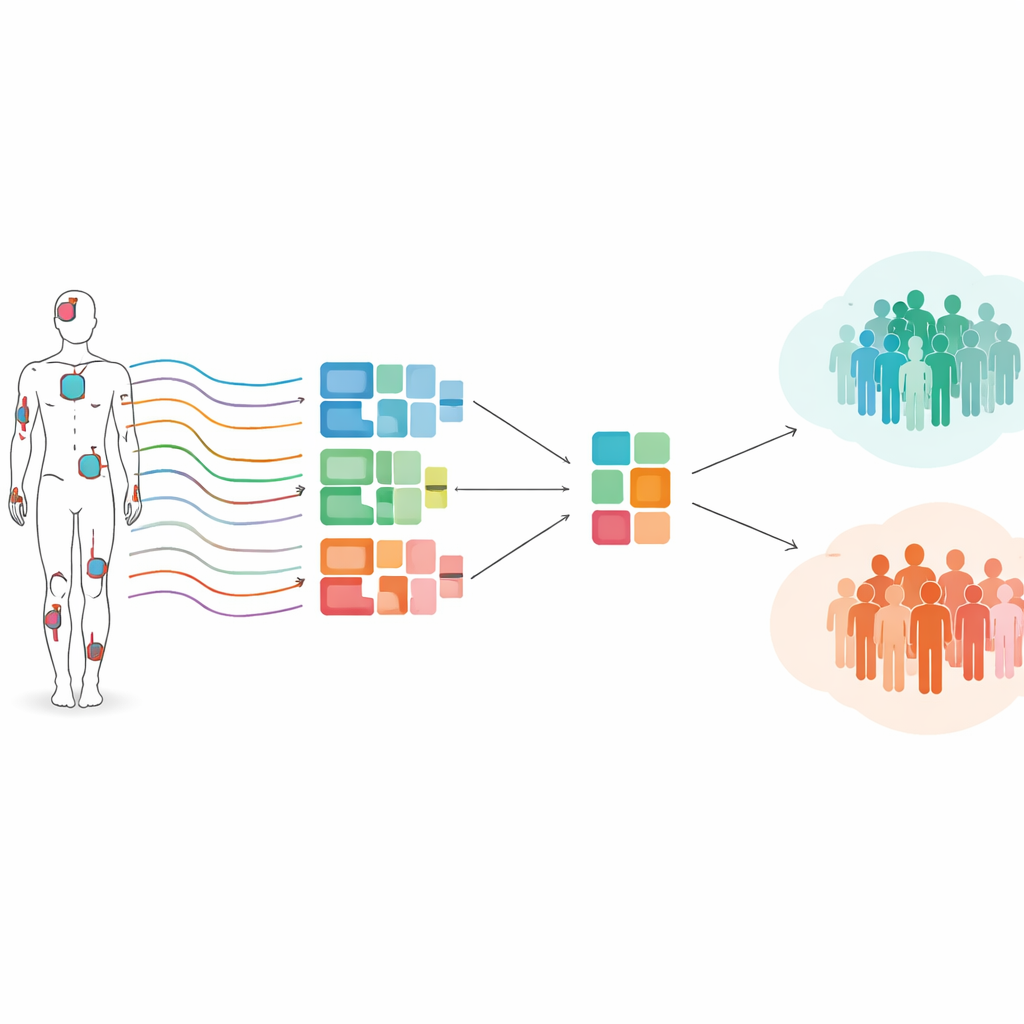
With so many possible measures, the challenge was to work out which ones truly separated stroke survivors from healthy walkers. The team used three different machine learning methods, all designed to sort people into two groups based on their gait: k-nearest neighbors, support vector machines, and decision trees. They first applied standard statistical tests to discard obviously unhelpful measures, then removed those that were nearly duplicates of each other. Finally, they used a step-by-step pruning approach that repeatedly trained each algorithm while removing one measure at a time, keeping only those that preserved high classification accuracy. Across many random splits of the data, the machines correctly distinguished stroke from healthy participants in roughly nine out of ten cases, with the support vector machine performing best and most consistently.
Zooming In on the Most Telling Walking Clues
From the original 79 measures, the process narrowed the list down to just nine that carried most of the useful information. These measures covered how fast people walked, how much their step timing varied, how symmetric their trunk motion was side to side, and how smooth the movements of the head and chest were, especially in the forward–backward and side-to-side directions. Notably, how smooth the head moved emerged as a fresh and powerful marker of stroke-related walking problems, hinting at issues in balance, gaze stabilization, and how the brain integrates signals from the inner ear and body during walking. Surprisingly, classic measures of left–right step asymmetry did not survive the selection, likely because stroke can disrupt gait in many different patterns, weakening their ability to reliably separate groups.
Letting the Data Group Itself
To test whether these selected walking clues were genuinely informative—and not just tuned to the specific learning methods—the researchers then used an unsupervised technique. Instead of telling the computer who had stroke, they simply fed in the chosen measures and asked it to form two clusters based on similarity. Using a method called k-medoids and several ways of measuring distance between data points, they showed that as few as three measures—overall walking speed, how much the stance phase varied, and a symmetry-related trunk signal—were enough to group people as stroke or healthy with about 90% accuracy. A distance rule that focused on the pattern of the measures rather than their absolute size proved the most stable across repeated tests.
What This Means for Everyday Care
To a non-specialist, the key message is that a short walk wearing five small sensors can reveal a compact “fingerprint” of how stroke has changed a person’s gait. Computers can use just a handful of carefully chosen movement measures—how fast you walk, how steady your steps are, and how smoothly your trunk and head move—to reliably tell stroke gait from healthy gait. This insight brings us closer to simple, clinic-friendly tools that can objectively track recovery, highlight hidden balance problems, and guide therapists in tailoring exercises. With further work to run these methods in real time and in more varied patient groups, such systems could become everyday companions in stroke rehabilitation, turning each step into useful feedback on the road to safer, more confident walking.
Citation: Brasiliano, P., Orejel-Bustos, A.S., Belluscio, V. et al. Identifying key gait features in stroke patients using wearable inertial sensors and supervised and unsupervised machine learning. Sci Rep 16, 8908 (2026). https://doi.org/10.1038/s41598-026-43666-7
Keywords: stroke gait, wearable sensors, machine learning, rehabilitation, walking stability