Clear Sky Science · en
Holistic IoT and cloud-based telemetry architecture for proactive fire monitoring in smart agriculture
Why smarter fire watching matters on the farm
Farmers around the world are under pressure to grow more food even as climate change makes their land drier and more fire‑prone. A single blaze can wipe out crops, soil, and equipment in minutes, threatening local livelihoods and food supplies. This paper presents a new real‑time fire monitoring system designed specifically for modern farms. By combining cheap sensors, small computers and cloud software, it aims to spot dangerous flames and smoke early, alert farmers within seconds, and keep the technology itself running reliably in the field.
Fires, fragile harvests, and the need for quick warning
Across many regions, rising temperatures, droughts and forest fires are shrinking usable farmland just as global food demand is soaring. Traditional fire management in agriculture tends to be reactive: people notice smoke, call for help, and respond only after flames are visible. Recent research has tried to improve this with drones, satellite images and artificial‑intelligence‑based fire recognition, but these solutions can be costly or focus on only one part of the problem, such as sensing or data storage. The authors argue that farms need an affordable, end‑to‑end system that not only detects early signs of fire but also moves data quickly, filters out false alarms, and proves it can operate day after day without overloading its own electronics.
Three layers working together like a nervous system
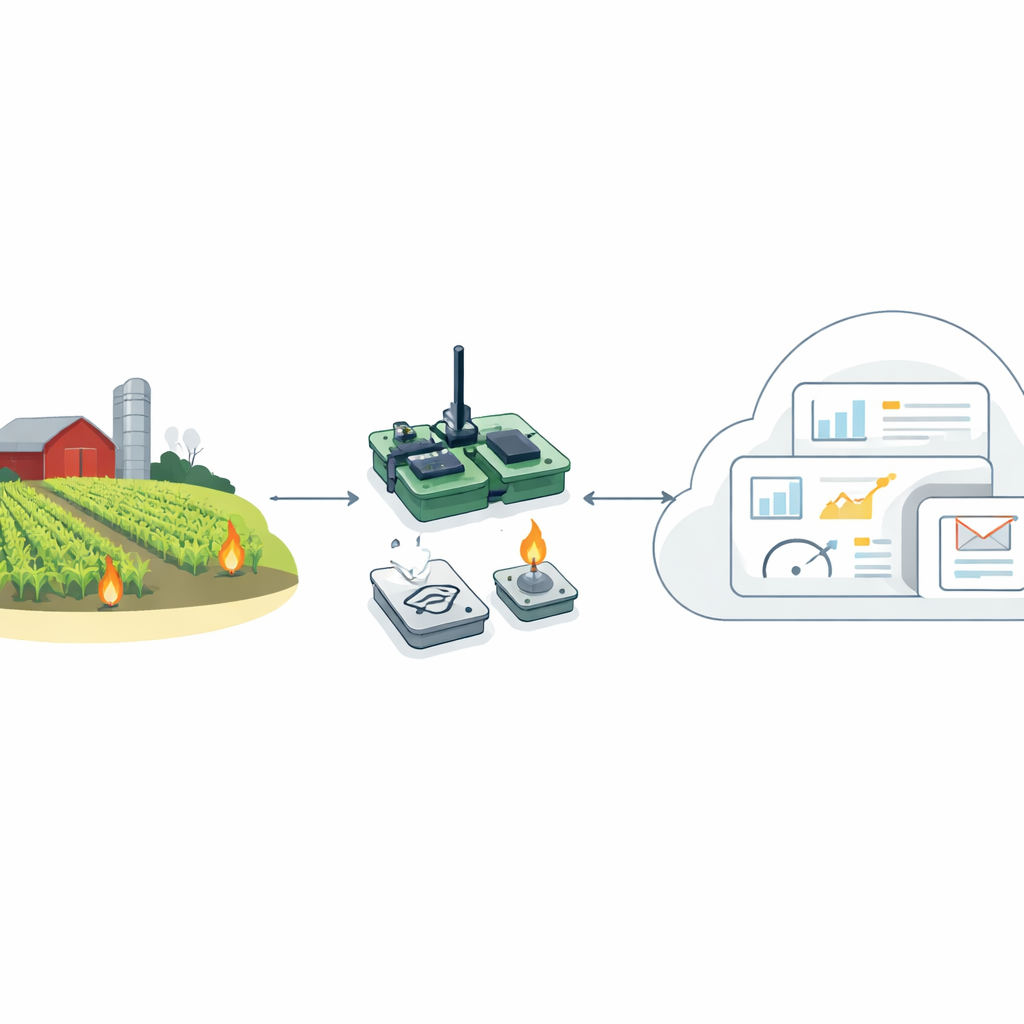
The proposed architecture acts like a nervous system for the field, built from three tightly connected layers. On the ground, a device layer uses simple smoke and flame sensors wired through an analog‑to‑digital converter into a Raspberry Pi 3 B+ mini‑computer and gateway. This layer constantly samples the air and nearby heat while also watching its own health by tracking the processor load and memory usage. The second layer lives in the cloud on an open‑source platform called ThingsBoard, chosen because it is flexible and inexpensive to scale. It receives a steady stream of compact data packets sent every two seconds using the MQTT messaging standard and JSON format, well suited to patchy rural internet links. The third layer processes this telemetry, driving dashboards, rule engines and automatic alerts that turn raw numbers into clear signals farmers can act on.
From sensor readings to instant alerts
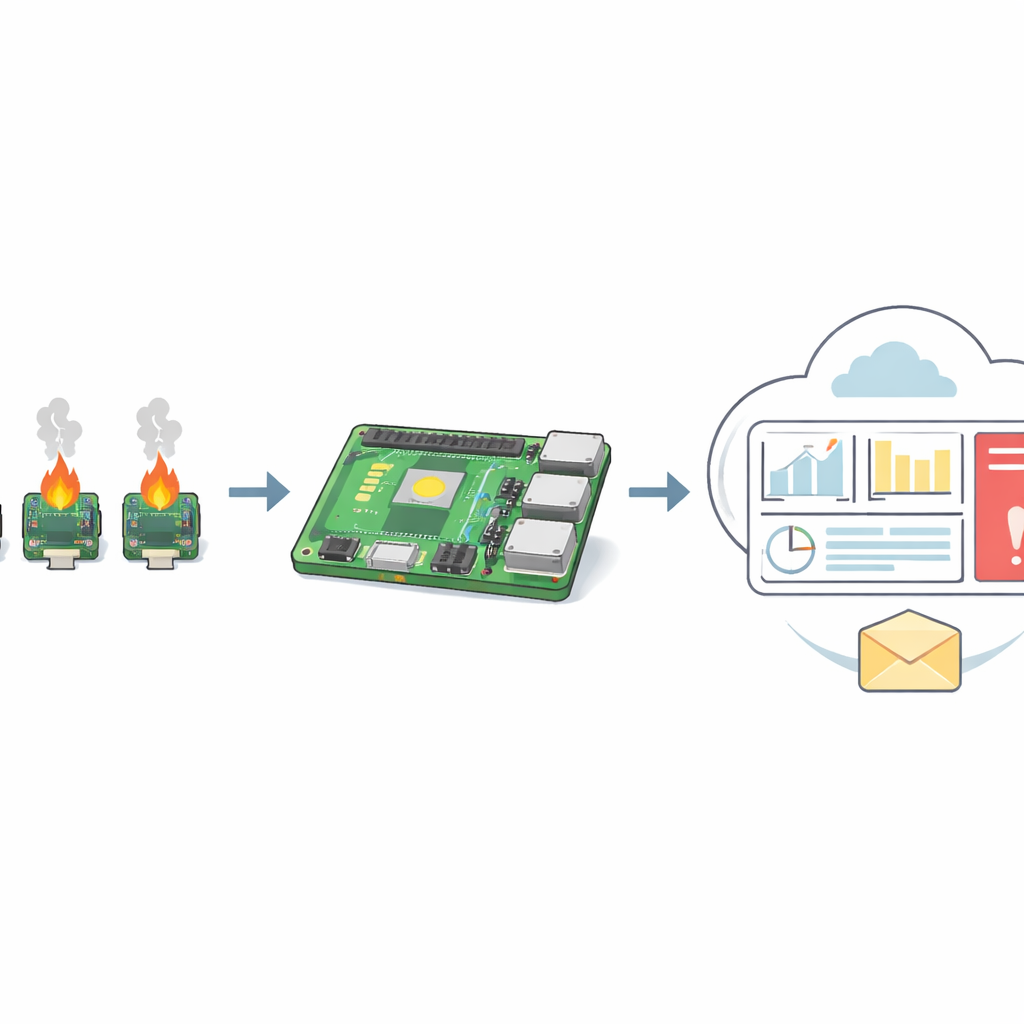
At the heart of the system is a self‑configuring algorithm that coordinates connection to the cloud, packages each sensor reading, and sends it with built‑in checks on timing and content. Every cycle, the Raspberry Pi gathers smoke and flame percentages, calculates whether conditions look like a real fire, and logs its own CPU and memory use. It then encodes all of this into a small message and publishes it to the cloud with quality‑of‑service settings that confirm delivery. In ThingsBoard, the data are displayed as graphs and gauges that show sensor behavior, processor workload and memory stability over time. Rules compare incoming values with thresholds; when flame and smoke spike together in a suspicious pattern, the system automatically triggers an email alert so the farmer can respond within minutes instead of hours. The same interface lets users export tables of past events to study trends or refine the thresholds.
How well the system performs in practice
The researchers tested their prototype under realistic conditions, repeatedly simulating both fire and non‑fire situations. Out of 35 staged fires, the system correctly recognized 34, achieving a detection accuracy of 96.1%. In 15 non‑fire cases, the false alarm rate stayed under 2.8%, showing it could distinguish genuine danger from everyday fluctuations in smoke or heat. Data took less than 300 milliseconds on average to travel from the Raspberry Pi to the cloud dashboard, providing near real‑time updates. Over longer trials, the system remained available more than 98% of the time, and the small computer’s processor and memory loads stayed modest and stable, even while continuously sending sensor and system‑health data. This suggests the design is robust enough to run for long periods without crashing or clogging the network.
What this means for safer, smarter farming
In plain terms, the study shows that an affordable mix of field sensors, a single small computer and open‑source cloud tools can act as a reliable early‑warning system for farm fires. By unifying detection, data transport, live visualization and automatic email alerts in one tested setup, the authors move beyond earlier prototypes that covered only one or two pieces of the puzzle. Their results indicate that farms could use such systems to catch fires when they are still small, limit damage, and better protect harvests and surrounding forests. While larger‑scale trials, improved energy efficiency and stronger internet‑outage handling are still needed, this work points toward a practical way to make agriculture more resilient in a warming, fire‑prone world.
Citation: Morchid, A., Salami, A., Khalid, H.M. et al. Holistic IoT and cloud-based telemetry architecture for proactive fire monitoring in smart agriculture. Sci Rep 16, 8669 (2026). https://doi.org/10.1038/s41598-026-43538-0
Keywords: smart agriculture, fire detection, IoT sensors, cloud telemetry, food security