Clear Sky Science · en
The key m6A methylation regulator IGF2BP1 possesses potential prognostic value in papillary thyroid carcinoma
Why this thyroid study matters
Papillary thyroid cancer is usually considered a “good prognosis” cancer, yet many patients still face tumor recurrence and the limits of current treatments. This study looks deep inside thyroid tumor cells to find a molecular signal that could help doctors predict which patients will do better and who might respond more strongly to certain drugs. The researchers focus on a little-known RNA‑binding protein called IGF2BP1 and uncover an unexpectedly protective role for it in papillary thyroid carcinoma.

Searching for better warning signs
The team began with a practical problem: even after surgery, hormone therapy, and radioactive iodine, more than one in ten papillary thyroid cancer patients will see their disease return. Existing clinical markers do not fully explain who is at risk. To hunt for better clues, the authors turned to a large U.S. cancer database containing genetic and survival data from nearly 400 papillary thyroid cancer patients. They focused on 17 genes that control a chemical tag on RNA called m6A, which fine‑tunes how cells read their genetic messages and is increasingly linked to cancer behavior.
Finding an unexpected protector
By comparing tumor tissue with normal thyroid samples, the researchers found that most of these 17 RNA‑modifying genes were dialed down in tumors. One gene in particular, IGF2BP1, stood out: it was clearly lower in cancerous tissue yet, paradoxically, patients whose tumors kept higher levels of IGF2BP1 lived longer. Using several statistical models, including clustering and survival analyses, the authors showed that IGF2BP1 could act as an independent predictor of overall survival, with a combined score of age plus IGF2BP1 giving highly accurate estimates of 1‑, 3‑, and 5‑year survival chances.
Connecting to spread, mutations, and the immune system
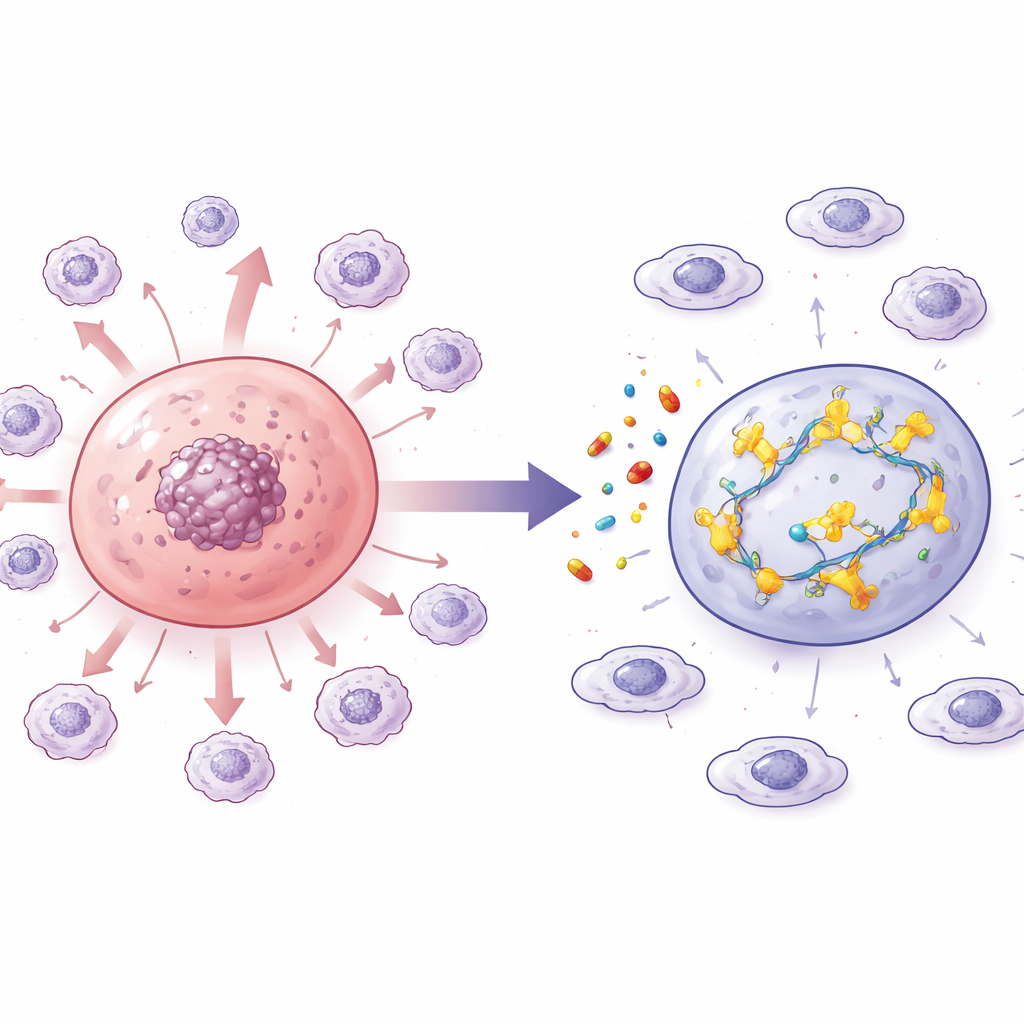
To see how this signal plays out in real patients, the team measured IGF2BP1 in tumor samples from 101 people who had undergone thyroid surgery. Again, they saw that cancer tissue tended to have less IGF2BP1 than nearby normal thyroid. Low levels were linked to spread to central neck lymph nodes and to a common cancer‑driving DNA change called BRAFV600E, both markers of more aggressive disease. Using large single‑cell and immune‑analysis datasets, they also observed that higher IGF2BP1 levels went along with a richer presence of key immune cells, such as certain T cells and natural killer cells, and with molecules involved in immune “checkpoints” that can either restrain or unleash anti‑tumor responses.
Zooming in on tumor behavior in the lab
The authors then moved from databases to living cells. They engineered papillary thyroid cancer cell lines to boost IGF2BP1 and compared them with control cells. In multiple lab tests, cells with extra IGF2BP1 grew more slowly, formed fewer colonies, and were less able to migrate or invade through artificial barriers—behaviors linked to lower metastatic potential. This contrasts with many other cancers where IGF2BP1 tends to act like an accelerator of growth, suggesting that in papillary thyroid cancer it may instead play the role of a brake. The team also used drug‑sensitivity models and found that higher IGF2BP1 expression was associated with greater predicted response to two drugs often used in advanced disease, doxorubicin and sunitinib, but not to paclitaxel or sorafenib.
What this could mean for patients
Taken together, the findings suggest that IGF2BP1 could serve as a useful marker to help sort papillary thyroid cancer patients into different risk groups and to guide treatment choices. Tumors that retain higher IGF2BP1 may be less likely to spread, more responsive to certain drugs, and associated with better five‑year survival, while tumors with very low IGF2BP1 could warrant closer follow‑up or more aggressive management. Although larger, multi‑center studies and deeper mechanistic work are still needed, this study points to IGF2BP1 as both a promising prognostic indicator and a potential therapeutic target in a cancer where finer‑grained risk tools are urgently needed.
Citation: Wang, J., Dai, C., Wei, M. et al. The key m6A methylation regulator IGF2BP1 possesses potential prognostic value in papillary thyroid carcinoma. Sci Rep 16, 8699 (2026). https://doi.org/10.1038/s41598-026-43501-z
Keywords: papillary thyroid cancer, prognostic biomarker, RNA binding protein, tumor immune microenvironment, targeted therapy