Clear Sky Science · en
Enhanced forecasting of friction and cohesion of augmented unsaturated soil with nanostructured quarry fines (NQF) addition
Why stronger soil matters for everyday life
Roads, embankments, and building foundations all rely on the strength of the soil beneath them. In many tropical regions, that soil is a moisture-sensitive lateritic clay that can weaken when it gets wet and strengthen when it dries, leading to cracks, rutting, and costly repairs. This study explores how to make such soils stronger and more predictable by adding recycled mineral powders and then using artificial intelligence to forecast how well the treated soil will perform. The goal is safer, longer-lasting infrastructure with less trial-and-error testing in the lab.
Turning local waste into helpful soil additives
The researchers started with a problematic lateritic soil from southern Nigeria, classified as highly plastic with a substantial clay content and modest natural shear strength. They combined this soil with two types of finely ground, largely waste-derived materials. One is a “hybrid cement” made from rice husk ash activated with a small amount of lime, and the other is nanostructured quarry fines produced by grinding quarry dust down to extremely small particles. These additives contain reactive oxides that can bond with soil minerals and, thanks to their tiny size, can pack into pores between grains, potentially increasing both friction and cohesion within the soil matrix. 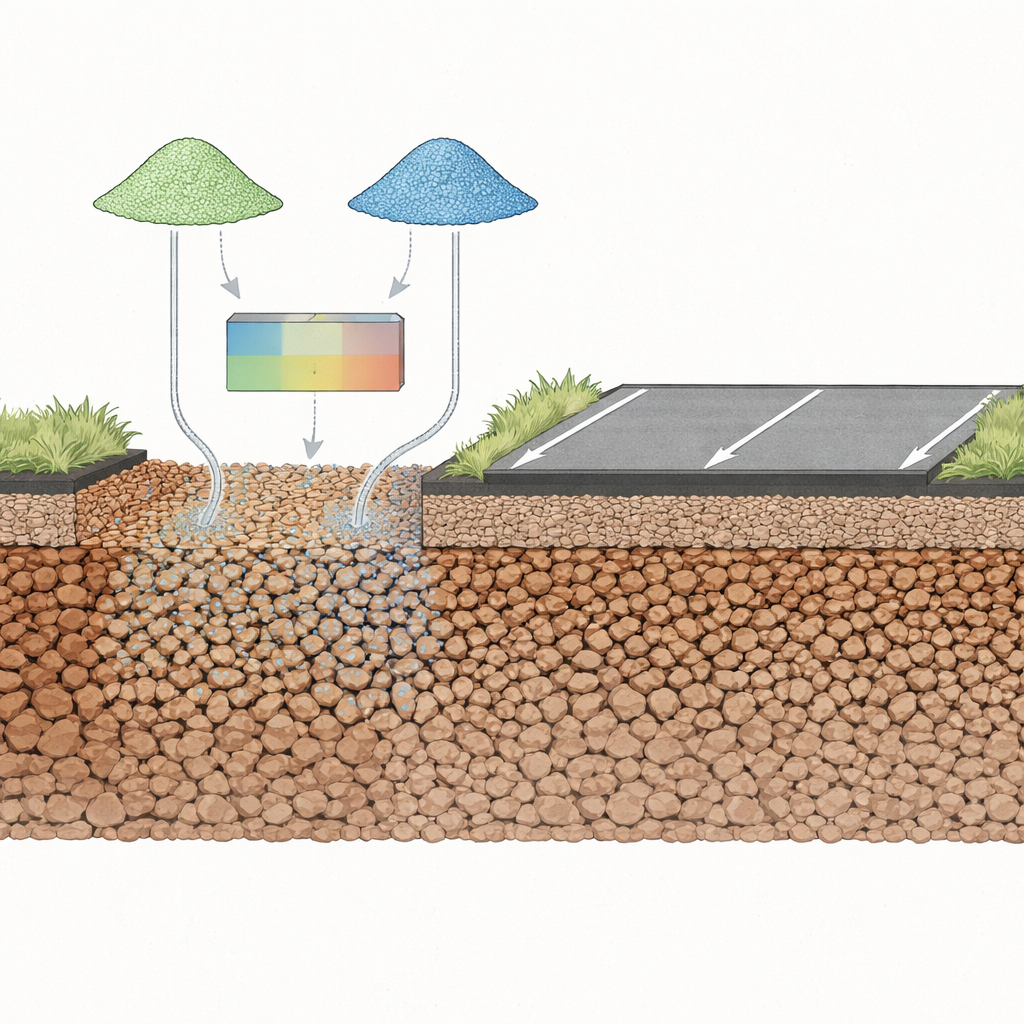
From laborious tests to smart predictions
Traditionally, engineers must run time-consuming and equipment-intensive shear tests to determine two key soil-strength properties: the friction angle and cohesion. Instead of relying solely on such tests, this study generated a rich experimental database and then trained computer models to predict these properties from simpler measurements. The team ran many laboratory mixes, varying the amounts of hybrid cement and nanostructured quarry fines and measuring eleven input properties such as clay content, plasticity, density, and moisture characteristics. They used a straightforward linear regression model as a baseline and then applied three more advanced “intelligent” approaches: support vector machines, radial basis function networks, and multilayer perceptron neural networks.
How the machines learned to read the soil
The dataset, consisting of 121 records, was split into a larger portion for training and a smaller portion for testing, mimicking how a student first studies examples and then sits an exam. Each model learned to map the eleven input soil descriptors to the two target outputs: friction angle and cohesion. Performance was judged with several standard metrics that check how close the predictions are to actual test results and how well the models generalize to unseen data. While all methods performed well, the neural-network-based approaches—especially the multilayer perceptron—stood out. They captured subtle, nonlinear relationships in the data, achieving very high correlation with measured strengths and very low prediction errors for both friction and cohesion.
What really controls strength in the treated soil
To move beyond “black box” predictions, the authors performed a sensitivity analysis that ranks which inputs matter most. They found that the weight of the unsaturated soil was the dominant factor controlling the friction angle, underscoring how compaction and moisture state govern how particles rub and lock against one another. For cohesion, clay content emerged as the most influential, consistent with the way fine, active clays and cementing products knit particles together. The mineral additives themselves—hybrid cement and nanostructured quarry fines—also showed strong positive influence, especially when considered alongside density and moisture parameters. This picture matches the microscopic evidence: nanoparticles and ash-derived binders fill voids, coat grains, and build a denser, more bonded skeleton. 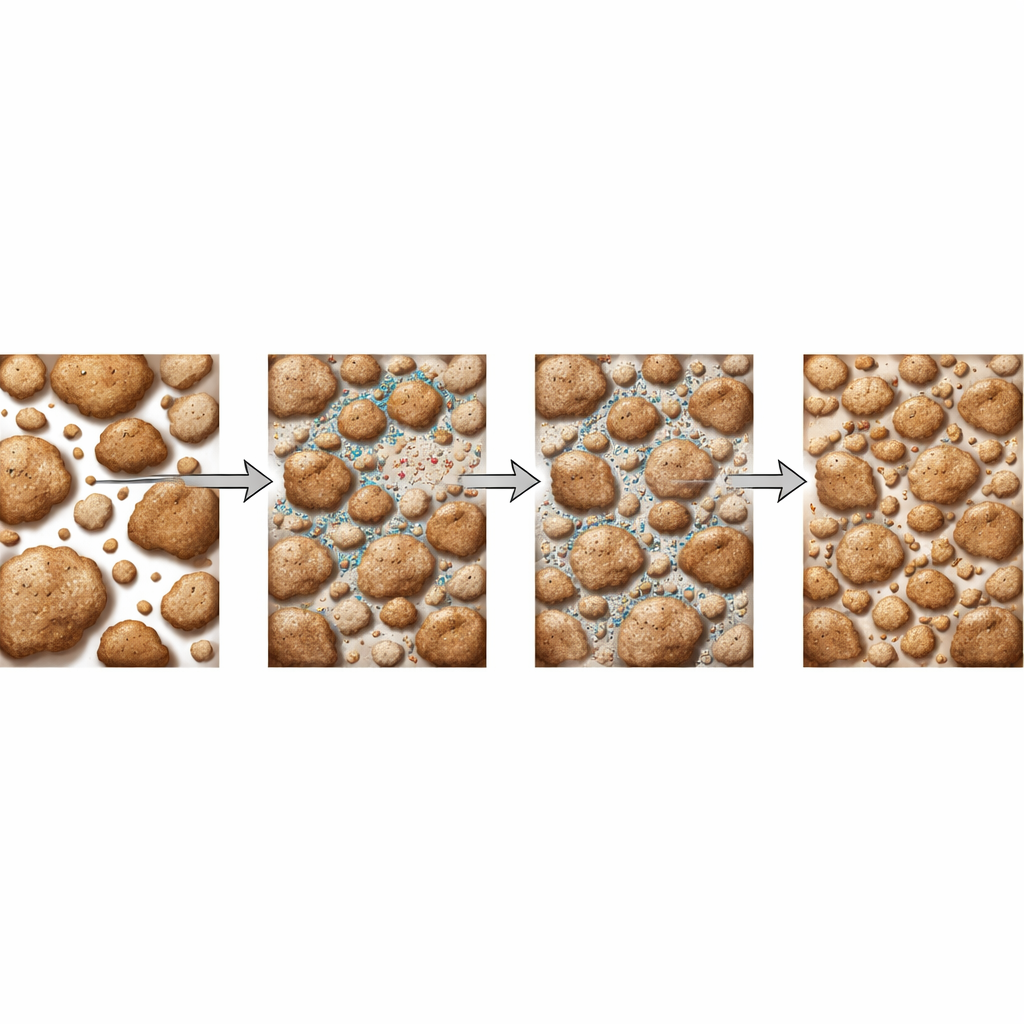
From research code to a usable design tool
To make the work directly useful for practitioners, the team embedded the best-performing neural network into a graphical user interface. With this tool, an engineer can enter basic soil and mix information and instantly obtain estimated friction and cohesion values, instead of scheduling new rounds of advanced shear tests. The interface is designed around the experimentally supported ranges of each parameter, but it can be expanded as more data become available or adapted to other soil types.
What this means for real-world projects
For a non-specialist, the takeaway is straightforward: the study shows that local waste-derived powders can significantly enhance the strength of troublesome tropical soils, and that modern machine-learning tools can reliably predict this improvement from easy-to-measure properties. This combination reduces both the environmental footprint—by recycling agricultural and quarry wastes—and the cost and complexity of geotechnical testing. In practice, that means better-informed design of roads and earthworks, especially in regions where laboratory resources are limited but the need for resilient infrastructure is high.
Citation: Kamchoom, V., Van, D.B., Hosseini, S. et al. Enhanced forecasting of friction and cohesion of augmented unsaturated soil with nanostructured quarry fines (NQF) addition. Sci Rep 16, 8899 (2026). https://doi.org/10.1038/s41598-026-43458-z
Keywords: unsaturated soil, machine learning, soil stabilization, nanostructured quarry fines, geotechnical engineering