Clear Sky Science · en
Integration of machine learning and microstructural characterization for strength forecasting with silica fume and M-sand for sustainable concrete
Stronger, Greener Concrete for Tomorrow’s Cities
Concrete is the backbone of modern buildings, bridges, and roads—but making it comes with a heavy environmental cost, especially from cement production and river sand mining. This study explores how to make concrete both tougher and more sustainable by blending industrial by-products into the mix and using advanced computer models to predict performance. The result is a recipe that not only cuts the use of traditional materials but also delivers stronger, longer-lasting concrete for future structures.
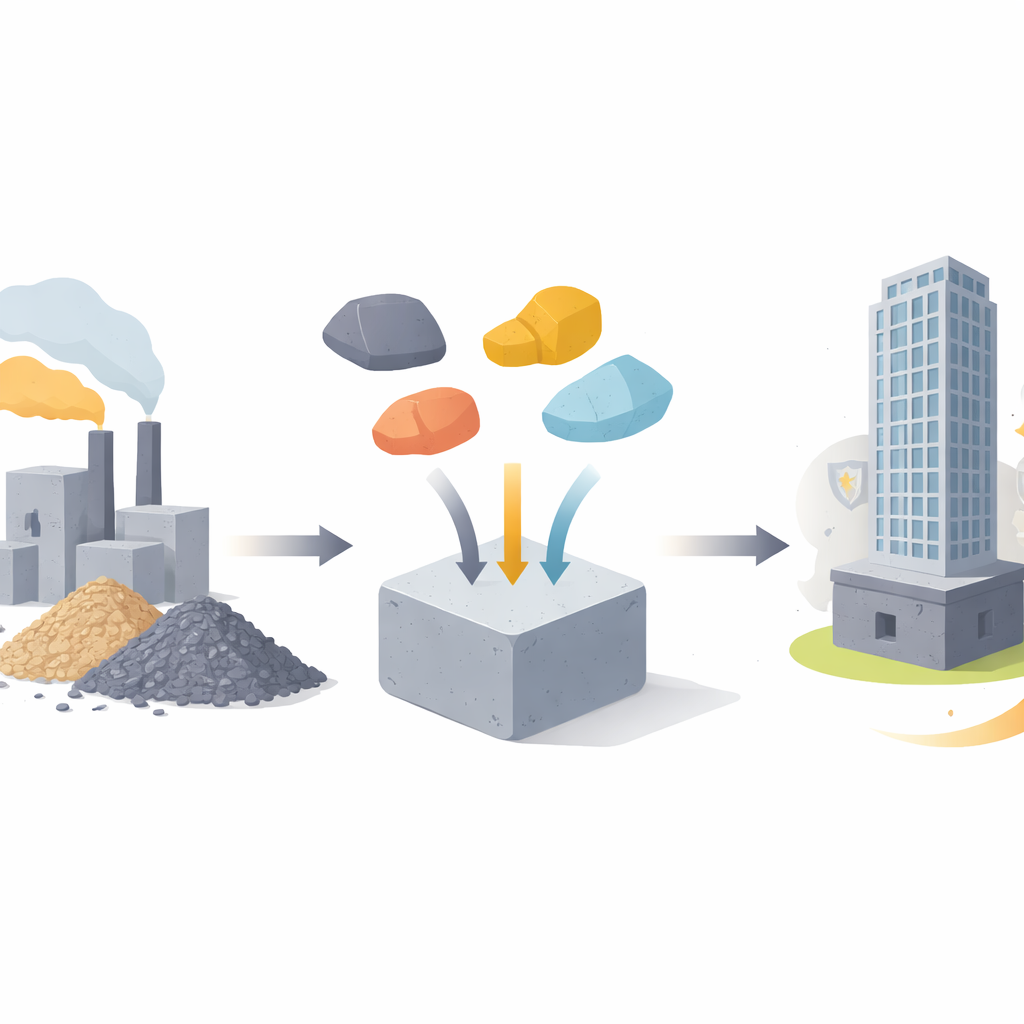
Rethinking What Goes Into Concrete
Instead of relying solely on ordinary cement and natural river sand, the researchers designed six different concrete recipes. Each used 10% fly ash (a fine powder from coal power plants), varying amounts of silica fume (a very fine by-product of silicon production), and replaced river sand completely with manufactured sand—crushed rock processed to mimic natural sand. These ingredients were combined in carefully controlled proportions, then cast into cubes, cylinders, and beams. The team tested how well each mix resisted being crushed, pulled apart, and bent after 7, 28, and 90 days of curing, mimicking how concrete gains strength over time on a construction site.
Finding the Sweet Spot for Strength
All of the modified concretes performed at least as well as the standard mix, and some clearly did better. The standout recipe contained 10% fly ash, 12% silica fume, and 100% manufactured sand. Compared with the reference mix, this blend delivered compressive strength gains of about 17% at 28 days and 20% at 90 days, with similar improvements in tensile and bending strength. Non-destructive ultrasound tests showed that this concrete was not only stronger but also of excellent internal quality, with sound waves traveling faster through its denser structure. However, the researchers also found that adding too much silica fume (18–24%) began to reduce the benefits, revealing that there is an optimal window rather than a “more is always better” rule.
Peering Inside the Concrete at the Microscale
To understand why the best mix behaved so well, the team looked inside the hardened concrete using electron microscopes and thermal analysis. Images of the internal microstructure showed that fly ash and silica fume help create a dense, glue-like network that binds the sand and stone together more tightly, with fewer pores and cracks. Chemical scans confirmed that the balance between calcium and silicon shifted toward a composition known to form especially stable binding gels. Thermal tests, in which tiny samples were slowly heated, revealed how water and other components were released, linking changes in weight to the breakdown of key internal phases. Altogether, these probes showed that the optimal mix produces a compact, well-connected internal skeleton that resists damage and slows the passage of water and other agents that usually weaken concrete over time.
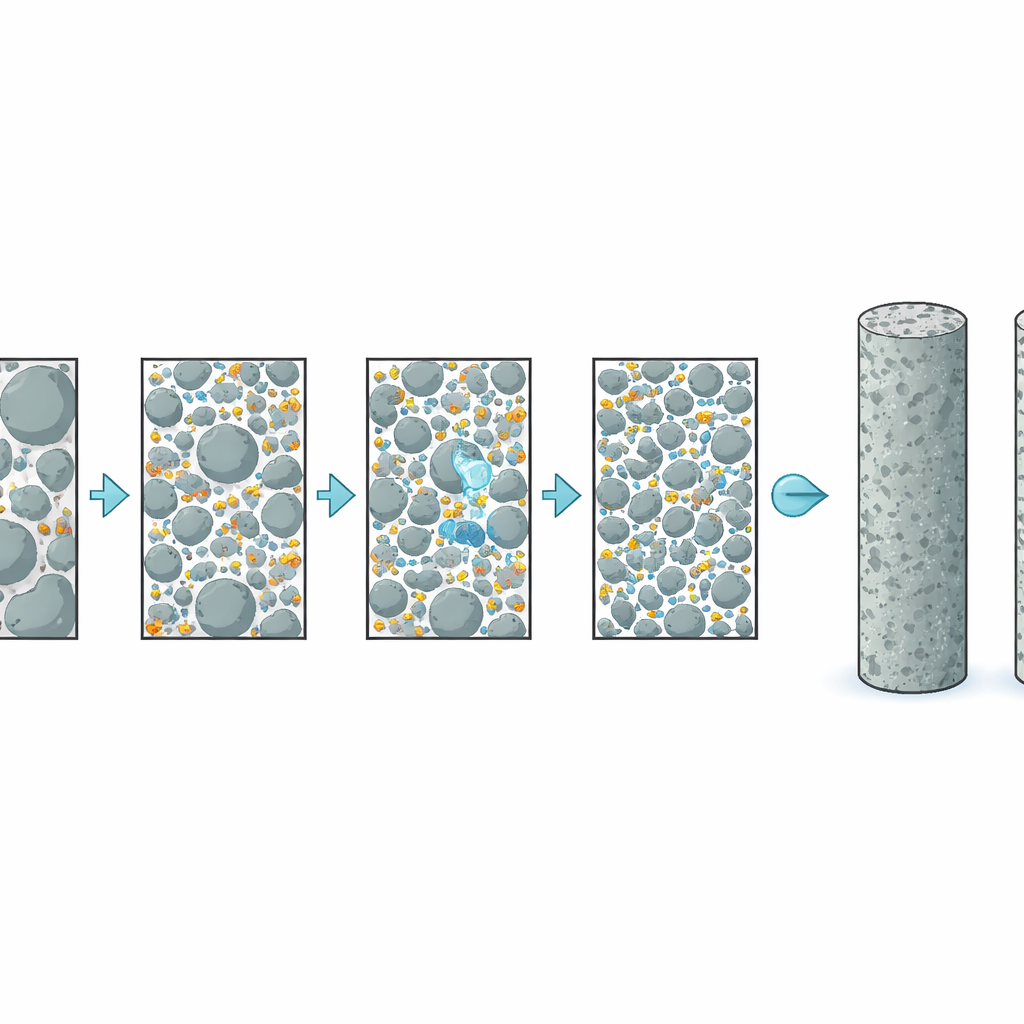
Letting Machines Learn the Best Recipe
Because laboratory testing of many concrete mixes is time-consuming and costly, the researchers also turned to machine learning to forecast strength from the mix ingredients and curing time. Using just 54 carefully measured data points from their experiments, they trained several types of algorithms to predict how strong a given recipe would be. The best-performing approach, a method called gradient boosting, reproduced measured strengths with very high accuracy, nearly matching test results across 7, 28, and 90 days. Other ensemble models also did well, while a simple linear method struggled, highlighting the importance of capturing complex, non-linear relationships between materials and strength. Feature-importance analysis showed that curing time was the single biggest driver of strength, but the presence of silica fume, fly ash, and manufactured sand also played meaningful supporting roles.
What This Means for Future Construction
For non-specialists, the key takeaway is that it is possible to design concrete that is both greener and better-performing by smartly combining industrial by-products and engineered sands, then using computer models to guide and reduce the need for trial-and-error testing. The study identifies a practical recipe—using 10% fly ash, 12% silica fume, and fully replacing river sand with manufactured sand—that yields stronger, denser, and more durable concrete without increasing cement content. When paired with reliable machine learning tools, this approach can help builders and engineers move more quickly toward sustainable construction while maintaining, or even improving, the safety and lifespan of our built environment.
Citation: Chaitanya, B.K., Sri Durga, C.S., Thatikonda, N. et al. Integration of machine learning and microstructural characterization for strength forecasting with silica fume and M-sand for sustainable concrete. Sci Rep 16, 8858 (2026). https://doi.org/10.1038/s41598-026-43410-1
Keywords: sustainable concrete, fly ash, silica fume, manufactured sand, machine learning