Clear Sky Science · en
Internal variability in numerical morphodynamical experimentation
Why tiny changes can reshape a coastal bay
Coastal bays may look calm and predictable, but the underwater sand and mud that shape them tell a different story. This paper explores how very small differences at the start—such as beginning a computer simulation a few hours earlier or later in a tidal cycle—can lead to noticeably different patterns of underwater channels decades later. For anyone interested in coasts, flooding, or how scientists use models to peer into the future, the findings highlight why nature can be both patterned and surprisingly hard to pin down.
Hidden uncertainty beneath the waves
The authors focus on “morphodynamics,” the shifting of seabeds and coastlines under the action of tides and currents. For years, researchers have used simplified models to explain how tidal inlets and branching channels can arise by themselves, even without changing storms or sea level. But as coastal models have become more detailed and realistic, one question has become pressing: when we see a change in simulated channels or erosion, is it really due to some external influence, like sea-level rise or dredging, or could it simply be the system’s own internal restlessness? Climate scientists tackle a similar problem when they separate human-caused warming from natural ups and downs. This study brings that way of thinking to the world of coastal seafloors.
A virtual bay as a testing ground
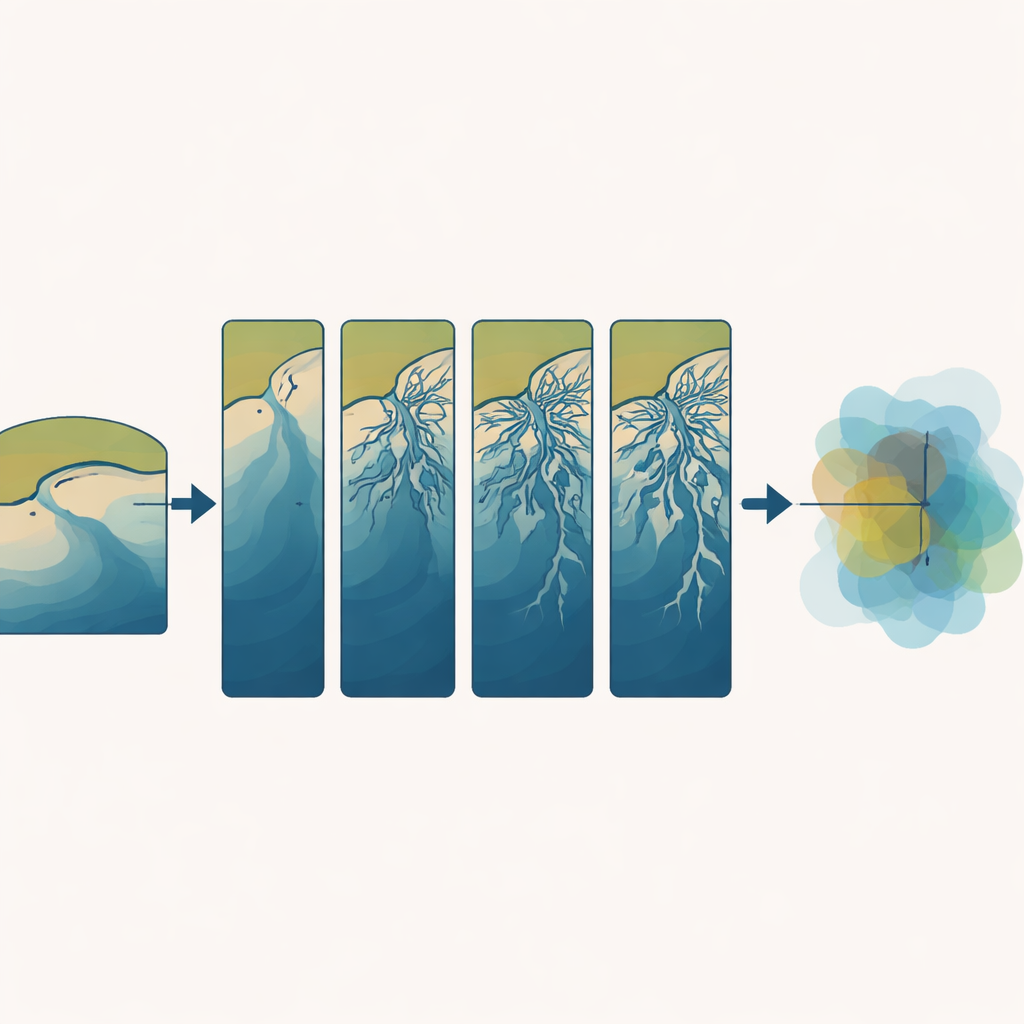
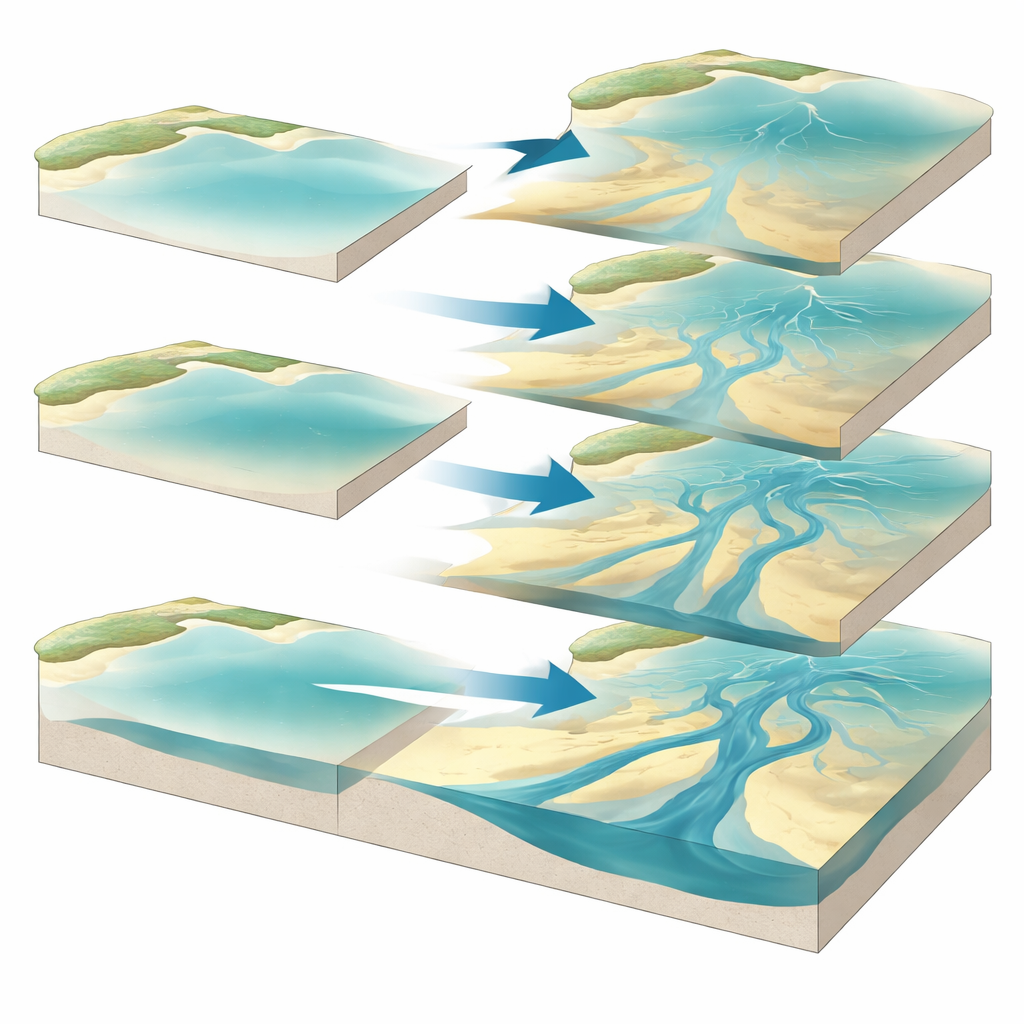
To probe this internal variability, the team set up a simplified yet realistic virtual bay: a semi-circular basin connected to the open sea by a single tidal inlet. Using an advanced coastal model, they allowed tides to flow in and out and move sand around on a flat, sandy seabed. They stripped away many complexities—no winds, no waves, no seasonal changes—to keep the focus on how the tides and sediment interact. Then they ran four simulations that were identical in every respect except one: each started at a slightly different moment in the tidal cycle, a difference of only a few days in a 240-year experiment.
Many possible channel maps from the same forcing
Over time, all four simulations developed branching networks of underwater channels that cut into the seabed and exported sediment to surrounding shoals. Broad statistics, such as how deep the main channels became, how many existed within certain distances of the inlet, and how far they reached into the bay, were strikingly similar among the runs. Yet, when looking at the detailed patterns—exact channel paths, where they split, and which branches became dominant—the members diverged. Tiny initial timing differences grew into distinct channel layouts that then locked in place. Once the main channels formed within the first few decades, their large-scale positions barely moved for the remainder of the 240-year simulations.
Order, chaos, and what counts as a signal
The behavior of the virtual bay has echoes of the famous Lorenz system from chaos theory, in which tiny nudges lead to very different outcomes. Here, early channel development resembles a kind of random walk: different members “choose” different primary pathways. But after these key pathways are established, the system settles into a relatively stable configuration that resists further small disturbances. The authors compare this to the idea of a “dynamic equilibrium” shaped as much by the model’s setup as by any natural rule of the real world. They also show that, despite the visual differences in channel maps, core statistical measures remain similar, suggesting that there can be many different but statistically equivalent futures for the same bay.
What this means for reading coastal futures
For practical coastal management and scientific studies, the message is clear: a single pair of “before and after” simulations is not enough to judge the impact of human actions or environmental change. Because internal variability can generate different channel patterns all by itself, scientists need ensembles—multiple runs of the same experiment—to estimate the background “noise” of the system. Only by comparing this noise to the changes produced by altered conditions can they decide whether a given effect is truly a “signal” of something new. While the model used here is idealized and omits many real-world processes, it offers a powerful lesson: even under constant tides, coastal landscapes can follow many plausible pathways, and understanding that inherent wiggle room is essential for making sense of both models and nature.
Citation: Lin, L., Zhang, W., Arlinghaus, P. et al. Internal variability in numerical morphodynamical experimentation. Sci Rep 16, 8963 (2026). https://doi.org/10.1038/s41598-026-43401-2
Keywords: coastal morphodynamics, tidal channels, internal variability, ensemble modeling, sediment transport