Clear Sky Science · en
Chaotic fluctuations mark the sign of mental activity in task-based heart rate variability
Why your heartbeat reveals what your mind is doing
Most of us know that our hearts beat faster when we run or feel scared. But this study suggests that the tiny, irregular wiggles between heartbeats also change in a special way when we think hard. By looking beyond simple averages and rhythms, the researchers show that mental effort leaves a distinctive “chaotic” fingerprint in heart rate patterns—one that ordinary measurements miss—hinting at a new, low-cost window into brain activity using only a chest strap sensor.
From steady beats to complex wiggles
Doctors and scientists often examine heart rate variability—the small changes in time from one heartbeat to the next—to judge how the body’s automatic control system is working. Traditional tools focus on simple statistics and how strong certain rhythmic components are. These methods work well for tracking how the nervous system responds to things like standing up or physical strain. But the heart and blood vessels are part of a deeply tangled biological system, and these straight-line methods can overlook more subtle, nonlinear behavior, such as chaos and complexity. The authors argue that to fully understand how the heart responds to the brain, we must also measure how irregular and unpredictable the heartbeat becomes.
Putting body and mind to the test
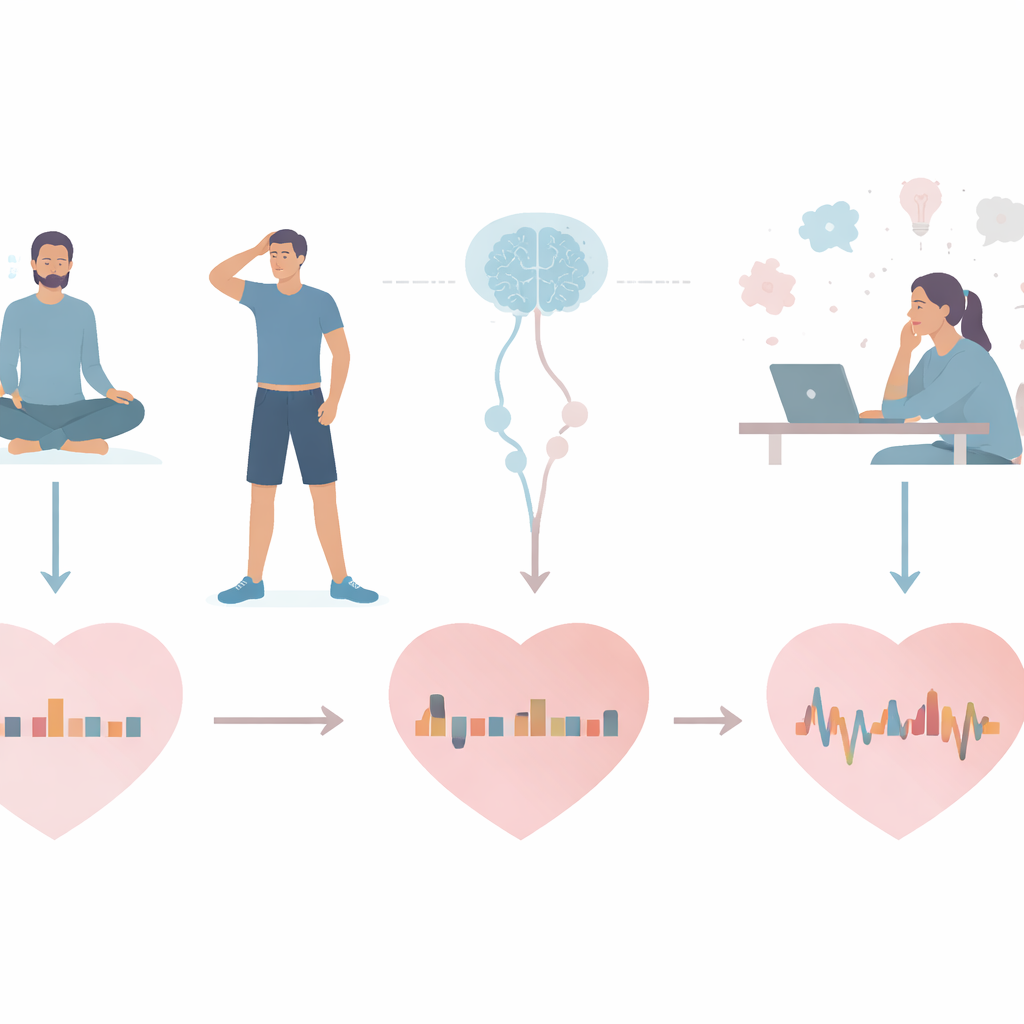
The team recruited 27 healthy volunteers and monitored the tiny gaps between their heartbeats using a high-precision chest strap. Each person completed repeated sessions on different days under several conditions: quietly resting in a chair, standing upright, and performing mental tasks such as mental arithmetic or Sudoku puzzles. For each seven-minute recording, the researchers calculated 15 different indices of heart rate variability. These included familiar measures from standard practice and a suite of nonlinear indicators that describe irregularity, complexity, and chaos, including two newer measures called chaos degree and improved chaos degree, which can be computed directly from real-world data without knowing the underlying equations of the heart’s dynamics.
What changes with movement versus thinking
When volunteers shifted from sitting to standing, standard measures behaved as expected: indicators linked to “fight-or-flight” activity increased, while those tied to “rest-and-digest” responses decreased. At the same time, all six chaos and complexity indices dropped, suggesting that the pattern of heartbeats actually became simpler and more predictable under postural stress. In striking contrast, when participants switched from rest to a mental task, most traditional measures barely moved. Yet all chaos and complexity indices rose noticeably, whether the volunteers were doing arithmetic or Sudoku. This pattern—decreased complexity with physical strain but increased complexity with mental effort—was highly consistent across people and tasks.
A new way to tell mind-work from muscle-work
To capture this contrast in a single number, the researchers introduced the “chaos indicator ratio,” which compares a chaos measure during a task to its value at rest. They found that this ratio tended to fall below one for standing (less chaos than rest) and rise above one for mental tasks (more chaos than rest), cleanly separating physical and mental load. Visual tools such as Poincaré plots, which map each heartbeat interval against the next, supported this picture: during standing, clouds of points collapsed into narrow, elongated shapes, while during mental tasks they spread into rounder, thicker clusters, reflecting greater uncertainty from one beat to the next.
How tangled brain networks may stir the heart
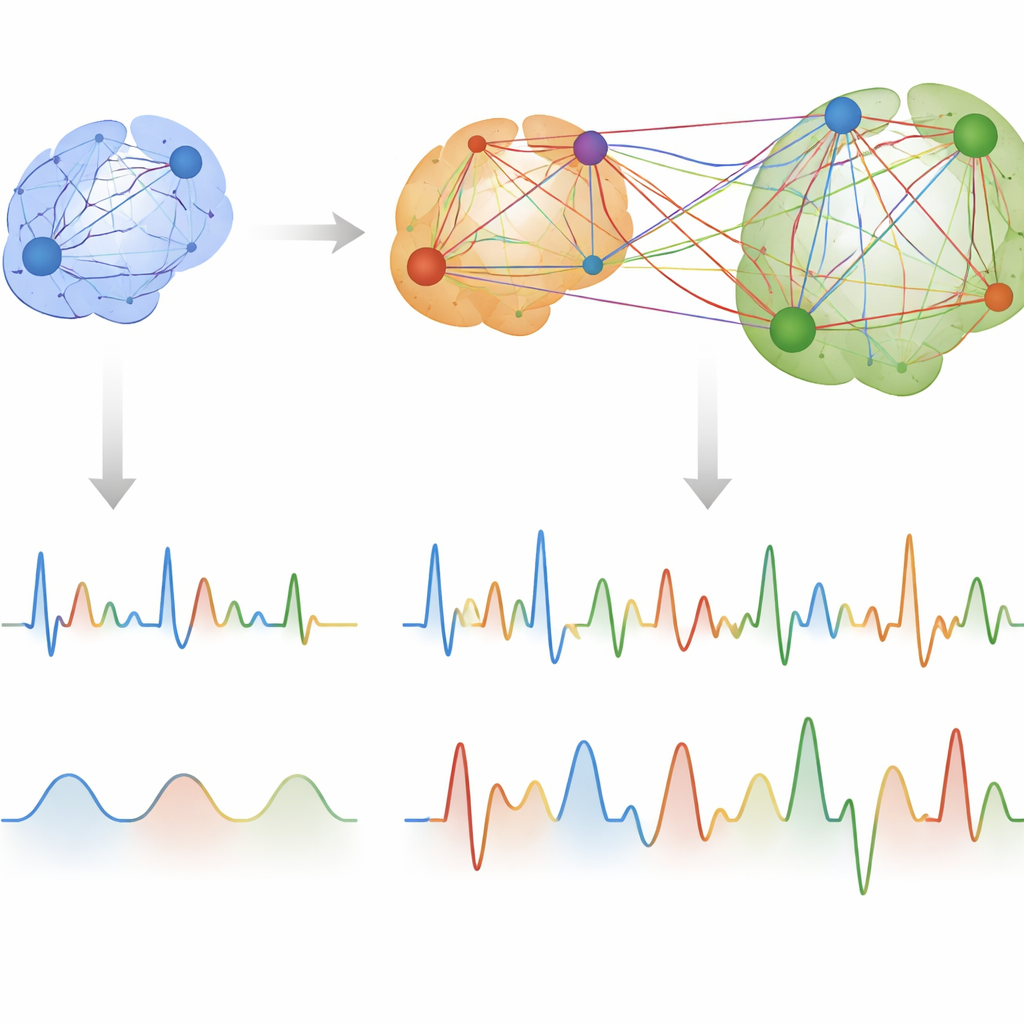
To explain why thinking hard would make heartbeat patterns more chaotic without strongly shifting classic “stress” markers, the authors turn to modern views of brain organization. They discuss three major brain networks involved in rest, focused thinking, and detecting important events. During simple rest, one of these networks dominates, potentially limiting the system’s degrees of freedom and keeping heart rhythms relatively orderly. During a demanding but not overly stressful mental task, the three networks may become similarly active and richly interconnected. The authors propose that this three-way interaction resembles a classic physical system where three bodies tug on one another, producing complex and chaotic motion. In their view, this higher-order brain activity propagates through the autonomic nerves to the heart, showing up as more chaotic heart rate variability.
What this could mean for everyday health
In plain terms, the study suggests that the “messiness” of your heartbeat carries clues about what your brain is doing. While traditional heart rate measures reveal how hard your body is working, chaos and complexity measures seem especially tuned to mental effort and the way large brain networks coordinate. Because these signals can be captured by simple wearable sensors and computed with relatively light calculations, they may one day support real-time tracking of focus, fatigue, or stress in classrooms, workplaces, or clinical settings. The work is still early and based only on heart data, but it opens a promising path toward using heartbeat fluctuations as a practical, affordable proxy for monitoring the invisible dance between brain and heart.
Citation: Mao, T., Okutomi, H. & Umeno, K. Chaotic fluctuations mark the sign of mental activity in task-based heart rate variability. Sci Rep 16, 9221 (2026). https://doi.org/10.1038/s41598-026-43385-z
Keywords: heart rate variability, mental workload, nonlinear dynamics, brain–heart interaction, chaos analysis