Clear Sky Science · en
Utilization of machine learning to identify lower extremity biomechanical predictors of rupture in a validated cadaveric model of ACL injury
Why this matters for knees on the move
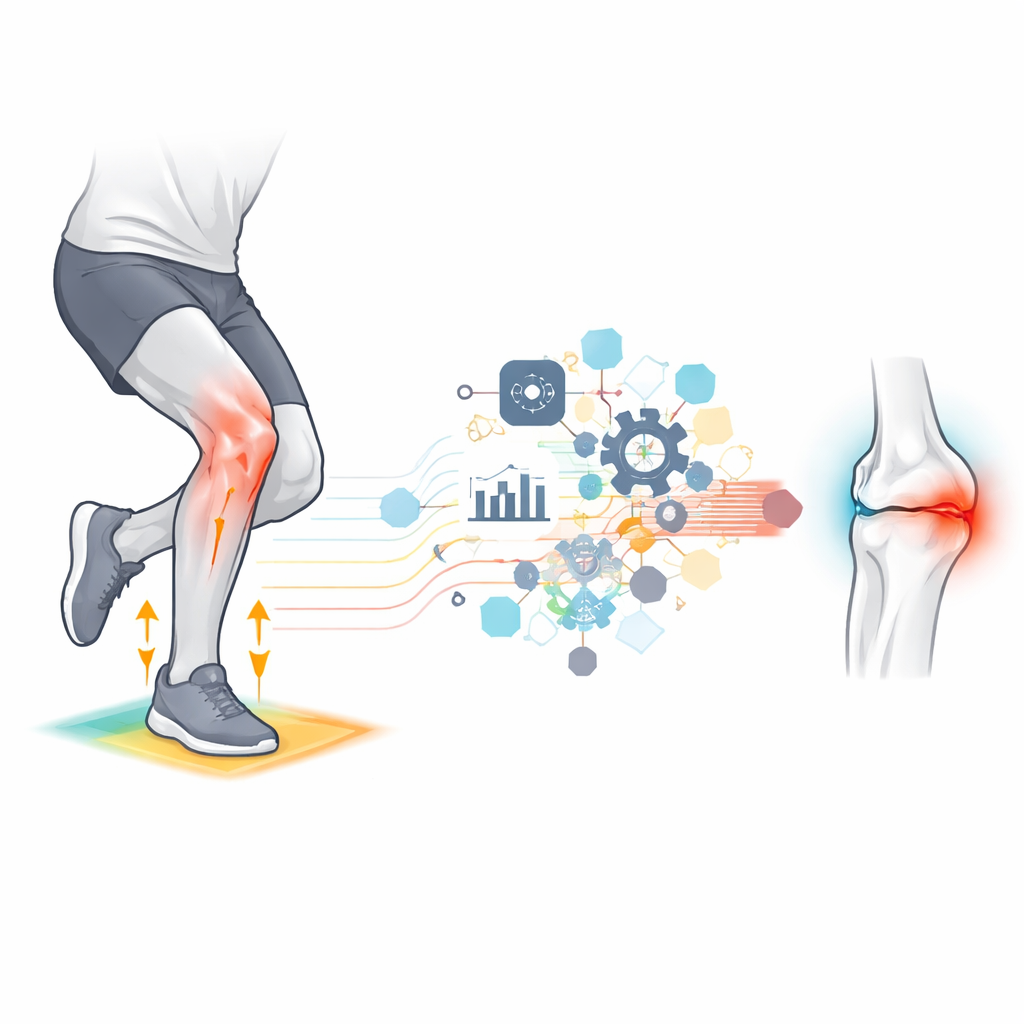
For athletes, soldiers, and active people, a torn anterior cruciate ligament (ACL) in the knee can be a life‑changing injury, often requiring surgery and long rehabilitation. Today’s medicine is very good at confirming that the ligament is torn after the fact, but far less capable of warning someone that their knee is just about to fail. This study explores whether machine learning — computer programs that learn patterns from data — can spot the dangerous loading on a knee milliseconds before a tear, and whether those warning signs could eventually be captured by practical wearable sensors.
How the researchers recreated knee injuries
Instead of studying injuries only after they happen in real players, the team used a specialized mechanical rig and donated cadaver legs to recreate realistic ACL tears in the lab. The simulator pushed and twisted each knee in several directions at once, mimicking the complex forces seen when an athlete lands from a jump or cuts to change direction. Tiny sensors on the ACL and surrounding structures recorded how much the ligament stretched, while force plates and load cells measured the directions and sizes of forces at the foot and knee. From 51 specimens, they extracted dozens of measurements at key instants around ground contact, along with basic information such as sex, height, and weight.
Turning raw motion into risk labels
To make this data useful for computer models, the researchers labeled each impact as belonging to one of several stages: clearly before any damage (“pre‑rupture”), the single trial immediately before the ligament failed (“trial prior to rupture”), the actual tear (“rupture”), and a later “post‑rupture” phase. For real‑time prediction, only the first three phases are meaningful, so post‑rupture data were removed. They then created four related datasets. Two included all 53 lab‑grade measurements; the other two shrank this to 13 signals that could realistically come from wearable devices, such as forces at initial foot contact. In each pair, one version used three classes (pre‑rupture, trial before rupture, rupture), while the other merged the last two into a simpler split: safe versus “elevated risk.”
Teaching machines to recognize danger patterns
The team tested eight common machine‑learning approaches, ranging from simple logistic regression to decision trees, random forests, gradient boosting, and linear discriminant analysis. They trained these models on data from most of the knees and then checked performance on knees the models had never seen, preventing the algorithms from simply memorizing individual specimens. For the rich, lab‑based data, the best models correctly classified about 80–87 percent of impacts into the three detailed stages. When the labels were simplified into just “pre‑rupture” versus “elevated risk,” accuracy jumped to about 92–95 percent. With the pared‑down wearable‑style data, three‑class accuracy was lower, around 60–77 percent, but again rose to roughly 81–83 percent once the classes were merged into safe versus elevated risk.
What the computers found inside the motion
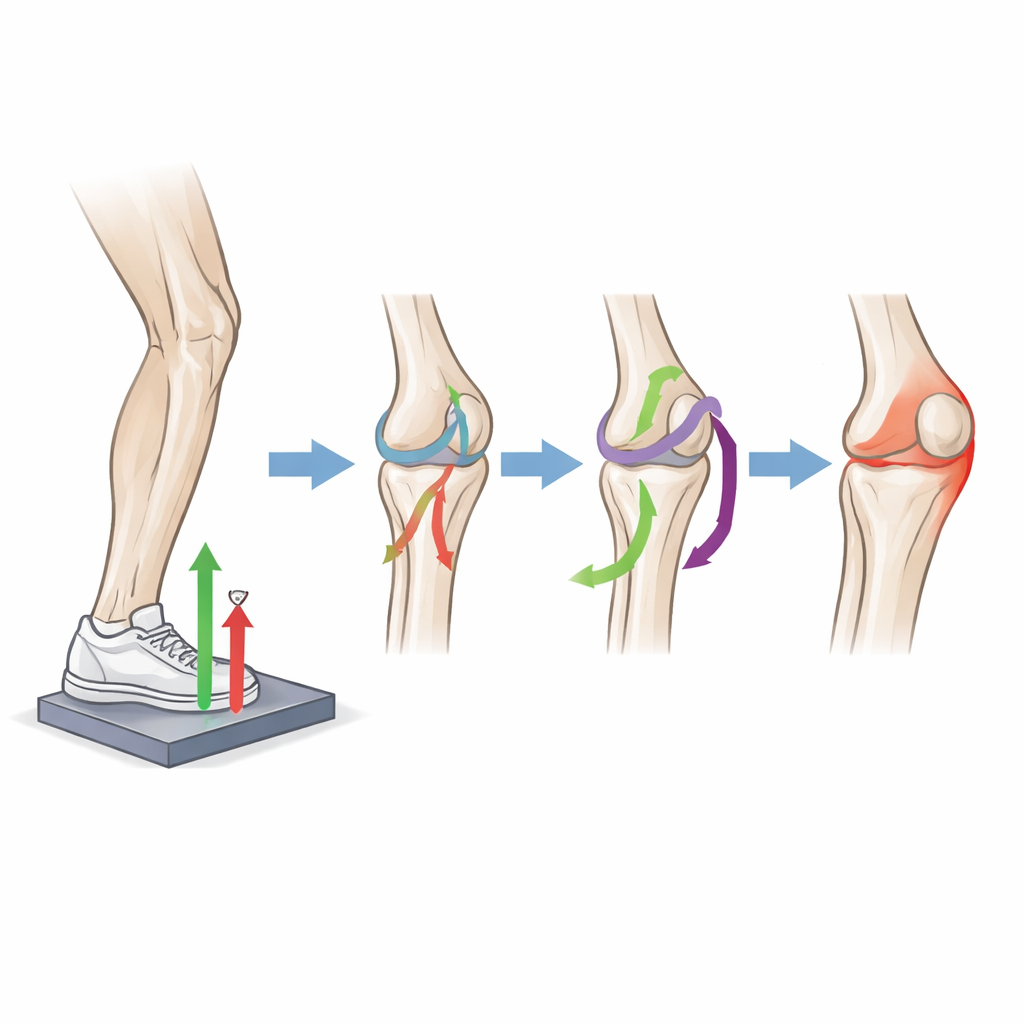
Across all models and datasets, a striking pattern emerged: the most informative clues came from very early forces during landing. Forces measured just 33 milliseconds after the foot hit the ground, especially those pushing and pulling the leg forward–backward and vertically, were repeatedly ranked among the most important features. Peak twisting and bending moments at the knee, and forces right at initial contact, also mattered. In contrast, demographic traits such as sex or height played only a secondary role once these rapid force signatures were available. The “trial before rupture” and “rupture” phases looked biomechanically very similar, which helps explain why the models struggled to tell them apart but could reliably separate both from the safer pre‑rupture trials. From a practical standpoint, this suggests that once the knee enters a dangerous loading pattern, the window between “almost torn” and “torn” is very brief.
From lab benches to smart braces and fields
For non‑specialists, the main message is that our knees broadcast their distress in the first few thousandths of a second after landing, and computer models can learn to read those subtle signals. By focusing on early impact forces — the way the leg is pushed, pulled, and twisted at initial contact — machine learning systems can reliably flag when a knee is shifting from normal loading into a high‑risk state, even with data simple enough for wearable sensors. The study was done in cadaver knees and on a modest sample size, so translation to living athletes will take more work, larger datasets, and likely more advanced algorithms. Still, it lays the groundwork for future smart braces, shoe inserts, or field‑side systems that warn players and coaches when a movement pattern is flirting with catastrophe, turning ACL care from a reactive surgery‑after‑the‑tear model into proactive injury prevention.
Citation: Khorrami, P., Braimoh, T., Reis, D.A. et al. Utilization of machine learning to identify lower extremity biomechanical predictors of rupture in a validated cadaveric model of ACL injury. Sci Rep 16, 8711 (2026). https://doi.org/10.1038/s41598-026-43183-7
Keywords: ACL injury prediction, sports biomechanics, machine learning in medicine, wearable sensors, knee injury prevention