Clear Sky Science · en
β-Nicotinamide mononucleotide preserves muscle strength in septic male mice
Why surviving sepsis can leave lasting weakness
Modern intensive care saves more people with severe infections than ever before, but many survivors leave the hospital with a troubling legacy: their muscles feel weak for months or even years. This lingering frailty, called intensive care unit–acquired weakness, makes it harder to walk, work, and live independently. The study summarized here asks a simple but urgent question: can a targeted nutrient help protect muscles during sepsis so that survivors keep more of their strength?
From severe infection to tired muscles
To explore this problem, researchers used a mouse model that closely mimics human sepsis, a life-threatening overreaction of the body to infection. The animals lost weight and muscle during the acute illness, then gradually regained both body weight and muscle size over two weeks. Yet when the scientists measured how hard the mice could push with their hind legs, the animals that had experienced sepsis remained noticeably weaker than healthy controls. Under the microscope, their leg muscles looked normal in size, but a closer look with electron microscopy revealed that many of the tiny power plants inside muscle cells—the mitochondria—were swollen, misshapen, and structurally damaged. 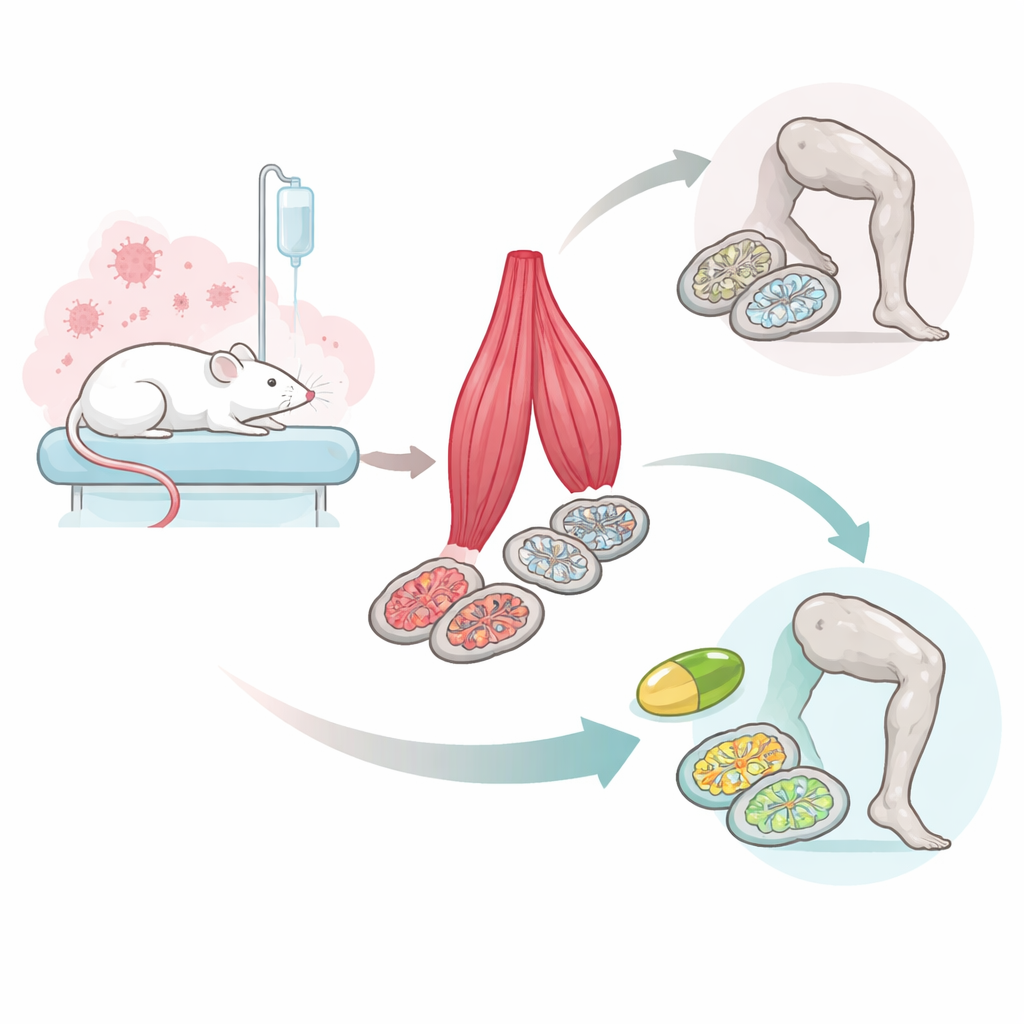
Zooming in on the cell’s power plants
The team next examined which genes were turned up or down in muscle after sepsis. They found broad shifts in activity, especially in pathways linked to energy production and mitochondrial health. A key player that stood out was Sirt3, a protein that normally helps keep mitochondrial proteins in good working order by removing chemical tags called acetyl groups. In septic muscle, Sirt3 levels dropped, while mitochondrial proteins showed extra acetyl tags, a pattern associated with sluggish energy production. When the researchers deliberately lowered Sirt3 in cultured muscle cells, the cells’ mitochondria consumed less oxygen and made less energy, mirroring what they had seen in septic mice. This suggested that a fall in Sirt3 activity during sepsis could directly undermine the ability of muscle mitochondria to fuel contraction.
A nutrient that refuels cellular energy
Sirt3 depends on a small molecule called NAD⁺ to function, and earlier work has shown that NAD⁺ supplies fall during sepsis. The investigators therefore tested whether boosting NAD⁺ could help. They turned to β-nicotinamide mononucleotide (β-NMN), a compound the body can readily convert into NAD⁺. In muscle cells with reduced Sirt3, adding β-NMN raised NAD⁺ levels and partially restored mitochondrial breathing and energy output. The most striking test came in living mice: animals with sepsis received β-NMN injections during the acute phase of illness, while comparison animals received only a salt solution. Both groups regained similar amounts of muscle mass and body weight, but the β-NMN–treated mice recovered much more of their leg strength. Electron microscopy showed that their muscle mitochondria were less distorted and more structurally intact than those in untreated septic mice. 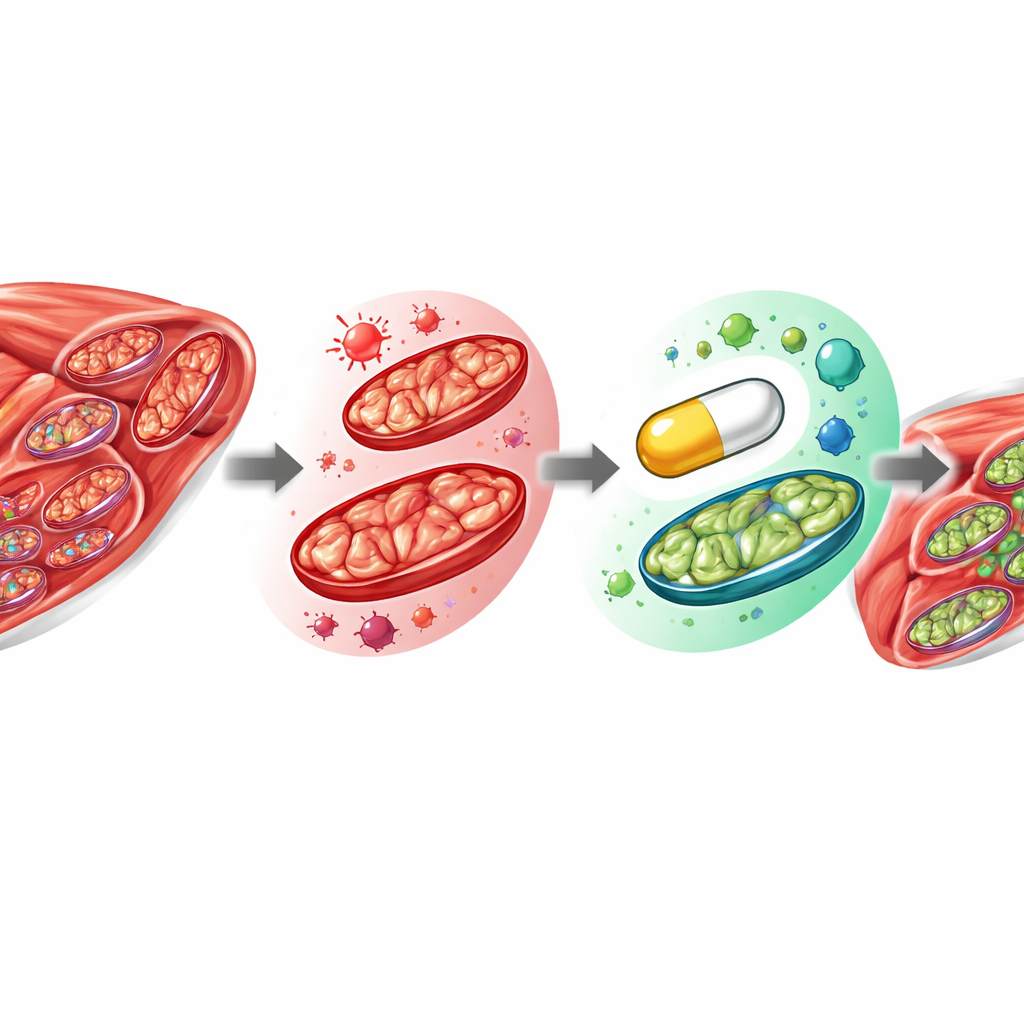
Rethinking nutrition after critical illness
Traditional nutrition in the intensive care unit focuses on calories and protein to prevent muscle wasting. This study suggests that such support, while important, may not be enough to preserve muscle quality. The work highlights mitochondrial health and NAD⁺ metabolism as central to long-term strength after sepsis. Rather than simply feeding muscles, future therapies may need to "feed" their mitochondria—using compounds like β-NMN to maintain the cellular chemistry that keeps Sirt3 and related proteins active. The authors note that their experiments were done in young male mice and over relatively short time frames, so much remains to be learned before translating this approach to patients.
What this could mean for patients
In plain terms, the study shows that after a life-threatening infection, muscles may look normal on the outside but remain tired on the inside because their internal engines are damaged. By supplying a building block for a key energy molecule, β-NMN helped protect those engines in mice, preserving more strength without changing muscle size. While it is far too early to recommend such supplements for people with sepsis, the findings point to a new kind of nutritional strategy—one that aims to restore the cell’s energy currency and safeguard independence for survivors of critical illness.
Citation: Saida, M., Saeki, N., Sakai, H. et al. β-Nicotinamide mononucleotide preserves muscle strength in septic male mice. Sci Rep 16, 8905 (2026). https://doi.org/10.1038/s41598-026-43172-w
Keywords: sepsis, muscle weakness, mitochondria, NAD+ metabolism, β-nicotinamide mononucleotide