Clear Sky Science · en
Study on enhanced sludge dewatering and mechanism by modified corn straw powder in conjunction with tannic acid
Turning Farm Waste into a Clean‑Up Tool
City sewage treatment plants all over the world struggle with an unglamorous problem: mountains of sludge that are mostly water. Hauling, drying, and disposing of this soggy material is expensive and can pollute the environment. At the same time, huge amounts of corn straw from farms are burned or left to rot, wasting a potential resource. This study explores how corn straw, a common agricultural leftover, can be transformed into a safe, plant‑based helper that makes sludge drier, lighter, and cheaper to handle—while also working together with a natural compound from plants called tannic acid.
Why Wet Sludge Is Such a Big Problem
Urban sludge is more than just dirty water. It is a thick mix of bacterial cells, sticky organic matter, and tiny particles bound together in a jelly‑like framework called extracellular polymeric substances, or EPS. This framework traps large amounts of water, pushing sludge moisture close to 95–99%, so it behaves like a heavy mud rather than a solid. Conventional chemicals can squeeze out some of this water, but many of them are based on metals or synthetic polymers that may leave toxic residues. As cities seek cleaner, low‑carbon solutions, there is strong motivation to find dewatering agents that are both effective and environmentally friendly.
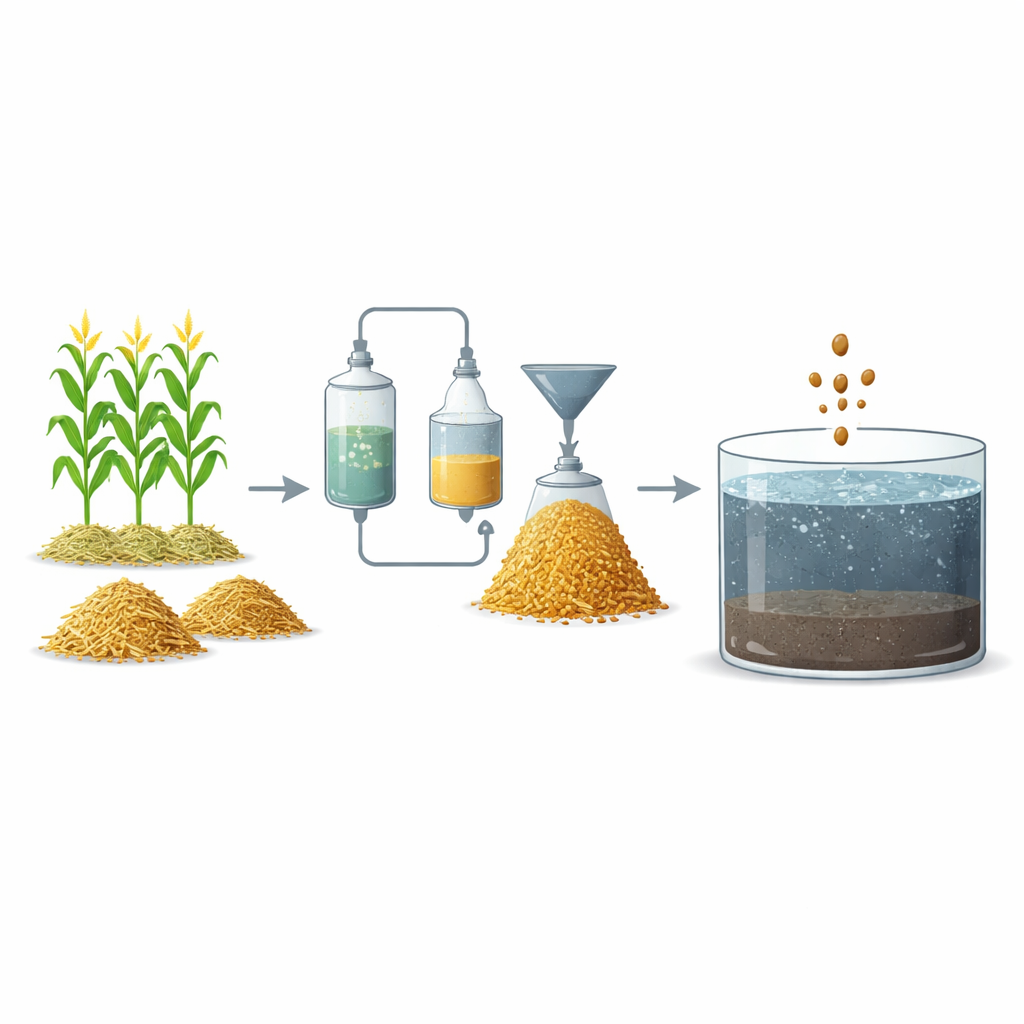
Giving Corn Straw a New Job
The researchers started with finely ground corn straw and subjected it to a carefully tuned chemical treatment using sodium hydroxide and two benign modifying agents. This process opens up the natural plant structure and attaches new charged and water‑interacting groups to the straw surface, producing what they call modified corn straw powder (MCSP). Tests showed that MCSP particles develop a honeycomb‑like, porous structure with a much larger internal surface area and bigger pores than raw straw. These features give MCSP plenty of sites to grab onto sludge particles and interact with the sticky EPS that holds water in place.
How the Plant‑Based Additives Free Trapped Water
When MCSP is mixed into sludge, its positively charged groups neutralize the naturally negative surfaces of sludge particles. This weakens the electrical repulsion that keeps tiny particles apart and helps them clump into larger, filterable flocs. At the same time, the porous MCSP acts like a sponge and scaffold, adsorbing fine particles and disturbing the EPS network so that water bound inside begins to escape. On its own, MCSP cuts sludge moisture by about 20% and halves the resistance to filtration, meaning water passes through filters more easily and quickly. The team then introduced tannic acid, a natural polyphenol found in many plants, which is already known to bind proteins and metals. Working alongside MCSP, tannic acid helps break down and reorganize the EPS, especially protein‑rich components that strongly hold water, and encourages small fragments to assemble into larger, drier flocs.
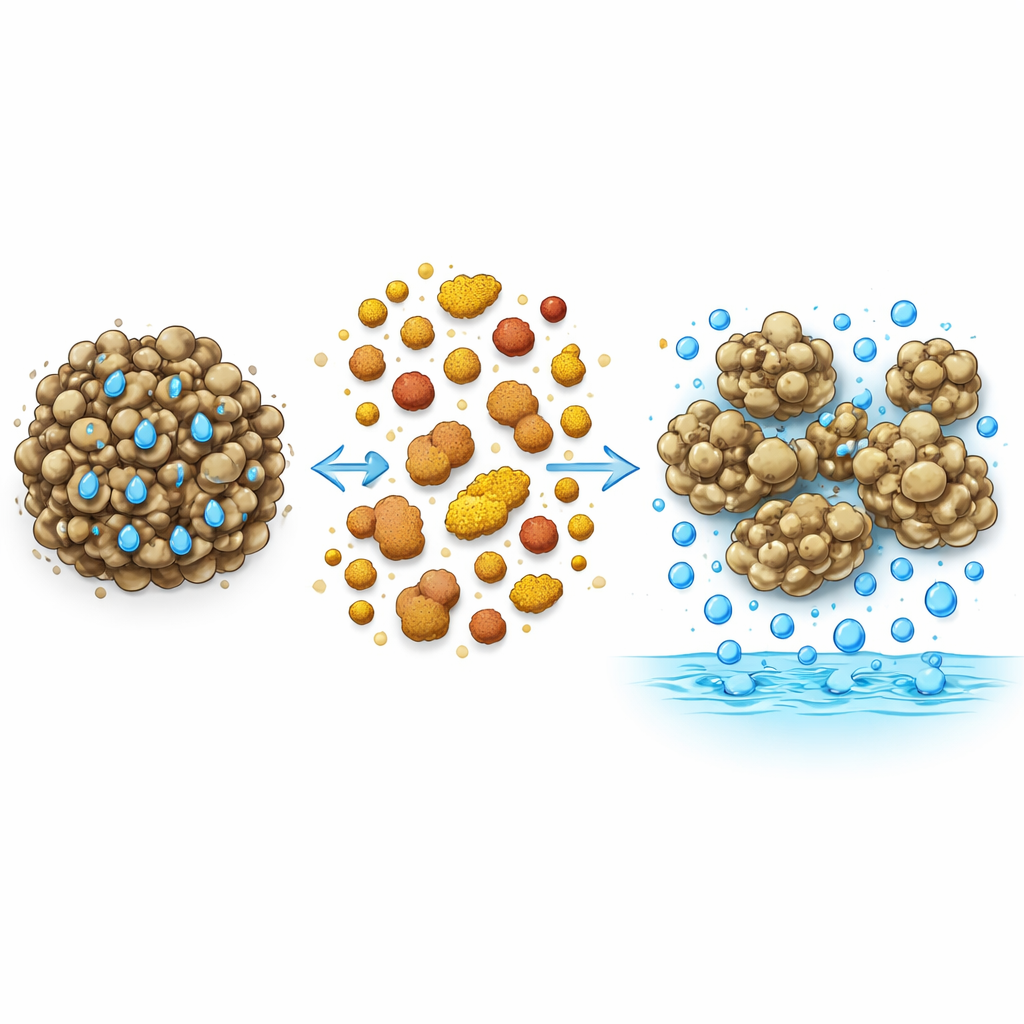
Cleaner Water, Safer Solids, Better Flow
To understand what is happening inside the sludge, the researchers measured particle sizes, surface charges, and the amounts of proteins, sugars, and humic substances in different EPS layers. They observed that, with MCSP and tannic acid together, sludge particles grow from small dispersed grains to larger, more open clusters, while the overall charge of the mixture moves toward neutral—ideal conditions for settling and filtration. Key EPS components, especially proteins and polysaccharides associated with strong water binding, are sharply reduced, and the ratio of proteins to sugars shifts in a direction known to favor dewatering. The treated sludge flows more easily through pipes, requires less pumping energy, and releases water faster during filtration. Importantly, the liquid that drains away contains fewer organic pollutants, and both the solid cake and filtrate stay well within national safety limits for heavy metals.
Environmental and Economic Payoff
Beyond the lab measurements, the study examined whether this plant‑based approach makes sense in real‑world budgets. Using cost and energy data from a Chinese city, the authors calculated that combining MCSP with tannic acid provides a net economic benefit: for each ton of sludge treated, the savings in fuel for drying and in transport of lighter, drier cake outweigh the cost of the additives. Because MCSP is derived from abundant corn straw that would otherwise be burned, the method also turns an agricultural waste into a useful material, reducing air pollution and promoting a circular economy.
What This Means for Cities and Farms
In essence, the paper shows that a smartly modified form of corn straw, especially when paired with tannic acid, can transform watery sewage sludge into a drier, more manageable solid without relying on harsh synthetic chemicals. Moisture drops by roughly 30%, filtration becomes easier, and the resulting solids and liquids remain environmentally safe. For a layperson, the takeaway is straightforward: by upgrading farm leftovers into gentle yet powerful treatment aids, cities can cut the cost and impact of dealing with their dirtiest waste streams while moving one step closer to sustainable, closed‑loop resource use.
Citation: Zhang, Y., Zhang, H., Xv, H. et al. Study on enhanced sludge dewatering and mechanism by modified corn straw powder in conjunction with tannic acid. Sci Rep 16, 8705 (2026). https://doi.org/10.1038/s41598-026-43109-3
Keywords: sludge dewatering, corn straw utilization, natural flocculants, tannic acid, wastewater treatment