Clear Sky Science · en
Stretch-mediated hypertrophy and strength increases and their impact on dynamic balance performance - a randomized controlled intervention study
Why stretching might do more than just loosen you up
Many people know they should strengthen their leg muscles to move confidently and avoid falls, yet not everyone can or wants to lift weights in a gym. This study explored a simple question with big real‑world appeal: can a focused stretching routine for the front of the thigh make muscles bigger and stronger—and even help with balance—without traditional strength training? The answer, based on a carefully controlled experiment in active young adults, is a cautious yes for muscle size and strength, and a “maybe” for balance.
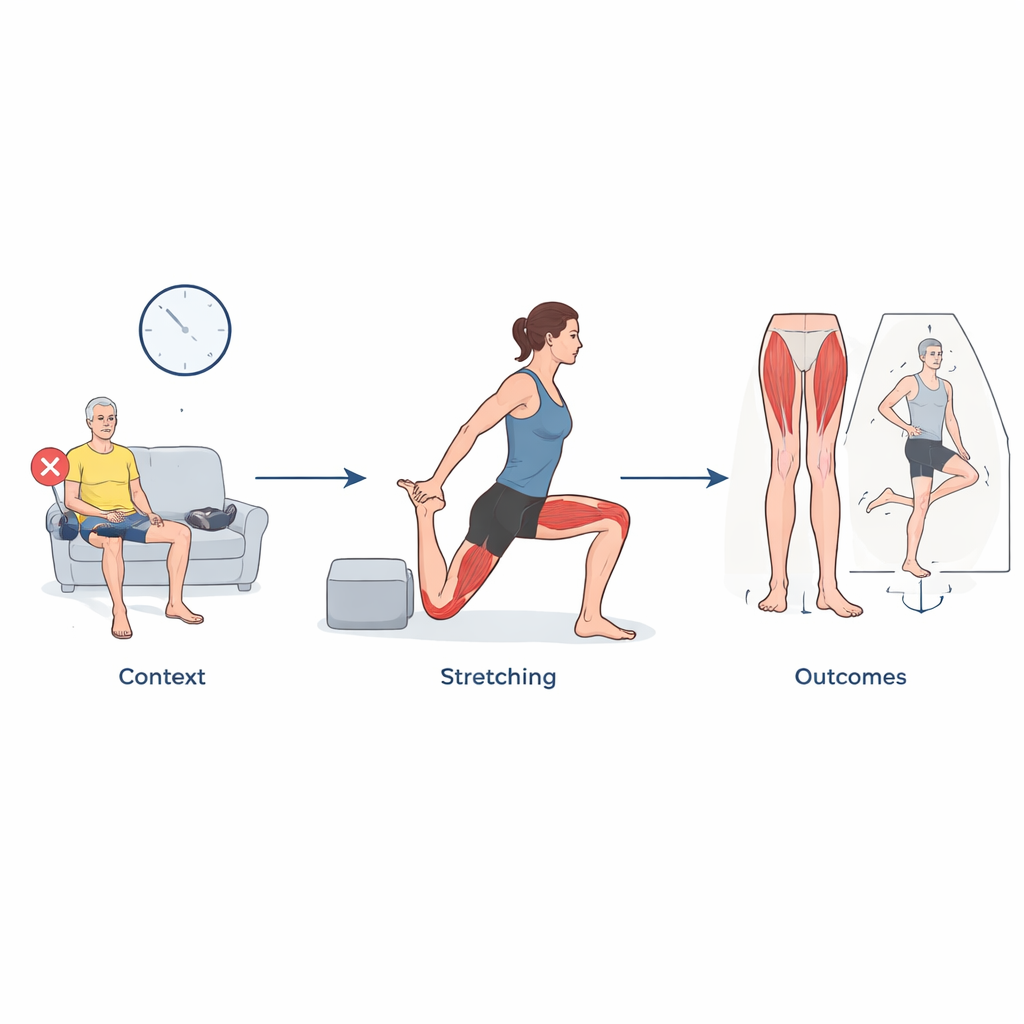
A different route to stronger thighs
Strong thigh muscles are important for sports, everyday activities such as climbing stairs, and especially for rehabilitation after injuries or fractures. Usually, resistance training with weights or machines is prescribed to build muscle. But supervised gym programs are not always accessible, especially for people who are immobilized, overloaded with appointments, or simply uncomfortable with heavy exercise. Recent research has hinted that long, intense stretching could be an alternative way to stimulate muscles. Most of that work focused on the calf; this new study instead targeted the quadriceps—the large muscle group on the front of the thigh that straightens the knee and helps keep us upright.
How the stretching program worked
Forty‑nine healthy, recreationally active volunteers were randomly assigned either to a stretching group or to a control group that kept their usual routines. Over four to five weeks, the stretching group performed a “couch stretch” three times per week in supervised sessions. Each session lasted 30 minutes—15 minutes per leg—broken into several five‑minute bouts. The position bent the knee and extended the hip to place the quadriceps under a strong, sustained pull. Participants were asked to maintain a high but tolerable level of stretch discomfort. Before and after the program, the researchers measured thigh muscle thickness with ultrasound, knee‑extension strength on an isometric machine, and dynamic balance using the Y‑Balance Test, where a person stands on one leg and reaches the other leg in three directions without losing stability.
What changed in muscle size and strength
After four weeks, the stretching group showed clear increases in the thickness of one key thigh muscle, the rectus femoris, in both its upper and lower portions. Another thigh muscle, the vastus lateralis on the outer side, also tended to grow, though results were less consistent. Importantly, the changes were large enough to exceed normal measurement noise, indicating real structural adaptation rather than random fluctuation. Strength gains were more specific: when participants pushed as hard as possible to straighten the knee from a more bent starting angle, the stretching group increased their isometric strength, while the control group did not. At a more open knee angle, strength did not meaningfully change. These findings suggest that prolonged stretching, performed intensely and often enough, can make the quadriceps slightly thicker and stronger even without lifting weights, at least over a short period.
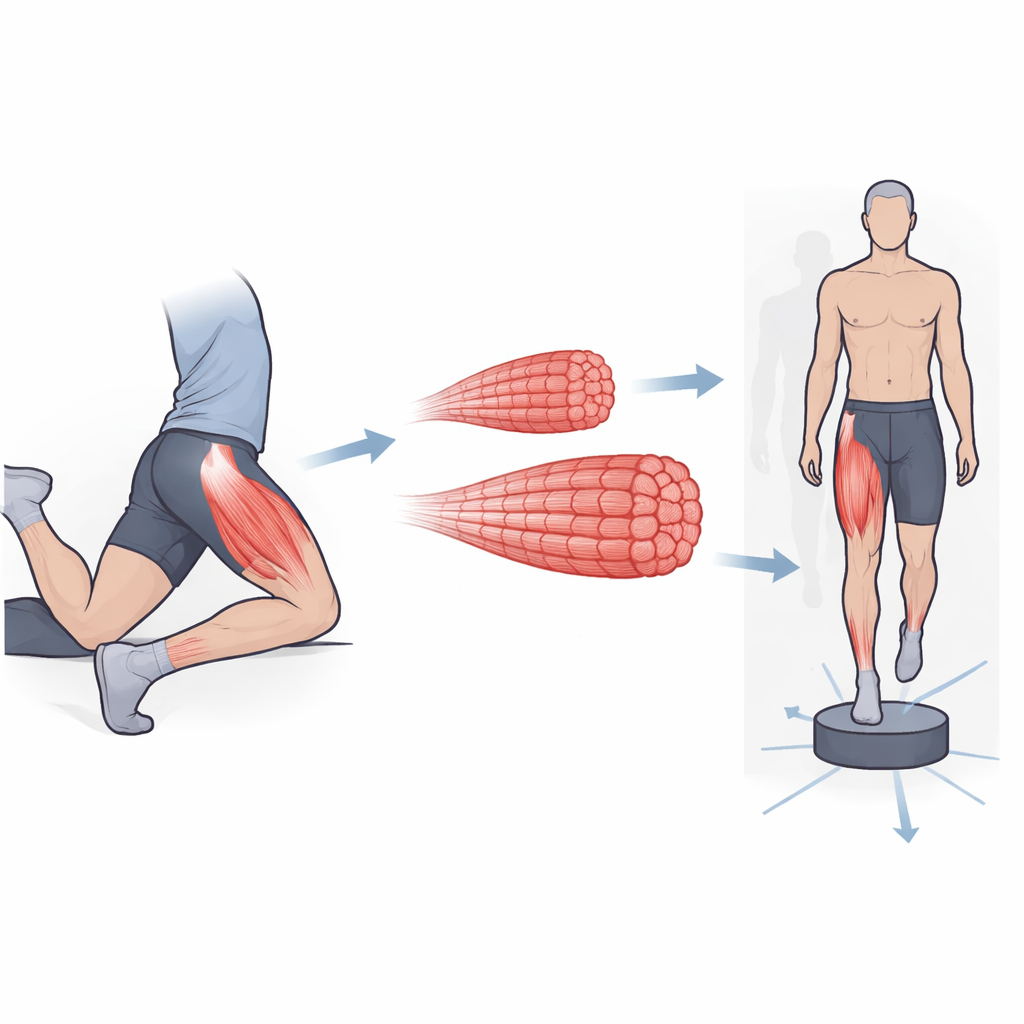
Small but intriguing shifts in balance
The researchers also wanted to know whether these muscle changes translated into better control when standing on one leg. Across all participants, those with stronger quadriceps generally performed better on the Y‑Balance Test, supporting the idea that leg strength and balance are linked. After the stretching program, both the stretching and control groups improved their reach distances somewhat, which could partly reflect learning the test. Only some directions and legs showed extra gains in the stretching group, and even there, the improvements were modest and started from slightly lower baseline scores. Statistical analyses hinted that, for certain positions, individuals who gained more strength also tended to improve more in balance, but the pattern was inconsistent.
What this means for everyday movement
For everyday readers, the main takeaway is that stretching—when done in long, focused, and fairly intense sessions—can do more than simply increase flexibility. In this study, it led to small but measurable increases in thigh muscle size and strength over just four weeks, without any added weights. However, its impact on dynamic balance, and therefore on fall risk, remains uncertain. Stretching alone is not yet a proven substitute for traditional strength training, especially for older adults or patients in rehabilitation, but it may become a useful option or complement when regular exercise is difficult. Longer studies in clinical populations are needed, yet this work lays the groundwork for viewing stretching as a potential, low‑equipment way to nudge muscles toward getting stronger.
Citation: Siegel, S.D., Sproll, M., Lohmann, L.H. et al. Stretch-mediated hypertrophy and strength increases and their impact on dynamic balance performance - a randomized controlled intervention study. Sci Rep 16, 8482 (2026). https://doi.org/10.1038/s41598-026-43038-1
Keywords: static stretching, quadriceps strength, muscle hypertrophy, dynamic balance, fall prevention