Clear Sky Science · en
Diverse foraging strategies of an avian apex predator in an old-growth forest
Why city birds matter to deep forests
Deep in one of Europe’s last primeval forests, some of its top feathered hunters are quietly commuting to town. This study follows male Eurasian Goshawks in Poland’s Białowieża Forest and reveals that these forest raptors do not all hunt in the same way. Some stay in the woods, others range over nearby farms, and several routinely fly many kilometres to towns to feast on urban pigeons. Understanding these choices helps us see how wildlife adapts to human‑shaped landscapes—and what that means for conserving both forests and their predators.
Life on the hunt
Like all animals, Goshawks must balance the energy they gain from food with the effort it takes to find it. Classic foraging theory predicts that, when prey is easy to catch and close to home, hunters can feed themselves and their young while travelling less. Białowieża Forest, with its towering old trees and rich bird life, should be an ideal hunting ground. Yet the surrounding region also offers farms, villages, and a nearby town where human activity has created new food sources. The researchers wanted to know whether male Goshawks breeding in this ancient forest all rely on the same “perfect” strategy, or whether different birds use different tactics that work equally well.
Tracking forest hunters
The team fitted 13 male Goshawks with lightweight solar‑powered GPS tags and followed their movements during the breeding season, when males do nearly all the hunting for their families. From April to June, each bird’s position was recorded every ten minutes, allowing the scientists to map the area it used most often for foraging. They also collected prey remains around nests to see what the birds were eating, and counted the number of nestlings that fledged from each nest. Around every nest they measured forest cover, forest age, and how close the site was to farmland and built‑up areas to test how these features might shape hunting ranges.
Three ways to make a living
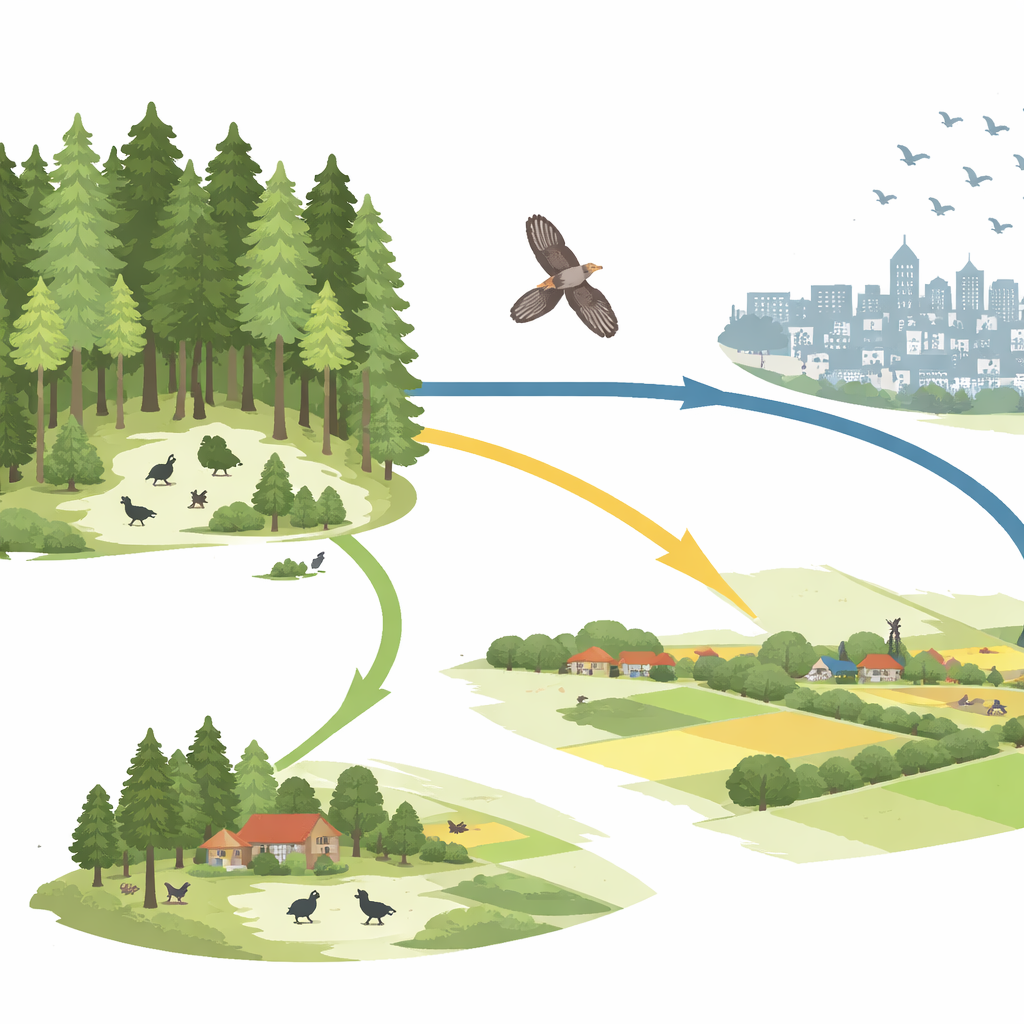
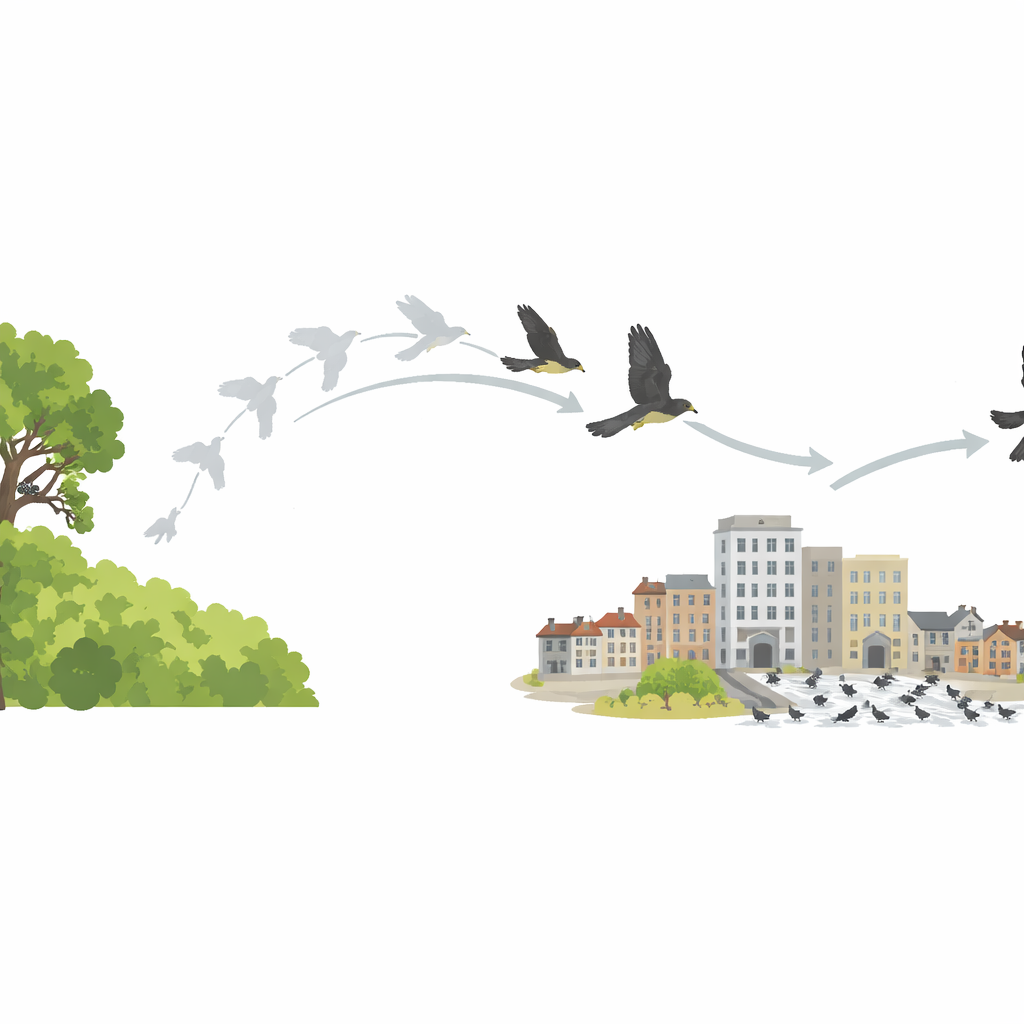
The GPS tracks revealed three main hunting styles. Some males stayed almost entirely within the forest, catching woodland birds such as wood pigeons, woodpeckers, and grouse, and raising around two chicks per year. A second group split their time between forest and nearby farmland, occasionally visiting villages and scattered farmsteads; they used larger areas, had the most varied diets, but tended to raise fewer chicks. The most surprising group spent most of their time near the nest in forest, yet made regular trips of up to 20 kilometres to a single town, often daily, to hunt feral pigeons. These urban‑visiting birds focused heavily on pigeons and had the narrowest diets—yet they fledged slightly more chicks on average than the other groups.
Many paths to success
Despite these clear behavioural differences, the size of each bird’s main foraging area did not strongly depend on how old or structurally varied the surrounding forest was, nor on how close the nest was to farmland or buildings. Forest cover around nests was consistently high, which may have masked subtle effects. What stood out instead was the flexibility of individual birds: even neighbours using similar nest sites could adopt very different routines, including long daily commutes to town. This suggests that home ranges are shaped at least as much by personal hunting tactics and competition among birds as by the basic layout of habitats.
What this means for forests and cities
For a non‑specialist, the key message is that there is no single “best” way for these hawks to live, even in a world‑class forest. Some males do well by staying in the woods, others by mixing forest and farmland, and others by tapping into the reliable buffet of city pigeons. All three strategies can support successful breeding. This flexibility—being able to adjust behaviour to exploit both wild and human‑made environments—may help Goshawks, and other predators like them, cope with rapid changes to forests and the spread of cities. Protecting old‑growth forests remains vital, but the study shows that nearby towns and farmland can also play an unexpected supporting role in sustaining apex predators.
Citation: Väli, Ü., Mirski, P. Diverse foraging strategies of an avian apex predator in an old-growth forest. Sci Rep 16, 8880 (2026). https://doi.org/10.1038/s41598-026-43036-3
Keywords: Eurasian goshawk, urban wildlife, old-growth forest, foraging behavior, raptor ecology