Clear Sky Science · en
Exploring differences between women and men in treatment-seeking patients with compulsive buying-shopping disorder
Why our shopping habits matter
Most people enjoy buying new things, whether it’s a pair of shoes or the latest gadget. But for some, shopping turns into a relentless urge that empties bank accounts, strains relationships, and worsens mental health. This study looks at compulsive buying-shopping disorder (CBSD) and asks a deceptively simple question: do women and men who seek treatment for this problem actually differ as much as common stereotypes suggest?

When buying becomes a burden
Compulsive buying-shopping disorder is more than just loving the mall or browsing online sales. People with CBSD feel a strong, hard-to-control urge to shop and often purchase items they do not need and may never use. The short-lived excitement of buying is quickly followed by guilt, financial stress, and conflicts at home. Many also live with other mental health problems such as depression, anxiety, eating disorders, or hoarding. Earlier research and popular culture have portrayed CBSD as a largely female problem, but studies have been mixed, and men have often been underrepresented—especially in treatment settings.
Who took part in the study
The researchers analyzed data from 141 adults in Germany who had actively sought help for CBSD at specialized outpatient clinics between 2017 and 2025. About three quarters were women and one quarter were men, with an average age in the early forties. All participants filled out questionnaires about their buying behavior, anxiety, and depression before starting therapy, and experienced clinicians used standard diagnostic interviews to assess additional mental health conditions. The team also recorded what types of products people tended to buy compulsively, how they preferred to shop (online, in-store, or both), and whether they went on to attend group therapy sessions.
More alike than different
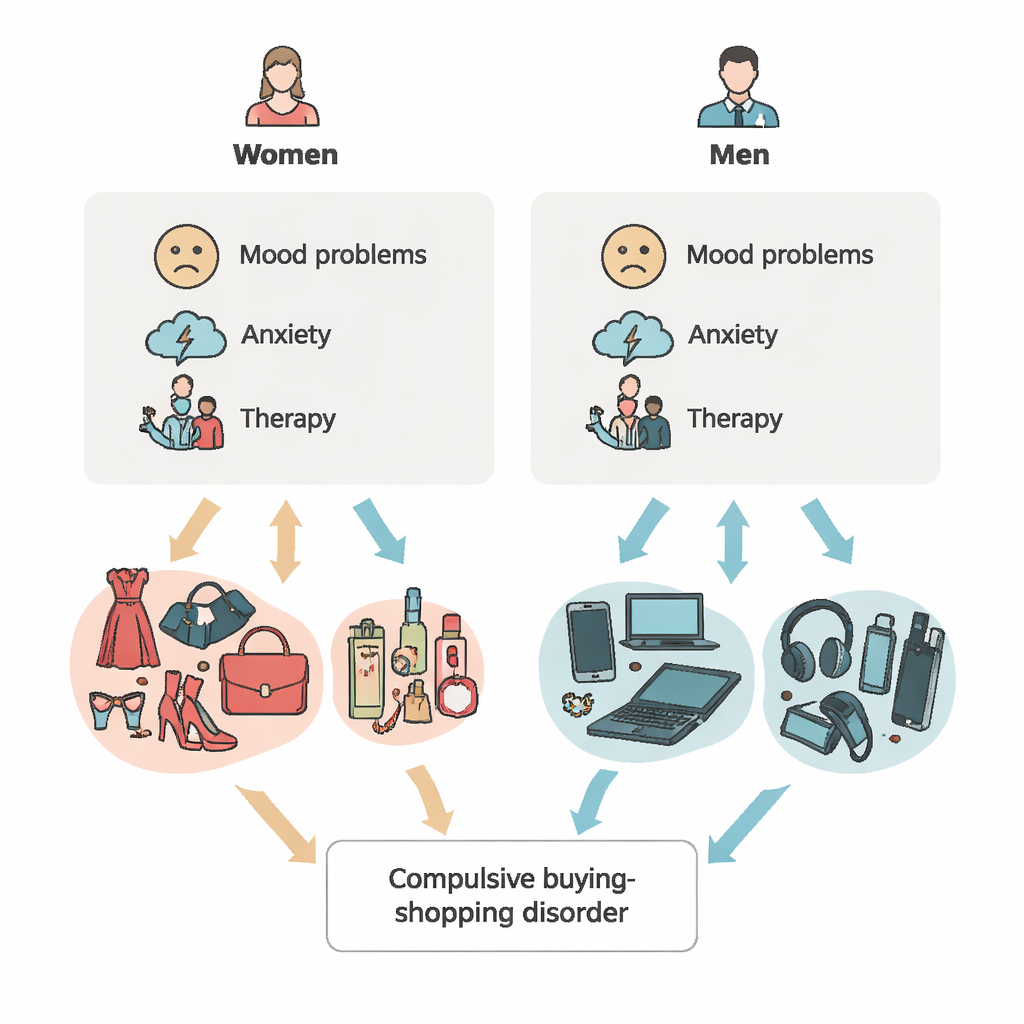
Contrary to the common image of CBSD as a women’s disorder, women and men in this treatment-seeking sample were strikingly similar on many counts. They did not differ meaningfully in age, education level, or whether they were in a relationship. Both groups showed high levels of depression and anxiety, and the overall burden of mental health problems was comparable. Women scored slightly higher on a standard scale of compulsive buying severity, but the difference was small and of limited clinical importance. Men and women were also equally likely to enroll in and continue group therapy once they had sought help, suggesting that both genders are similarly motivated to work on their problem when they reach the clinic.
Where the differences show up
The clearest gender differences emerged not in how ill people were, but in what they bought. Women were much more likely to report compulsive purchases of clothing, shoes, bags, cosmetics, jewelry, and some household goods and food. Men, in contrast, more often reported compulsive buying of small and large electronic devices such as smartphones, headphones, or televisions. These patterns matched long-standing gendered consumer trends and remained noticeable even in the age of online shopping, where all kinds of products are just a click away. While some differences in depression and eating disorders were seen in women, these were modest and did not remain statistically robust when the researchers applied stricter tests.
What this means for help and prevention
For a layperson, the main message is that compulsive shopping is not just a “women’s problem,” even if the products in question often reflect familiar gender roles. Men and women who seek treatment for CBSD are similarly distressed and similarly engaged in therapy; what mainly differs is the kind of items that get them into trouble. The authors argue that treatment and prevention should acknowledge these product patterns and the emotional meanings attached to them—without assuming that one gender is more at risk overall. Future research, they suggest, should look more closely at how social expectations around gender and identity shape compulsive shopping, and should also include people who do not fit neatly into the male–female binary.
Citation: Tetzlaff, BO., Bogel, T., Thomas, T.A. et al. Exploring differences between women and men in treatment-seeking patients with compulsive buying-shopping disorder. Sci Rep 16, 8254 (2026). https://doi.org/10.1038/s41598-026-43027-4
Keywords: compulsive shopping, behavioral addiction, gender differences, mental health, consumer behavior