Clear Sky Science · en
Interaction of two parenchyma ray types regulates redwood heartwood deposition
Why the Hidden Wood Inside Redwoods Matters
Deep inside every coast redwood lies a dark, aromatic core of heartwood that helps these trees live for thousands of years and store enormous amounts of carbon. This inner wood is packed with natural chemicals that slow decay, allowing fallen trunks to linger on the forest floor for centuries. The study summarized here asks a deceptively simple question: how do living cells in a redwood trunk decide how much of this protective material to make, and how does that decision change in different forests and climates?
Two Kinds of Tiny Highways in Wood
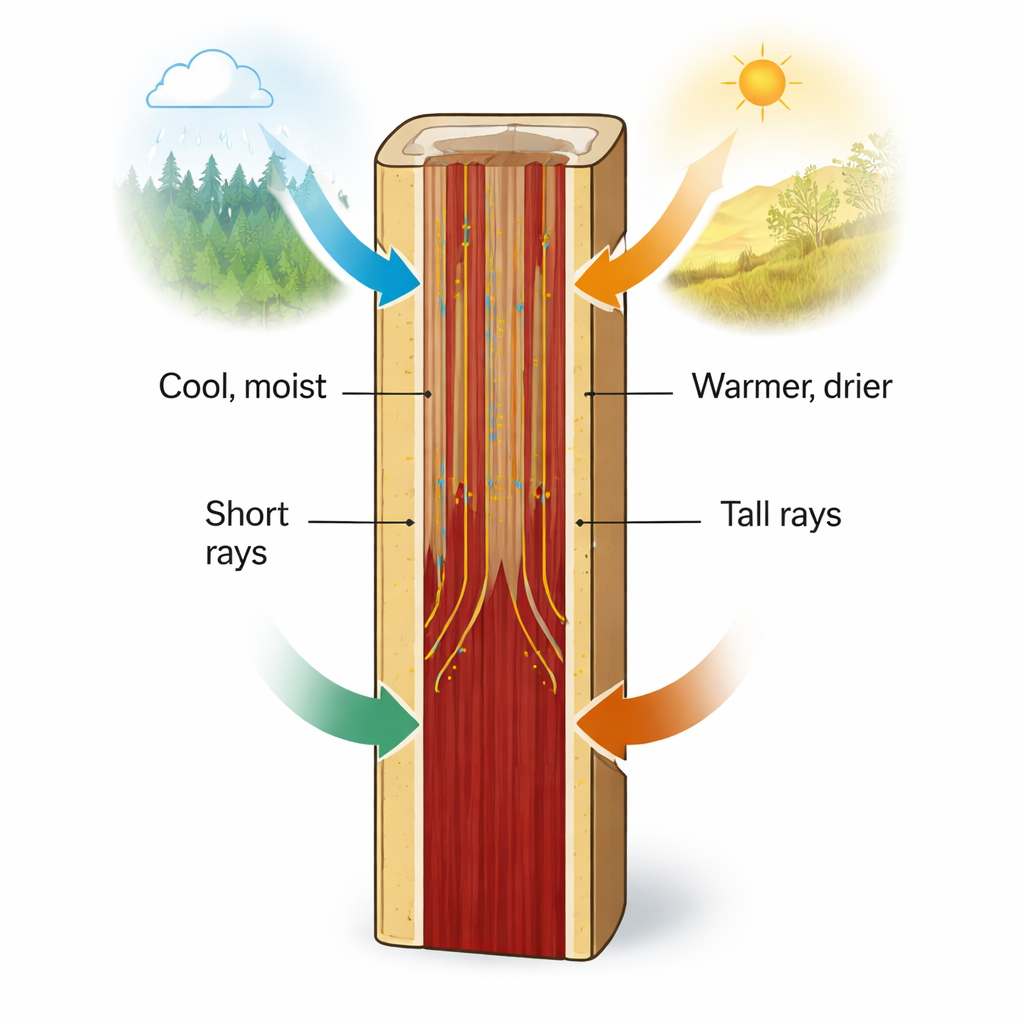
Redwoods, like other trees, contain narrow vertical tubes that move water and support the trunk, but they also have flat sheets of living cells called rays that run sideways through the wood. These rays act like tiny storage units and transport corridors for sugars and other compounds. Using high-resolution X-ray scans, the researchers discovered that coast redwood has two distinct ray types: short rays that span only a few rows of cells and tall rays that stretch much farther through the wood. Both appear in similar numbers, but they differ in size, structure, and how densely packed they become once the wood has turned from living sapwood to dead heartwood.
Peering Inside Trees with Powerful X-Rays
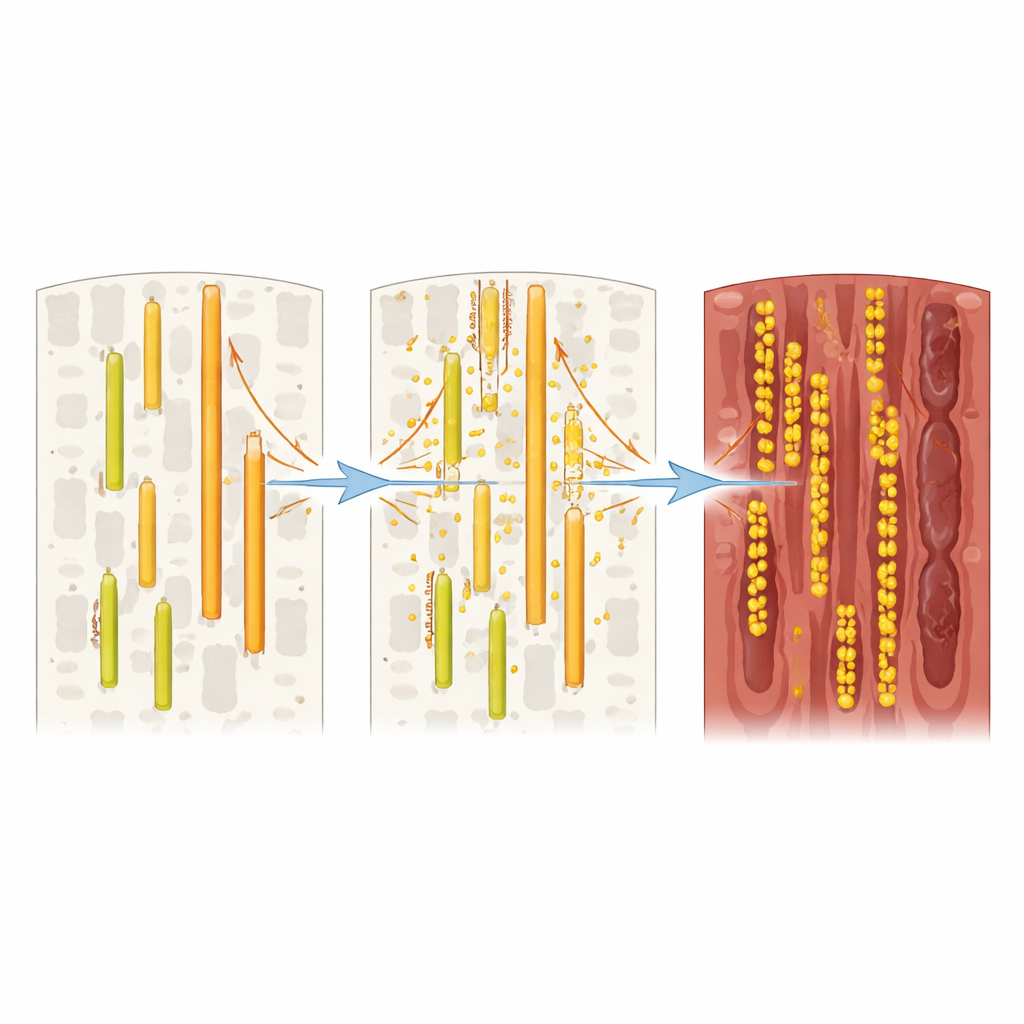
To explore how these rays relate to heartwood, the team analyzed wood cores taken from redwoods in old, never-logged forests and in younger, recovering stands, from both the wet northern coast and the drier southern edge of the species’ range. They used synchrotron-based micro–computed tomography, a powerful X-ray method that produces extremely detailed three-dimensional images. These scans revealed how bright, and therefore how dense, different tissues were. By comparing paired samples of outer sapwood and inner heartwood from the same height in the same tree, they could estimate how much extra dense material—called extractives—had been deposited during heartwood formation.
Short Rays as Key Builders of Durable Heartwood
The X-ray images showed that in primary (never-logged) forests, short rays became markedly denser in heartwood than tall rays, suggesting they store more decay-fighting compounds per unit volume. In contrast, in younger secondary forests, rays did not show such strong density gains when sapwood turned to heartwood, even though the wood still contained extractives. Across all forest types, the number of short rays in the sapwood was the single best predictor of how much extra dense material appeared in the heartwood. When the scientists built statistical models, they found that heartwood investment could be explained well—often more than half of the variation—by combining information on short-ray abundance with the size, length, and spacing of tall rays. Importantly, these models only worked when short and tall rays were treated as separate components; lumping them together erased the signal.
Forest History and Climate Shape the Inner Architecture
The study also shows that environment and forest history reshape this microscopic architecture. Rays were larger in southern, drier primary forests and more numerous in northern secondary stands. Relationships between ray traits and the age of the local growth layer differed between old-growth and younger forests, hinting that as redwoods age, lose their original tops, and rebuild complex crowns, their internal ray systems and heartwood strategies shift. The authors suggest that climate signals, such as rainfall and temperature, likely influence hormone levels in the growth layer, which in turn control whether new rays are created, how long they persist, and whether they will function more like short or tall rays.
What This Means for Forest Carbon and Management
By tying the fine-scale structure of living sapwood to the buildup of durable heartwood, this work offers a new way to read the future of a tree’s inner core from its present anatomy. For redwood forests, that matters because heartwood extractives are a powerful, long-lived carbon store that also underpins the species’ legendary durability. If managers can learn how thinning, restoration practices, or shifting climate affect the balance of short and tall rays, they may be able to encourage trees to invest more heavily in resistant heartwood rather than short-term sugar reserves. In essence, the study shows that the tiny rays threading through redwood trunks operate as long-term planners, helping determine how much carbon stays locked in these giant trees and for how long.
Citation: Chin, A.R.O., Sillett, S.C., Laín, O. et al. Interaction of two parenchyma ray types regulates redwood heartwood deposition. Sci Rep 16, 10847 (2026). https://doi.org/10.1038/s41598-026-42938-6
Keywords: coast redwood, heartwood, wood anatomy, forest carbon, tree longevity