Clear Sky Science · en
Morpho-biochemical and molecular identification of Bacillus licheniformis and Bacillus cereus isolates from sorghum (Sorghum bicolor L.) rhizosphere
Friendly microbes at the root of a tough crop
Sorghum is a hardy cereal that feeds millions of people, especially where heat and drought make farming difficult. But sorghum doesn’t stand alone in poor soils: its roots are surrounded by tiny soil-dwelling partners that can help it find nutrients, fight disease, and cope with stress. This study explores which bacteria live around sorghum roots in eastern India and takes a close look at two key helpers from the genus Bacillus, showing how careful detective work in the lab can reveal who they are and how they are related to their many cousins.
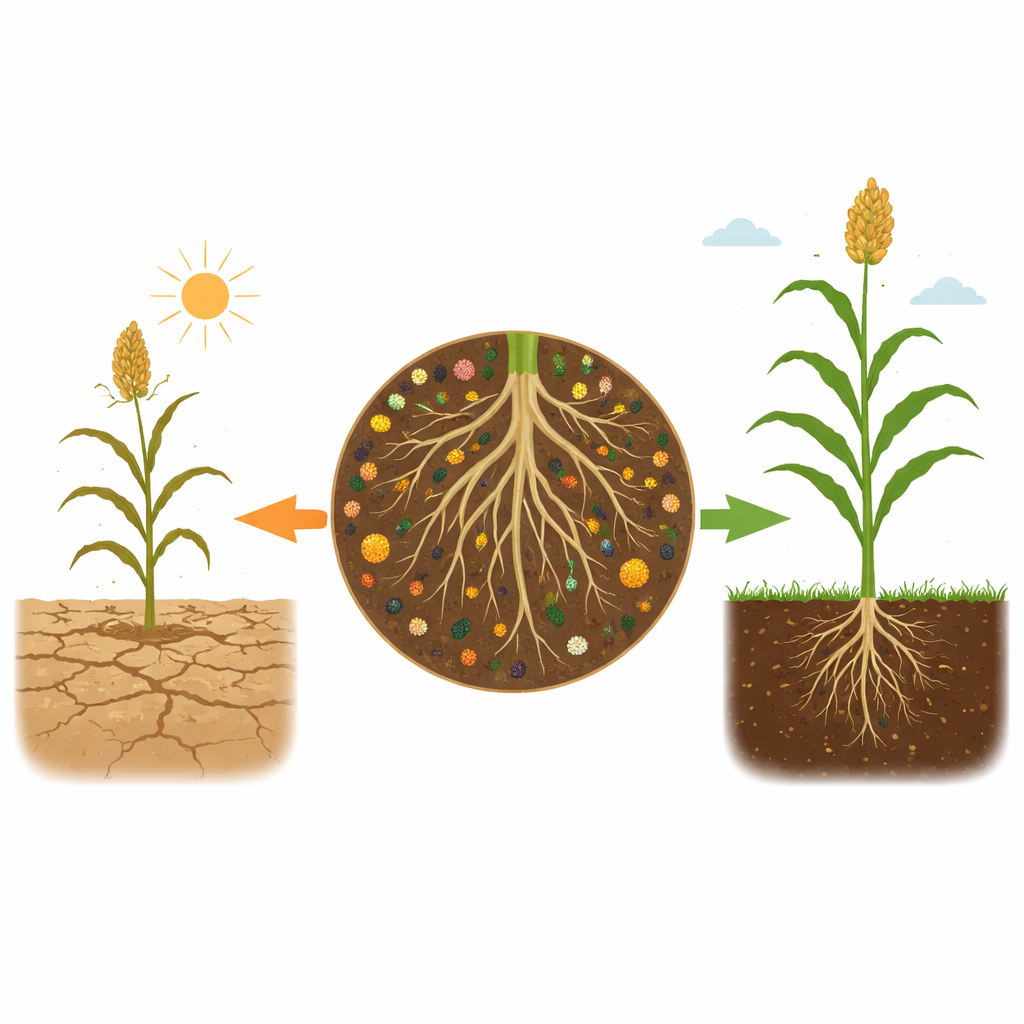
Digging into life around the roots
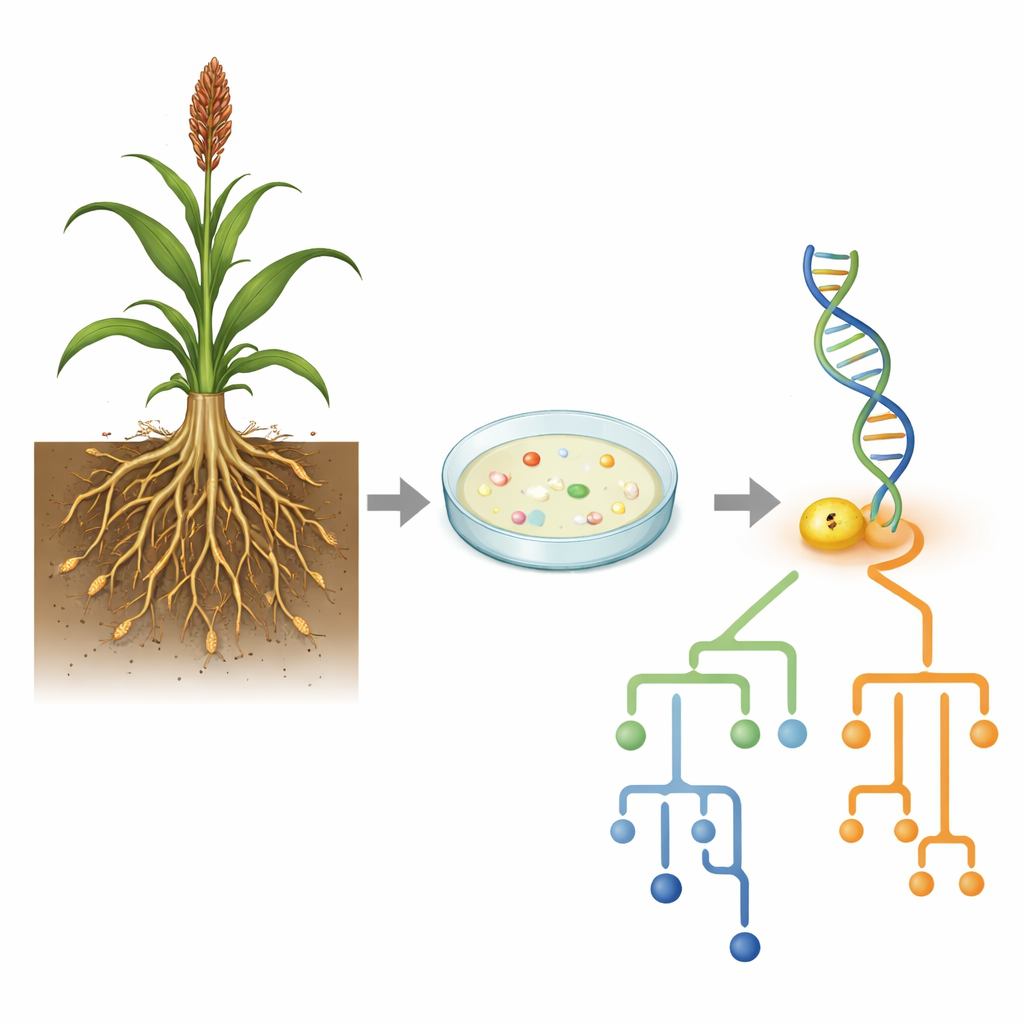
The researchers collected soil clinging to the roots of several sorghum varieties grown in three different locations around Bhubaneswar, India, including a city park, an agricultural station, and a university campus. From these root-zone (rhizosphere) soils, they used standard culture techniques to grow bacteria on nutrient-rich plates, then picked colonies that differed in color, shape, and texture. A first pass under the microscope and with Gram staining showed that most of the 13 isolates were rod-shaped bacteria with thick cell walls, a hallmark of Bacillus and its close relatives, along with a few spherical forms and one thinner-walled, Gram‑negative strain.
Testing what the microbes can do
To move beyond appearances, the team ran simple biochemical tests that reveal how each microbe handles oxygen, breaks down certain molecules, and ferments sugars. For example, adding hydrogen peroxide shows whether cells make catalase, an enzyme that protects them from reactive oxygen, while other tests detect acid formation or the ability to cut apart the amino acid tryptophan. Patterns in these reactions helped narrow down each isolate’s likely identity. Two rod‑shaped strains, labeled AG3 and AG11, stood out: both tolerated oxygen well, handled harmful by‑products efficiently, and showed a similar fermentation style typical of Bacillus species known to thrive around plant roots.
Reading the genetic barcode of bacteria
Because many Bacillus species look and behave alike, the scientists turned to their DNA for a more precise answer. They focused on the 16S rRNA gene, a widely used genetic “barcode” for bacteria. After extracting DNA from AG3 and AG11, they copied this gene using the polymerase chain reaction and confirmed, on a gel, that the fragments were the expected length. The team then read the gene sequences with Sanger sequencing and compared them to thousands of known sequences in the public NCBI database. The matches were striking: AG3 aligned almost perfectly with Bacillus licheniformis, while AG11 was an exact match to Bacillus cereus. Both are common in agricultural soils and are known to have strong interactions with plants, sometimes boosting growth and sometimes, in the case of B. cereus, posing health concerns in other settings.
Placing the new finds on the tree of life
Knowing the closest match is only part of the story; the authors also wanted to see where these isolates sit on the broader bacterial family tree. They built evolutionary trees by lining up the 16S sequences from AG3 and AG11 with dozens of related strains and using statistical models to estimate how rapidly different positions in the gene have changed over time. Bacillus licheniformis AG3 clustered tightly with a large group of similar strains, but showed strong variation in how quickly different parts of its gene have evolved, hinting at regions under different evolutionary pressures. In contrast, Bacillus cereus AG11 fell into a distinct subgroup within the B. cereus complex, with its gene positions changing at more even rates. These patterns suggest that, even within one genus, different lineages can follow different evolutionary paths while still occupying similar soil niches.
What this means for future farming
The study shows that sorghum roots in a single region host a diverse cast of bacteria and that combining simple microscope and chemical tests with DNA sequencing is a powerful way to pinpoint key players like B. licheniformis and B. cereus. For non‑specialists, the take‑home message is that the health and yield of crops depend not just on seeds and soil, but also on these hidden microbial partners. Although this work did not yet test how the identified strains affect sorghum growth directly, it maps out which microbes are present and how they are related—crucial steps toward designing safe, targeted microbial inoculants that could help farmers grow more resilient sorghum with fewer chemical inputs.
Citation: Jurry, A.G., Sahoo, J.P., Sharma, S.S. et al. Morpho-biochemical and molecular identification of Bacillus licheniformis and Bacillus cereus isolates from sorghum (Sorghum bicolor L.) rhizosphere. Sci Rep 16, 8983 (2026). https://doi.org/10.1038/s41598-026-42932-y
Keywords: sorghum, rhizosphere bacteria, Bacillus licheniformis, Bacillus cereus, plant growth promotion